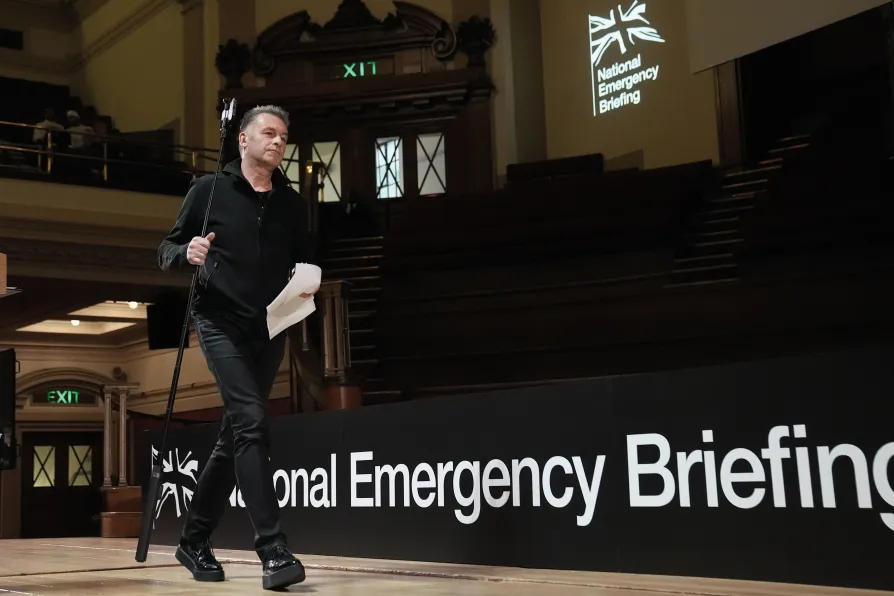
The National Emergency Briefing outlines the need for urgent action to address environmental crisis, says PAUL DONOVAN, warning that there’s no time to indulge the arguments of the fossil-fuel-funded climate-change deniers


 Latest editorial
A care system on the brink cannot afford to lose migrant workers
Behind the headlines on immigration lies a workforce delivering vital care across Scotland and beyond. FAVOUR DAVIDKING explains why reform of the sponsorship system is urgently needed
 A general view of staff on a NHS hospital ward at Ealing Hospital in London
Campaigners say criticism of Labour MP Stephen Morgan’s position on Gaza has been met with police intervention and cancelled opportunities for debate. HESTER WOLFE reports
The Committee for the Defence of Iranian People’s Rights warns of escalation danger in Iran war
Claudia Webbe pays tribute tribute to KANYA KING CBE, February 12 1964 to June 3 2026
The Milburn review presents itself as a plan to help young people into work, but Dr DYLAN MURPHY argues it is laying the groundwork for a harsher benefits regime
Campaigners from across the continent will gather in Brussels on June 14 to oppose Europe’s accelerating militarisation and cuts to public services, write MAGGIE SIMPSON and BOB ORAM of No Cold War Britain


MY LAST Voices of Scotland contribution in October 2025 reflected on the stark details uncovered by Unison’s Migrant Worker Survey of the lived experience of workers on Certificate of Sponsorship (CoS) visas in the social care sector.
Since then, the survey has catalysed our campaign to tackle these issues head on.
The UK government’s proposal to retrospectively extend indefinite leave to remain (ILR) eligibility from five years of CoS status to 10 or 15 years will have disastrous effects.
Decision-makers have been warned that up to 60 per cent of migrant social care workers could leave the UK if this proposal becomes policy. In fact, 17 per cent of those Unison surveyed told us they are already considering leaving.
On December 17 2025, health and social care workers from across Unison took our message directly to Westminster. In a historic event, over 150 MPs and three ministers met 700 workforce representatives. They heard first-hand testimonies of abuse and exploitation under a system where the employer holds an individual’s visa and therefore their security in this country.
Our demand is simple: end exploitation by establishing a sector-wide visa scheme, namely a Certificate of Common Sponsorship.
Unison’s general secretary, Andrea Egan, has consistently championed immigrants as huge net contributors to the economy who must never be used as political footballs.
In Scotland alone, over six million hours of social care support are delivered by migrant workers. We pay taxes, we spend in local economies, and we keep essential services afloat. Yet, despite having no access to public funds, migrant workers are used as negative headlines day in and day out.
Throughout 2026, our campaign has turned toward local constituencies, including leafletting Shabana Mahmood’s constituency and holding a national day of action in Scotland on April 24. We are providing local MPs with hard evidence of the crisis we face, while simultaneously organising on the ground for better pay, health and safety, and working conditions.
There are five key reasons why a Certificate of Common Sponsorship is beneficial to the whole of our society:
- Care quality: migrant workers provide a quarter of Scotland’s social care. The Home Office risks losing six million hours of vital care every month by driving away a skilled workforce.
- NHS crisis: collapsing the care sector will push the NHS from delayed discharges to total collapse resulting in blocked beds, queuing ambulances and avoidable deaths.
- Families in crisis: around 800,000 Scottish workers balance employment with unpaid care for relatives. The wider economy cannot sustain the loss of the care foundation.
- Discrimination: this hostile environment is the racist element of a larger wave of discrimination targeting the elderly, disabled and vulnerable young people.
- Human rights: dismantling care services is an abhorrent human rights attack on workers, service users and families alike.
Politicians routinely trash immigration, creating deep uncertainty. Some tag care work as “a job no-one wants to do,” but fail to ask why. This aversion raises a striking contradiction: why do some domestic workers refuse care work? Could it be the low wage?
Low pay drives British residents away from the sector — you can earn more working in a supermarket than caring for societies most vulnerable. Meanwhile approximately 13,000 client visits per month are delivered by migrant workers. We must therefore unite as a whole workforce and society against divisive rhetoric and policies, fighting for a fair deal for all workers including fair visas.
Britain’s reliance on migration is nothing new. Migrants were explicitly called upon to rebuild the framework of this society after the war; they are a fundamental part of the British spine.
Furthermore, we must look at root causes. History shows us that Britain colonised African and other nations, extracting wealth and reshaping their futures. Perhaps it is finally time for former colonising countries to pay reparations and invest heavily in those economies. If you build up those nations, their people will no longer need to migrate. Britain owes migrants a receipt, and it’s time to settle the bill instead of blaming the people keeping the care system afloat.
We continue this on-the-ground campaign with a national day of action on June 10 2026. Unison members and allies will rally at Holyrood, the Home Office and Downing Street. Join us in defending the workforce that defends you.
