

 Latest editorial
Concerns grow over whether new stoppage rules serve profit rather than football’s integrity, writes JAMES NALTON
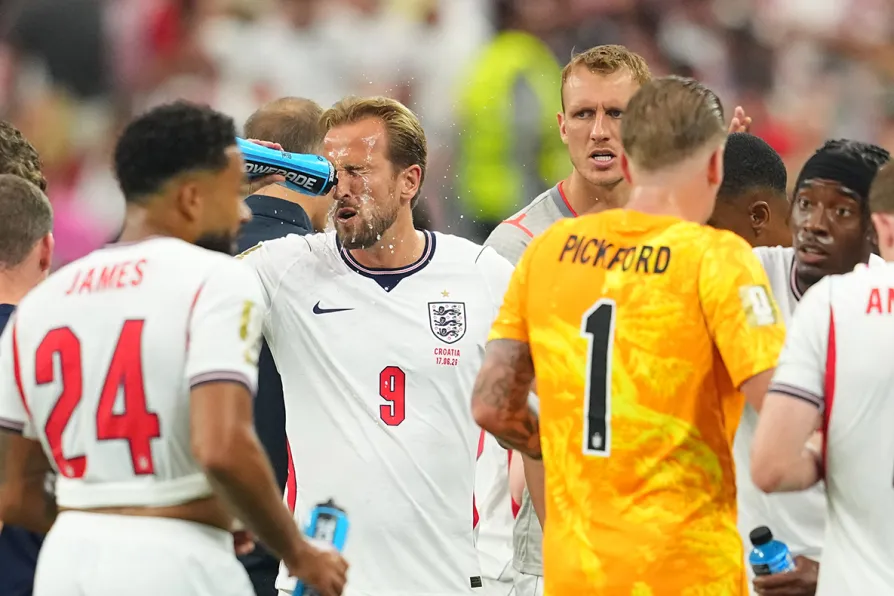 England's Harry Kane (9) cools off during a hydration break of the World Cup Group L soccer match between England and Croatia in Arlington, Texas, near Dallas, June 17, 2026


THEY were the type of weather conditions that would have made the victorious Ghana manager, Carlos Queiroz, think he was back in Manchester, where he was once an assistant to Alex Ferguson at United, rather than in North America for a summer World Cup.
The rain came down constantly as his team kicked off their opening match of the World Cup against Panama in Toronto, where they eventually secured a 1-0 win thanks to a dramatic late winner. It was already bordering on jacket weather thanks to a cool breeze coming off Lake Ontario, but that was made even cooler by the wet conditions.
Fans donned ponchos, and some journalists and media regretted not carrying a coat with them to the game, but for the players, this refreshing shower with only a slight breeze was ideal weather for playing football.
It seemed ludicrous, then, that the game had to stop twice in the middle of each half for hydration breaks.
There is justification for the idea of drinks breaks, as players are increasingly being asked to play in soaring temperatures in hot countries in a warming world. There might even reach a point where more regular opportunities to take on fluids are needed, even if they are more opportunistic in the game’s natural breaks, rather than forced stoppages in play.
At this World Cup, however, the hydration breaks have felt unnecessary on many occasions, and are now just a vehicle for something that has nothing to do with player welfare.
Many in the US, where they wear their commercialism on their sleeve, are calling it as it is. They mark the end of a quarter, and are a chance to show some adverts.
It makes the player welfare angle seem like a cover story for something introduced to further turn the game into a money-focused entertainment product to create financial gain for those running it.
There’s a worrying sense that, now introduced, the powers that be in football, who travel further towards the commercialisation of the sport at every chance they get, will want to borrow from US capitalism and American football and split the game into quarters, meaning more stoppages and more adverts.
These additional breaks in play have dramatically changed the dynamic of the sport. Though football has natural ebbs and flows and regular periods where not much is happening, those lulls are still an important part of the way a game builds, and it is important that they flow as part of the rest of the game. Enforced stoppages in the middle of a half feel abrupt and artificial.
It is important, therefore, that there has been some pushback against these hydration breaks on the occasions when they are clearly not required.
They break the natural fluency of a football match, and there have been numerous instances where a team is just about to gain some momentum, only to have it rudely interrupted by an unnecessary break.
Fans have grown increasingly frustrated with these stoppages. The new concept has gradually caught on, but not in a positive way. Initial suspicion has turned into widespread condemnation, including in the stadiums themselves. The boos for the announcement of hydration breaks are getting louder with each game.
Make no mistake, if there were no pushback against these mid-half stoppages, then those running football would jump at the chance to turn what was initially proposed as something to ensure the wellbeing of players in hot conditions, into a commercial opportunity.
No-one knew how TV companies would manage the stoppage, but it was no surprise that US broadcaster Fox, among others, cut straight to adverts without a second thought. They are even calling it a match break, rather than a hydration break, leaving no doubt that this isn’t for the players’ benefit but exists so they can run more adverts. On one occasion early in the tournament, Fox broke its agreement as a World Cup broadcaster by missing some of the action as adverts overlapped the resumption of the game.
“I’m not sure about this decision [to introduce hydration breaks in every game], but it is also true that in a lot of games around the world, they are not playing in favourable weather conditions,” Queiroz said when asked about this in his post-match press conference in Toronto.
“I think in the future, this law must be adapted to weather conditions. If players are playing in extremely hot and humid environments, they need water breaks, no doubt about that, but in other games, I have doubts about it.
“Now is not the time to debate the decision, but at the end of the World Cup, we need an integrity report about what happened, to see if this decision was made for marketing reasons or really to protect the health of the players.”
Queiroz highlights both sides of this issue, rightly pointing out that the player welfare side of this is very important. If anything, it should be looked into further to see how, when the conditions are extremely hot, players can stay better hydrated throughout the game, as well as at half-time or in designated breaks.
On the other hand, at this World Cup, there have been many occasions where the hydration breaks were just not needed, and have just been an excuse to break games up into four-quarters rather than two halves, and for those inclined to do so to run adverts.
Fifa says breaks in all games, whether they are needed or not, are “to ensure equal conditions for all teams, in all matches,” but they have failed to achieve this in other areas, most notably with Iran’s US-enforced travel restrictions and late switch of training base.
The descent of the game further into one that sells products and exploits fans has been brazen at this World Cup, and though hydration breaks are a potentially very important part of player welfare going forward, it’s no surprise to see them hijacked by commercialism here.
