
The new Prime Minister must abandon decades of automatic support for US foreign policy, which makes us all less safe, argues DIANE ABBOTT MP


Belfast burns again
Recent violence in Belfast was not spontaneous — it was built on years of failure and political neglect, argues STIOFAN O NUALLAIN
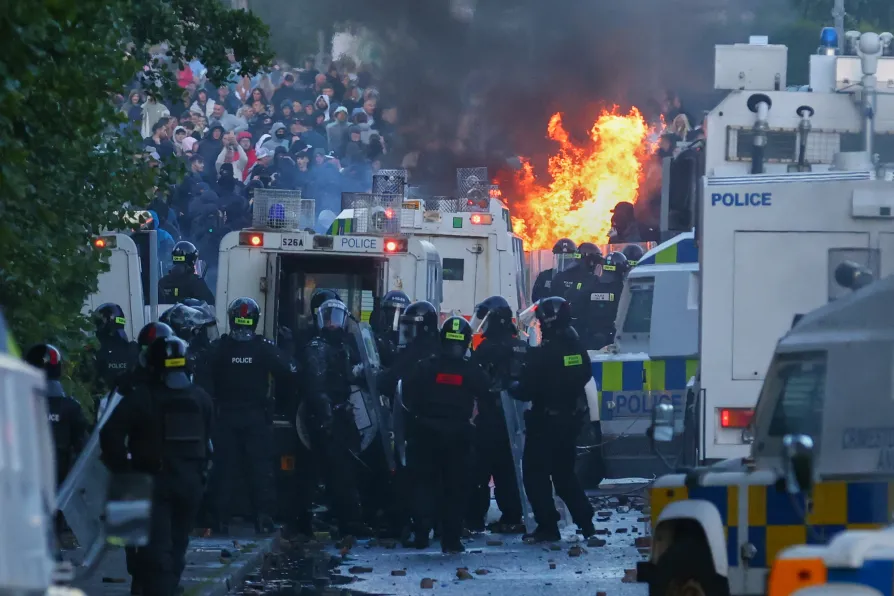
 SCENES OF CHAOS: Violence has spread across Belfast
Media Lens at 25: David Cromwell and David Edwards reflect on a quarter-century of media criticism, explaining why independent journalism is more important than ever
by Weyman Bennett and Maz’s family
The International Court of Justice has delivered its clearest ruling yet that the right to strike is protected under international law, write Professor TONIA NOVITZ, Professor KEITH EWING and Lord JOHN HENDY KC
Emergency phone alerts could help Britain respond to rising wildfire risk, but Australia’s experience suggests they work best as part of a broader strategy, write ELLIOT CONVERY-FISHER and KATE PARKINS
A champion motorcyclist, trade union organiser and communist, Clem Beckett went from Britain’s speedway tracks to the battlefields of Spain, where he gave his life resisting Franco’s forces at Jarama. GEOFF BOTTOMS pays tribute to this remarkable anti-fascist


ON THE night of June 8, a man was stabbed outside apartments on Kinnaird Avenue in north Belfast. He lost an eye and is in critical condition.
A Sudanese man has been charged with attempted murder. Within hours, a video of the attack had gone viral, and by Tuesday night hundreds of masked protesters were moving through Belfast’s streets burning buses, cars, businesses, houses, targeting ethnic minorities.
While the brutal attack and the riots that followed have been shocking, they’re not surprising, race hate crimes in Northern Ireland have reached their highest recorded level since 2004, with nearly 1,500 offences in the year to March 2026, following on from last year’s racist riots this last week is not simply a spontaneous eruption of working-class anger. It is organised, it has happened before and it will happen again.
The vast majority of the violence took place in Loyalist areas of Belfast, with sporadic incidents elsewhere across the north. The evidence of loyalist paramilitary involvement was suggestive rather than conclusive with senior PSNI officers recognising that the co-ordination of mobilisation across multiple areas may point to organisation, while politicians from Sinn Fein and the SDLP were more direct in naming it directly.
The precise degree of that involvement is difficult to ascertain, but the broad consensus among those working across these communities is that the disorder could not have occurred without some level of paramilitary engagement, whether an active green light from leadership, or something potentially more worrying, an inability to exert much influence at all.
That would point to a shifting dynamic within Loyalism, with younger and more militant elements driven not by sectarianism alone but by far-right narratives that have become steadily more mainstreamed and normalised. But as with previous outbreaks, the pattern is familiar, early caution about naming loyalist paramilitary involvement, which is only to be confirmed later when the flames have abated.
This raises again the question of why Loyalist paramilitaries exist at all, still organising, still recruiting, embedded in communities. This is not a fringe movement or a disorganised mob. It is an armed militia capable of terrorising entire communities at will.
What makes it more insidious still is the political cover provided by the Loyalist Community Council, a body that grants proscribed terrorist organisations a veneer of legitimacy while they engage in criminal activity and exercise coercive control over their own communities.
That they receive state recognition and operate with such impunity is a profound indictment of how seriously the British state takes racist violence when it wears a particular kind of flag. The same level of armed paramilitary organisation would not be tolerated in republican communities. Or indeed in Finchley.
Of course social media has played a role in both organising and escalating the disorder. Posts circulated widely giving times and locations for protests, laced with anti-immigration and overtly racist messaging. Others listed roads to be blocked or instructed businesses to shut.
Among the most disturbing material to emerge was a compiled list of home addresses of migrant families, collated and shared across platforms putting lives at risk.
Analysis will follow, but two things are already clear — social media channels with links to established Loyalist networks played a role in co-ordinating the disorder, alongside a flood of disinformation and racist conspiracy theories that had both domestic and international origins.
The role of social media in co-ordinating and amplifying the disorder will be examined in detail in forthcoming research from Trademark Belfast on far-right networks, online radicalisation and disinformation in Ireland.
But there is another truth from last week that goes largely unreported in the British press. In Belfast, Republican communities held the line. There were a handful of attempts at organising anti-immigrant protests that emerged and dissipated very quickly. In Republican areas there were no attacks on foreign workers. No scapegoating. No pogroms.
While others burned people out and whipped up fear, Republican communities stood firm not as a favour, but as a principle and it stands in sharp contrast to what Loyalist militias and their political enablers have spent this week doing to their own city.
Amid the disorder, however, the response from local communities and civic society was immediate and striking. Organisations and community groups from across Belfast moved quickly to provide mutual aid, open safe spaces and help rescue families caught in the violence.
Their solidarity and bravery in the face of organised intimidation stood in sharp contrast to those intent on terrorising their neighbours.
To understand why this keeps happening, you have to look past the immediate violence and the viral video to the system that makes this kind of violence predictable, repeatable and not isolated to the Six Counties. If a government can’t provide homes, healthcare and dignified work for its people, that’s not a migrant problem, that’s a capitalism problem. The state’s failure to meet basic needs has nothing to do with people seeking asylum and everything to do with decades of privatisation, austerity and ruling-class theft.
Northern Ireland has felt this more acutely than most, serving as an austerity punchbag with billions stripped annually from the block grant the consequences of which are visible in the very communities from which the violence has emerged. The low-wage, low-productivity service economy exists because capitalists want a disposable, precarious workforce, undocumented or not.
Blaming migrants for wage competition or housing shortages is a trap. The real competition is between workers and bosses, and the real housing crisis is driven by financialisation, landlords, vulture funds and vacant properties.
And the British state offers no serious challenge to any of this, no genuine attempt to restructure the economy, to redistribute wealth, just performative border noise, militarism and more austerity. Migrants remain vulnerable, housing stays unaffordable, and social cohesion frays further and not because of migrants, but because the system demands it and the far right fills the vacuum with the occasional pogrom acting as a safety valve for the failures of a dying economic system.
The only way out is to stop asking how to “control borders” and start asking how to abolish the conditions that force people to move and make cheap labour profitable in the first place.
A working-class politics worthy of the name should be arguing for massively expanded public housing and rent controls for everyone. Raise wages by strengthening unions and ending the reliance on precarious work not by restricting migration, but by making the exploitation of any worker illegal. That requires a robust immigration and asylum system rooted in an anti-imperialist foreign policy that opposes militarism framed around solidarity, collective bargaining, and the simple truth that migrants aren’t the enemy.
It’s important to remember that fascism is not a working-class phenomenon, it’s a ruling-class project. But recruitment to fascism still relies on the weaknesses of working-class self-organisation and working-class consciousness. Just as the far right has grown in the absence of a socialist alternative, we need to talk about and build those alternatives because the failure to do so will only mean a worsening of material conditions for increasing numbers and a hardening of real grievances that provide fertile ground for the far right.
Solidarity, not scapegoats. Revolution, not reaction.
Stiofan O Nuallain is a co-director at Trademark Belfast, a unit of the Irish Labour Movement.
