

 Latest editorial
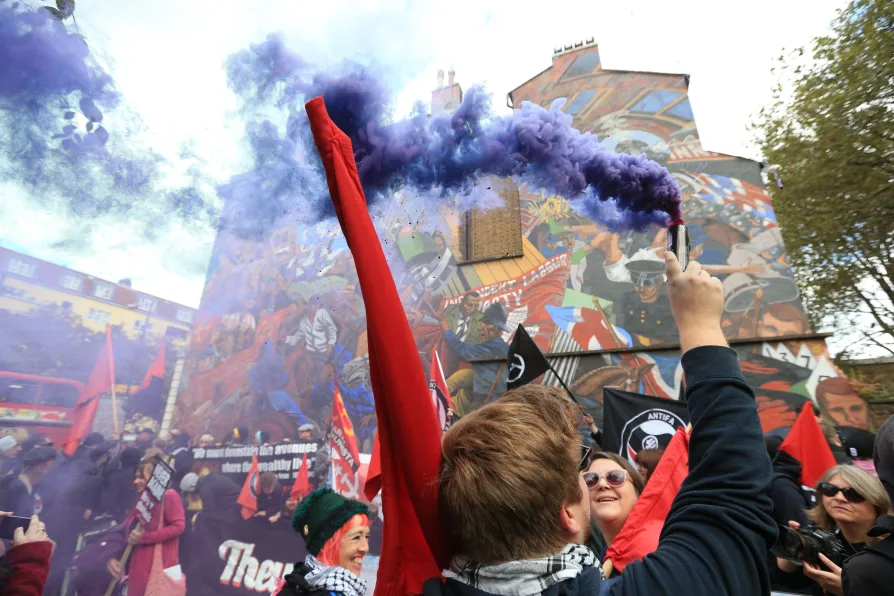 A demonstrator releases a smoke flare in front of a mural on Cable Street in the East End of London, which commemorates the Battle of Cable Street


MORNING STAR readers and many other people will be pleased with today’s news that the Cable Street 90 committee is calling for a huge display of people’s unity on Sunday October 4 this year.
On that day 90 years ago, more than 100,000 people of every race, creed and colour in London and beyond blocked the path of Sir Oswald Mosley’s Blackshirts through the East End. That was to have been a real “hate march,” unlike the pro-Palestine anti-genocide events condemned as such by Labour and Conservative politicians and the gutter press today.
But back then, local residents — Jewish, Irish, English and Somali — trade unionists, communists, socialists, the Scots and Welsh turned out to enforce the slogan of the day: “They Shall Not Pass!” Mosley and his police collaborators had to abandon their efforts to force their way through Gardner’s Corner and Cable Street. Instead, they retreated to the West End with their tails between their legs.
Those same watchwords in Spanish — “No Pasaran!” — were used to resist the military putsch launched by Generals Mola and Franco in July 1936 against the Popular Front government in Madrid.
As in Britain, a wide coalition of forces came together to resist the fascists, not only from the political left but from the democratic centre, too. Basque and Catalan nationalists understood that Franco’s victory would put an end to their immediate hopes of national self-determination and cultural self-expression.
Meanwhile in Britain, non-military but physical and political battles were escalating across England, Scotland and Wales against the British Union of Fascists. Whereas the Communist Party, the Independent Labour Party and left-wing Labour MPs such as Aneurin Bevan called for fascism and antisemitism to be confronted on the streets of Aldgate and Stepney, the Labour, Conservative and Liberal leaderships urged their supporters to stay at home and avoid trouble.
In the case of Cable Street, the Board of Deputies of British Jews urged the Jewish people of east London to cower behind closed doors, albeit unsuccessfully.
Having led his uniformed thugs to a humiliating defeat on October 4, Mosley swanned off to Berlin the next day to marry wealthy aristocrat Diana Guinness in the town-house parlour of Joseph Goebbels. Best man Adolf Hitler presented the lucky couple with a framed photograph of himself.
In Spain, after a bitter three-year struggle and despite the support of the Soviet Union and the Communist International, the Spanish Republic was shattered by the Nationalists and the armed forces of Fascist Italy and Nazi Germany. The balance of forces and internal divisions proved decisive.
In Britain, the fascist movement was repulsed in the 1930s by broad popular mobilisations around a united front of working-class organisations. Many volunteers went from Cable Street and other anti-fascist battlefields to those in Spain, enrolling in the International Brigades and its medical teams.
The national and international situation is not the same now as in the 1920s, although some similarities are disturbing. Right-wing and racist reaction is on the offensive and Labour Party leaders have abandoned social democracy for the discredited policies of neoliberalism.
Yet we now have many more local working-class communities where millions of people accept and even celebrate our multiracial, multicultural society.
Certainly, trade unions and the left must confront today’s organised racists and fascists.
But October 4 2026 also offers us the opportunity to celebrate the unity, diversity and cultural richness of modern Britain. Where better to do so than on Cable Street in the London borough of Tower Hamlets?
