

 Latest editorial
For the first of LAYTH YOUSIF’S Canadian World Cup diaries, he discovers a Gunners’ haven in Oshawa, Ontario, and explores the town’s role in the historic 1937 labour strikes
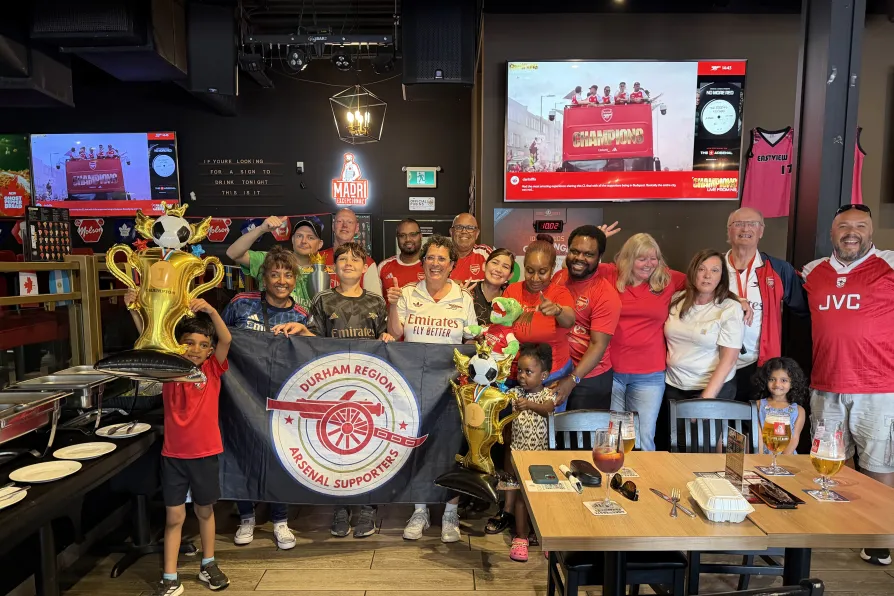 Layth Yousif and Durham Region Arsenal Supporters Group in Oshawa, Ontario

In the second part of LAYTH YOUSIF’S history of the New York Cosmos, he reflects on their stunning reboot


THIRTY miles from Toronto, on the Taunton Road, in the town of Oshawa, on the banks of Lake Ontario you’ll find a welcoming haven of loyal Arsenal supporters.
Based at the Hardy John Bar & Grill, approximately 5,750km from Ashburton Grove, is the Durham Region Arsenal Supporters Club, where passionate Canadian Gooners gather to watch every single match.
Formed nearly a decade ago by staunch Arsenal fan John Butcher, this dedicated band of brothers and sisters, young and old, meet at all times of the day or night to cheer on their heroes in red and white, whenever and wherever Mikel Arteta’s side play.
Good-natured John welcomes myself and my old university friend and his children, with whom I am staying with here in Oshawa, to the bar with a convivial handshake and wonderfully cordial greetings.
John, whose great-grandfather attended Arsenal’s first ever match at Highbury, against Leicester Fosse back in September 1913, is there with his son and fun-loving gang of Gunners. He tells me they had 250 Gooners in for the Champions League final, not to mention similar numbers across the campaign, culminating in the never-to-be-forgotten merry month of May, when Arteta’s side memorably clinched the title.
While the 2025-26 club season officially ended last weekend, following Arsenal’s valiant defeat on penalties to the billionaire moneybags of PSG in the Champions League final on a cruel Budapest evening, generous John has organised and paid for an end of season party to say thank you to his loyal band of members, with free beer and food provided. And, of course, to celebrate once again Arteta’s Arsenal becoming Premier League champions after 22 long years.
Fittingly, the bar’s screens are now showing the trophy lift at Selhurst Park as the backdrop to our sunny Sunday afternoon conversation.
“After going so long without winning, it was amazing to finally see Arsenal win the title here,” he tells me.
John started the club nearly a decade ago, with just himself, his son and his grandfather watching an Arsenal game here at Hardy John. “The owner and staff bought into the idea of the bar being a place for Arsenal fans to gather, and it just grew from there,” he tells me modestly.
Around us are big TV screens everywhere, splendidly replaying goals and key highlights from the season, which John, with the bar’s happy blessing, is streaming from his phone. The parade is also shown, when 1.5m people took to the streets to celebrate Arteta’s Champions last weekend.
“It’s in the blood to be an Arsenal fan,” genial John tells me, adding: “We are proud to have such a diverse fan base here, which also represents Arsenal having such diversity.”
With a five-hour time difference, gathering communally to watch their heroes across the Atlantic is no mean feat, especially for those pesky Saturday lunchtime kick-offs in N5, which ensure the bar is open at 7am to offer sustenance to hungry and thirsty Gooners. With beers in hand I ask? Without missing a beat, convivial John, who is wearing a green Arsenal goalkeeper’s top with David Raya’s name printed on the back, in honour of the club’s world-class netminder, assures me with a ready smile: “7am we have beers in our hands.”
As befits a country where everyone is either an immigrant or descended from an immigrant, all colours and creeds are represented in John’s supporter group, packed with a heartily friendly bunch of Arsenal obsessives proudly intent on supporting their team, despite it being a seven hour flight from Toronto’s nearby Pearson international airport to London’s Heathrow.
“It doesn’t matter who you are, or where you are from,” John says, adding with feeling: “if you’re an Arsenal fan, then that’s all that matters.”
The 1937 Oshawa Strike
Oshawa has a proud tradition of togetherness, unity and solidarity, with the town playing an important part in the history of Canadian trade unionism.
During the Great Depression, in April 1937, 4,000 assembly line workers at the town’s General Motors plant went out on strike in a bid for better pay and conditions, including calling for an eight-hour workday, and recognition of their union, the United Auto Workers.
Ontario Liberal Party leader, Mitchell Hepburn, who had been elected on a platform of helping the working class, chose to side with the company, bringing in armed support which was intended to intimidate the strikers, and break up any union action.
However, the union and its striking workers had the backing of the town’s population and other unions against the hated armed militia, disparagingly known as Hepburn’s Hussars, as well as far more colloquially being called the “Sons of B***hes.”
Hepburn’s armed group never saw action, as the union point-blank refused to be drawn into violent means as a way of progressing their cause. And, on April 23, 1937, a mere two weeks after the strike started, the company caved into the walkout and gave way to the majority of the workers’ demands.
The Durham Region Arsenal Supporters Club
Back to the present, apart from their utterly engaging solidarity and camaraderie, the group is reassuringly knowledgeable on all things Arsenal, with the details the fans share with me as informed as you’ll find in any pub in Islington on matchday.
Amid enjoyable discussions about Max Dowman, including his goal against Everton back in March that was celebrated so joyously from north London to Lake Ontario — there is a particularly loud cheer when the 16-year-old prodigy’s strike against the Toffees is shown on the big screens front and centre in this must-visit bar that offers 29 different types of chicken wings — we also speak about Olivia Smith, Arsenal Women’s first £1 million signing, who joined Renee Slegers’ side last summer from Liverpool.
With no little pride, John tells me the 21-year-old Canadian international started playing football at popular junior grassroots level club Oshawa Kicks. The same club that the nine-year-old son of my university friends plays for now. And who happens to be wearing a shirt sporting their badge.
Nodding to my friend’s son’s Oshawa Kicks top, John says: “We’re so proud of Olivia,” underlining the fact that “we support the Arsenal Women as well as the men.”
Caring John also made sure my friend’s son was given a blow-up balloon of the Premier League trophy, before showing the delighted lad the correct way to lift it. Mirroring the cheeky shimmy the players did before hoisting the silverware high in the air, as Arteta and his team did so memorably at Selhurst Park a mere two weeks ago, we all then take turns doing the same thing, as laughs and smiles abound among beers and bonhomie.
We line up for a group photo — John has also organised a replica trophy to be delivered to the bar just in time — the ages of the group range from nine to an astonishing 92.
Alas, by the time I try to speak with the nifty nonagenarian — not least because John tells me the man in question was a passionate advocate of the women’s game back in the 1980s, taking his lead from the fact Arsenal were the early pioneers of women’s football more than four decades ago — the gentleman in question had already left the bar.
Following a rousing rendition of Arsenal’s club anthem, Angel, North London Forever rings out around the bar from everyone, the afternoon’s enjoyable event draws to a close.
John’s dream is to finally visit north London and see his heroes in action one day.
I ask him what he would most like to experience on a matchday. Caring father John, whose son is autistic, tells me: “One of the things I would most like to do on a matchday is for us to visit Arsenal’s sensory room at the stadium.”
I share with him that I had the privilege of writing about the popular facility when it first opened back in 2018, when I was Arsenal reporter at the club’s local newspaper, the Islington Gazette.
The club’s state-of-the-art sensory room was designed specifically for fans with autism and sensory processing issues. The much-needed, and much-adored site inside the stadium provides a safe and calm environment for families to savour matchdays without overwhelming noise from the crowd, nor the bright lights of stands.
“That sums up Arsenal for you,” John tells me proudly. “Class. A classy club. Of course we have the history and tradition that other clubs would die for, but we also have such class.
“Things like knowing the club has a sensory room makes me so proud to say I am an Arsenal fan. It runs deep. It’s more than just what happens on the pitch, as amazing as winning the league title has been.
“Arsenal is a special club, which means so much to so many people here in Canada.”
Not least for passionate John and his loyal Gooner family at the Durham Region Arsenal Supporters Club, thirty miles from Toronto, on the Taunton Road, in the town of Oshawa, on the banks of Lake Ontario.
