

 Latest editorial
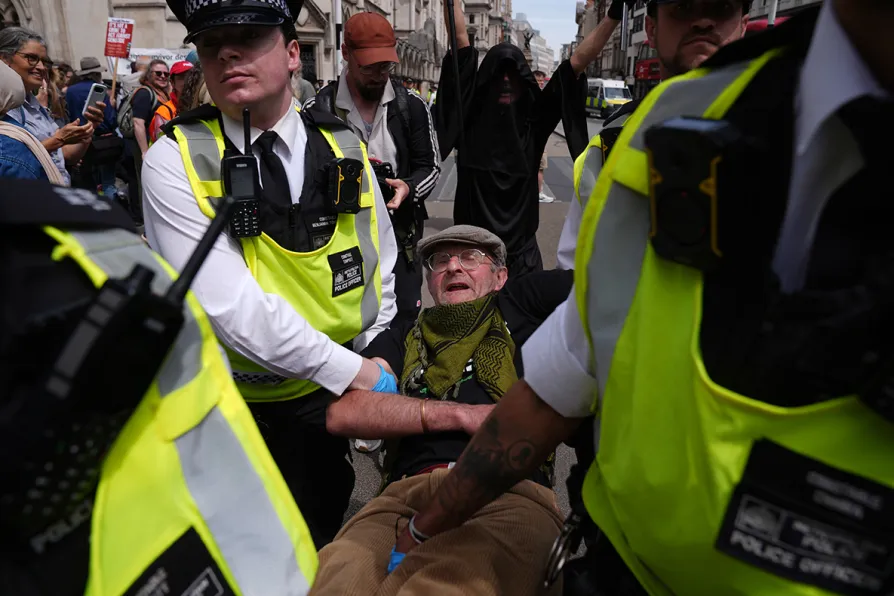 Police remove protesters from outside the Royal Courts of Justice in central London after the Court of Appeal ruled that the decision to ban Palestine Action as a terror group was lawful, June 15, 2026


KEIR STARMER’S resignation as Prime Minister attracts all the usual plaudits to his decency, integrity and commitment to serve. He merits none of them.
Establishment pundits will echo too his mythologising claim to have made Labour electable again — a misrepresentation of Britain’s recent history by a discredited elite still trying to shore up a Westminster consensus the whole country can see is broken.
The most sycophantic lobby journalists might hesitate to repeat his other boasts. Britain’s “reputation in the world restored… standing up for decency, respect and the rule of law” when police now routinely make mass arrests of peaceful protesters against genocide, and ministers claim unconvincingly to be friends with a US administration that openly backs the far-right mobilisations on our streets?
Was it his commitment to “wealth and opportunity for all, not just the privileged few” that inspired his unseemly grab for freebies from a wealthy aristocrat as soon as he entered Downing Street?
Is a party floundering because of its support for the plutocrat-worshipping Peter Mandelson, despite knowing of his long and close association with paedophile tycoon Jeffrey Epstein, entitled to accuse its last leadership of “political, financial and moral bankruptcy?”
It is no surprise that Starmer said that, though — the service he rendered the ruling class is and was the defeat of his predecessor Jeremy Corbyn, and dashing the hope of real change Labour inspired a decade ago.
This mission was his whole purpose in politics. It dovetailed well with his work, as Brexit lead in Corbyn’s shadow cabinet, to commit Labour to reversing the Brexit vote of exactly 10 years ago — both because this guaranteed the electoral disaster that ended Corbyn’s leadership and because Brexit, like Corbynism, was a revolt against the politics-as-usual he was determined to restore.
Starmer succeeded on one level.
He successfully used Brexit as a wedge issue to wreck the electoral coalition that won Labour its largest vote this century under Corbyn in 2017.
He drove hundreds of thousands of socialists, including Corbyn, out of the Labour Party with bogus charges and stitched-up disciplinaries, or simply by making continued membership politically and morally intolerable. He changed the rules, making the future election of a socialist leader all but impossible.
He imposed the most repressive internal regime the party had ever seen, withdrawing the whip from MPs at any hint of rebellion, forcing out mayors or councillors showing any hint of independence, making opposition to Nato or Israel’s illegal occupation of Palestine dangerous heresies.
These were the actions of a liar — there is no reconciling the policies Starmer advocated when running for the leadership with his conduct since — and a bully who, despite his career in law, has shown consistent contempt for due process, natural justice and human rights.
And on another level it was all for nothing. Because politics-as-usual could not be put back together again.
The Westminster consensus on privatising and outsourcing every public service, allowing unlimited freedom to big banks and foreign “investors” to shape our economy in their interests, and on total subordination to Washington in foreign policy is universally resented.
It is blamed — rightly — for NHS waiting lists and crumbling schools, poisoned rivers and unaffordable housing, for British complicity in genocide in Gaza and unprovoked war on Iran.
All Starmer achieved with his Remain manoeuvres was the sleaze-ridden Boris Johnson premiership. The cost of what he has done to Labour since may be still higher, if Reform UK sweep the far right to power.
Can a post-Starmer Labour be part of the effort to stop that? In the end that will not be down to a new Labour leader. It is a question for the whole trade union movement and the wider left.
