While international actors discuss governance and reconstruction, Netanyahu has made it clear that Israel has no intention of ending its military occupation, says RAMZY BAROUD


 Latest editorial
Labour needs to put workers at the heart of its party
Burnham must finish what Starmer promised to start when it comes to employment rights, write TONY BURKE, co-chair of the Campaign for Trade Union Freedom; Professor KEITH EWING, president of the Campaign for Trade Union Freedom; and Lord JOHN HENDY KC, vice-president of Campaign for Trade Union Freedom

NICK WRIGHT continues his series analysing the trends in European politics
We have the alternative economics, histories of our struggles and the confidence to change the world
General Federation of Trade Unions assistant general secretary HENRY FOWLER reports on the final day from the GFTU’s residential Summer School at the Workers’ Retreat, Quorn Grange Hotel
Capitalism has exploited — and polluted — our natural resources for too long, it’s time we treated our rivers as living beings, writes MIRIUM GAUNTLETT, LIAM SHAW and ROX MIDDLETON
Treating the Clacton by-election as a joke risks reinforcing the Reform leader’s claim to be the victim of an out-of-touch Establishment, argues JOHN McINALLY
MPs and others called for the urgent release of tortured Palestinian doctor, Hussam Abu Safiya, held hostage by Israel and reportedly near death, reports LINDA PENTZ GUNTER


THE Starmer government has left a legacy of unfinished business. This is particularly true in relation to worker and trade union rights — the Employment Rights Act 2025 has not gone the full distance in implementing Labour’s electoral promises.
It is for Andy Burnham as prime minister to finish the job.
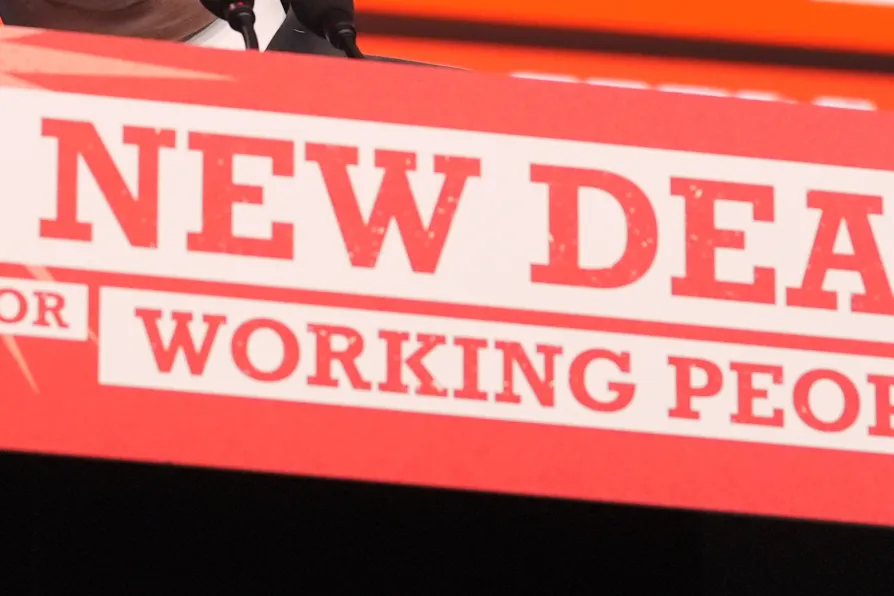
The Campaign for Trade Union Freedom (CTUF) and many of our affiliated unions are pushing for a second Bill on employment rights to ensure that more issues of concern are included so that the original Labour Party proposals in A New Deal for Working People are brought into effect.
As Labour Unions (Tulo) said in May 2026 the government must “deliver the rebalancing of power in the workplace promised in A New Deal for Working People, in full, without any carve-outs or loopholes.”
CTUF proposes eight simple measures which Burnham’s government could introduce. With one exception (tribunal reform), they would cost the government nothing to implement while demonstrating to workers and trade unions that the government is on their side.
Status of workers
Different categories of worker in the UK workforce have different employment rights.
So, for example, only “employees” in the legal sense of “employee” are entitled to claim unfair dismissal, only “employees” and “limb (b)” workers can claim the national minimum wage and paid holidays. This incentivises employers to recategorise their “employees” to downgrade the rights they can claim.
A New Deal for Working People promised to abolish these different categories in favour of a single status to include protection for all workers (except for only the genuinely self-employed who are in business on their own account with their own clients and customers).
Although this is widely accepted, the government has put off consultation on the form of the necessary legislation. The secretary of state should begin that consultation immediately and the legislation should form the backbone of a second Employment Rights Bill.
The consultation process must make clear in advance that the purpose is to ensure the maximum coverage of labour legislation: labour law protection should be universal and comprehensive. Apart from the genuinely self-employed, anyone who works for another should be protected.
There should be no exclusion from protection of the vulnerable and the exploited.
Zero-hours contracts
In the light of the manifesto commitment, workers and unions are expecting an end to exploitative zero-hours contracts.
It is time for the new government to revisit the legislation which is so complex that it occupies 31 pages of the Employment Rights Act 2025 and leads many to fear that the most exploited zero-hours workers may not benefit from it.
To do otherwise will leave working people and their families (1.2 million workers in the UK are working on zero-hours contracts) once again bitterly disappointed that a Labour government has failed on a clear commitment.
Trade union right of access
A New Deal for Working People provided for a trade union right of access to workers on employer premises or electronically.
The Employment Rights Act 2025 only gives unions the right to seek the agreement of the employer to such access.
Thereafter the union can apply to the Central Arbitration Committee (CAC) for an access order and if the employer refuses to comply, the union can apply again to the CAC.
Ultimately the union can ask the CAC to impose a fine on the employer which is paid to the CAC — not the union.
The process is cumbersome, legalistic, and invites delaying litigation by un-co-operative employers.
The Act must be amended to give unions a right of access without the need for an access agreement.
It should then be possible for a union to apply to the High Court for an injunction to prevent an employer interfering with its right of access.
Trade union recognition procedure
The current statutory recognition procedure introduced by the Blair government has become virtually unusable and unused. The small number of applications to the CAC is extraordinary given the declining levels of collective bargaining coverage. The ineffectiveness of the legislation presumably explains why it was retained by the Cameron, May, Johnson, Truss and Sunak administrations.
The procedure needs to be radically reformed, if it is to have any credibility. Although changes have been made by the Employment Rights Act 2025, these do not do enough to deal with the constipated nature of the complex and drawn-out procedure, or the problem of employer hostility present for instance at Amazon in Coventry in 2024 used to defeat a recognition application by the GMB.
To begin with, all state agencies, including Acas and the CAC should have an overriding duty to promote collective bargaining. Thereafter, a union should be able to secure recognition by showing evidence of majority support (as in Australia). There should be no need for a ballot in these cases.
In addition, it should be unlawful for an employer to takes steps to encourage or facilitate workers to resign from their union; to use labour consultants as part of an anti-union strategy; to foster a hostile anti-union environment particularly when a union is taking part in an organising campaign.
Where an employer violates these and related prohibitions currently in the legislation, the employer should be liable to injunctions and financial penalties. These penalties for the protection of workers should be commensurate with the penalties imposed by bodies like Ofgem for the violation of legislation designed to protect consumers.
Sectoral collective bargaining
The first priorities of a Labour government must be to reduce inequality and raise wages. This can only be done by reintroducing extensive collective bargaining.
The restoration of collective bargaining is advocated by the Organisation for Economic Co-operation and Development (OECD) and other global institutions. The EU requires all member states to have an action plan to achieve at least an 80 per cent collective bargaining coverage rate within five years.
In contrast, UK coverage for pay, terms and conditions set by collective agreement has been slashed from over 80 per cent before the 1980s to around 25 per cent today. The government should support restoration of at least 80 per cent coverage to prevent UK workers falling even further behind Europe.
New legislation should give the secretary of state the task of identifying (in consultation with unions and employers) sectors of the economy that would immediately benefit from a sectoral collective agreement to set minimum pay, terms and conditions.
Once the sectors are identified, a Joint Industrial Council should be established in the sector in question under statutory powers (somewhat similar to the wages councils in an earlier era, and in accordance with A New Deal for Working People).
Agriculture, hospitality, and fast food delivery are obvious candidates for a Joint Industrial Council.
The right to strike
The International Court of Justice (ICJ) ruled in May 2026 that the right to strike is protected by the International Labour Organisation’s (ILO) Convention No 87. As A New Deal for Working People sets out, the UK’s laws on industrial action should comply with the Treaties that the UK has voluntarily ratified.
These obligations include the right of prison officers in England and Wales to take industrial action. The UK government should immediately lift the ban on prison officers in England and Wales being allowed to take industrial action (as their colleagues in Scotland have long been permitted to do).
They also include the right to take solidarity action in support of other workers in dispute. The right to take solidarity action was removed by the Thatcher government in 1990, a step that has been criticised by the International Labour Organisation (ILO) on a regular basis ever since. Legislation is needed to repeal these restraints and to restore trade union freedom.
Fire and rehire
Workers and unions also expected that there would be an end to fire and rehire, as promised in A New Deal for Working People.
But the Employment Rights Act 2025 does not prevent it and the P&O Ferries situation — where 800 seafarers were sacked to enable contract labour to replace them at less than half the pay rate and on far worse conditions — will still be possible, though it will cost the employer a bit more.
Where fire and rehire is used by employers without going through the necessary consultation the law ought to allow a trade union to seek an immediate injunction against the employer thus halting the process until the legal requirements have been met or an agreement is reached.
Tribunal reform
Finally attention needs to be devoted to the creaking employment tribunal system. There is no point introducing new legislation if the enforcement system is unable to cope with what will inevitably be an increase in the number of complaints.
Serious failings in the enforcement of workers’ rights have been identified by several organisations, including the BBC, the Bureau of Investigative Journalism and the Work Rights Centre.
Research by these bodies paints a bleak picture of justice delayed by virtue of long waits before cases are heard, and justice denied in the sense that in many cases compensation awards are never paid.
As a result, employers are laughing at the “justice” system, which many appear to ignore with impunity. Tribunals need the power to award more effective remedies and stronger powers to ensure that their awards are complied with.
Workers need legal aid to pursue unpaid compensation orders, there is a need for personal liability of directors, owners and managers in the event of corporate default, and there is a need for a greater investment of resources in the tribunal system.
At the same time, a proactive justice system demands a comprehensive labour inspectorate with powers to prevent employers from breaking the law and to require them to take steps to redress any breaches. That will require a properly resourced Acas but also a very different mindset.
The issues referred to above will require new legislation.
Conclusion
One other matter that needs urgently to be addressed is the restoration of the Ministry of Labour.
It is extraordinary that there is no government department and no minister who can speak for workers at the Cabinet table.
There was of course previously a Ministry of Labour in this country, which was renamed as the Department of Employment, headed by a cabinet minister. But it was abolished by the Tories in the 1990s, never to be restored by Labour governments since.
The lack of political representation at the highest level is perhaps the best indication of the low priority now attached to workers and their trade unions. It is not acceptable that workers’ rights should be the responsibility of a junior in the Department for Business and Trade.
If employers merit their own department and with it political representation at the highest level, so do Britain’s 34 million workers. This could be done now: it does not need primary legislation.

Similar stories



The unions are unhappy with the Employment Rights Act 2025 and with good reason. KEITH EWING and Lord JOHN HENDY KC take a close look at why the Bill promised more than it delivered