Andy Burnham’s message of hope will defeat Reform if Labour delivers the New Deal for Working People in full, says JOANNE THOMAS


 Latest editorial
Is Manchesterism a welcome start?
Can Andy Burnham’s programme deliver a productive economy – or merely a softer version of capitalism, asks VINCE MILLS
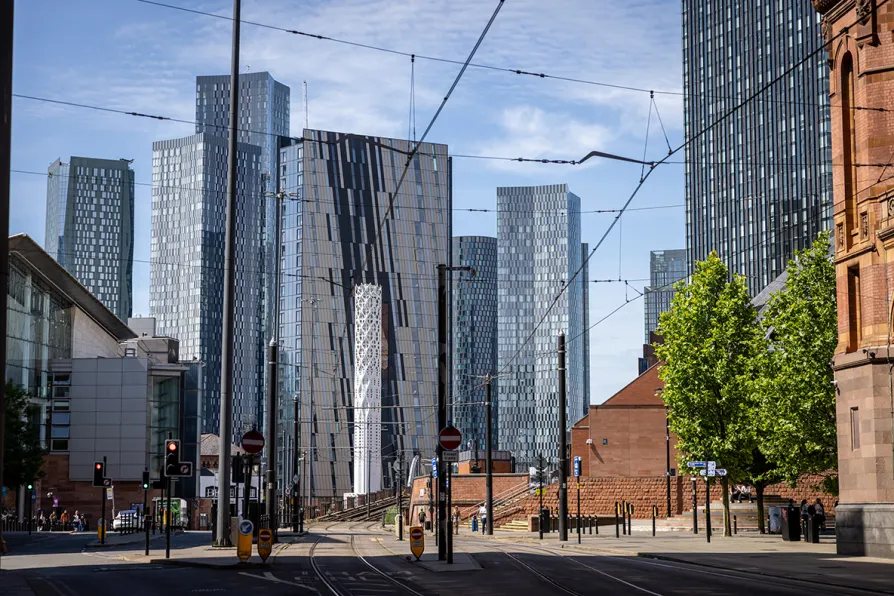 A view of the skyline in Manchester City Centre

The government’s latest asylum proposals abandon labour movement values and fuel division by aping Reform UK, writes DIANE ABBOTT MP
IAN LAVERY MP warns that decades of neoliberal policies have left former industrial communities behind — but a renewed Labour commitment to working people could change the political landscape
We need a government that invests in saving lives not destroying them, argues SOPHIE BOLT
HENRY FOWLER outlines the GFTU’s new 2026-27 education programme and argues that investing in trade union education is essential to building worker power, developing leaders and strengthening collective action
PAOLO SANTALUCIA reports on how an Italian region defies US pressure to end a Cuban doctors programme


IN AUGUST 2022, Anas Sarwar, then not long leader of the Scottish Labour Party (having ousted the Richard Leonard the committed socialist and supporter of Corbyn) invited Andy Burnham to Scotland.
The occasion was the launch of a Scottish Labour Party paper on local government, arguing, among other things, for Scottish local authorities to have the power to elect a “local champion” in a role such as mayor, for which Sarwar has a well-known fixation. Of course, in just that role Burnham had acquitted himself with notable success in Greater Manchester.
I was surprised at the event, and much of the audience of Sarwar supporters were too, but for them, not in a good way. Burnham — going beyond the issue of local government and mayors — advocated a programme of public ownership at a national not just local like Greater Manchester’s locally controlled bus and tram Bee network. It was my first encounter with what has now been dubbed “Manchesterism.”
It appeared that Burnham had experienced a conversion from New Labour’s and Westminster’s consensus neoliberalism towards, well, what? A publicly operated franchised transport network, and increased levels of social housing, however welcome, do not a radical economic strategy make.
Three years later, enter, stage left, Mainstream. Seeking to accommodate both the left and centre of the Labour Party, Mainstream offers a theoretical underpinning for Burnham’s approach in Manchester.
Last month it published The Productive State. It must be said from the outset that this is not, nor does it purport to be, a socialist strategy. It is very much within the social democratic, Keynesian tradition. Its authors Mathew Lawrence and Alex Williams, both part of the think tank Commonwealth (to be distinguished from the Scottish left think tank Commonweal) are very clear about this.
They argue, not for the replacement of capitalism, but for the amelioration of its deficiencies: “The Productive State is not a call to return to the administered economy of the postwar settlement. It aims instead to build the institutional foundation that makes a genuinely innovative and competitive economy possible — one in which dynamism derives from genuine productivity rather than the exploitation of infrastructure monopolies or insecure labour markets … Markets do real and irreplaceable work — aggregating information, rewarding innovation, enabling genuine competition.”
Even without a Marxist critique of the source of value, this benign view of markets surely glosses over some very obvious and urgent problems. Aggregating information for what purpose — why does Palantir, for example, want to integrate different health datasets? And what of the economist’s Mazzucato’s analysis showing that the economic success of innovation in key areas, like mobile phone technology, would have been impossible without state-funded investments.
Telecommunication services, ironically, are one of the areas where Lawrence and Williams explicitly argue the markets should be allowed to get on with it without intervention by the state, given “genuine substitutability.”
Last week we learned Virgin media had been repeatedly preventing customers from cancelling their contracts for nearly three years with the obvious intention of impeding competition.
Still, its emphasis on production and its excoriation of private capital’s predatory behaviour in key utilities like power and transport and especially water, where the extraction of “value” was the only objective are very welcome: “Twenty-eight per cent of the typical water bill in England goes to debt servicing, against 10 per cent for publicly owned Scottish Water. Nearly a quarter of the typical electricity bill in 2024/25 was estimated to be corporate profit. Since the mid-1990s, privatised transport, energy, and water companies have paid out close to £200 billion (in today’s prices) in dividends while delivering lower investment rates than their publicly owned predecessors.”
To combat this and Britain’s sclerotic growth, the authors argue that we need to develop an economic system with three distinct tiers: a foundation that provides decommodified essentials based on affordability, universal access, environmental sustainability and worker welfare; a stabilised market economy which would rest on this foundation where the state only intervenes to prevent instability and rent extraction and at the apex, largely private players characterised by rapid technological change and uncertainty but supported by an ambitious industrial strategy.
Whatever limitations the left might find in this model — for example why are only privately owned organisations deemed capable of operating in sectors dominated by rapid technological change when state organisations in the Soviet Union developed an unprecedented innovative space programme — nevertheless, it is clearly a step away from the universal application of the market where, no matter the sector or the social consequences, profits, disguised as “efficiency” have till now been the only imperative.
Indeed, should Burnham seek to implement this approach, he will face fierce opposition from those corporations and their supporters in Parliament and elsewhere (including some in the ranks of the Parliamentary Labour Party) with stakes in those privatised assets and in the political networks that facilitated private expropriation. Think Mandelson and friends.
The Productive State says little on how a Labour government would go about taking such assets into public ownership, save that they would be taken over by public corporations which would have commercial independence and arm’s-length governance and that: “The pace and feasibility of such a programme would depend on legal constraints, market conditions and fiscal considerations, rather than a single acquisition mechanism…”
Organised opposition would be the first problem. The second which would be exacerbated, indeed encouraged, by those organising corporate resistance, is the expectation of immediate action from an electorate tired of austerity, the cost-of-living crisis and the perfidy of politicians. Burnham’s government does not have much time to rectify all of this.
The Productive State does have plans to address the cost-of-living crisis by a fully tax-funded package to lower inflation by reducing the cost of energy, housing and transport and to tackle the housing shortage through a network of regional public housing corporations.
If Burnham is serious about pushing back neoliberalism and its deeply politically embedded supporters, he needs to do all of these things, but he needs to do more.
Given the time lag between legislation and action on the ground, he needs to mobilise working-class support for such a programme through the unions and grassroots political and community activism.
Indeed, the left should start now to push the prime-minister-in-waiting in the right direction, by getting behind this programme that could at least change the direction of British politics in the right direction. As a political programme Manchesterism has significant limitations, but it’s a start and potentially an important start for a left, popular movement which has largely been absent from British politics for some time.

Similar stories


Only an ambitious programme of state-led investment can restore growth and improve living standards, argues MICHAEL BURKE

The HS2 debacle exposes what happens when public infrastructure is handed to private contractors – especially when set against China’s state-led high-speed rail success, says CARLOS MARTINEZ

Years of underfunding are eroding Scotland’s local services and deepening inequality in communities, says VINCE MILLS