STEPHANIE BROWN draws attention to the hidden labour of the female embroiderers, and how a 19th century replica made no such error


 Latest editorial
Miraculously composed in the midst of genocide
JAMIE BRITTON recommends that we all buy at least two copies of a remarkable book of poems
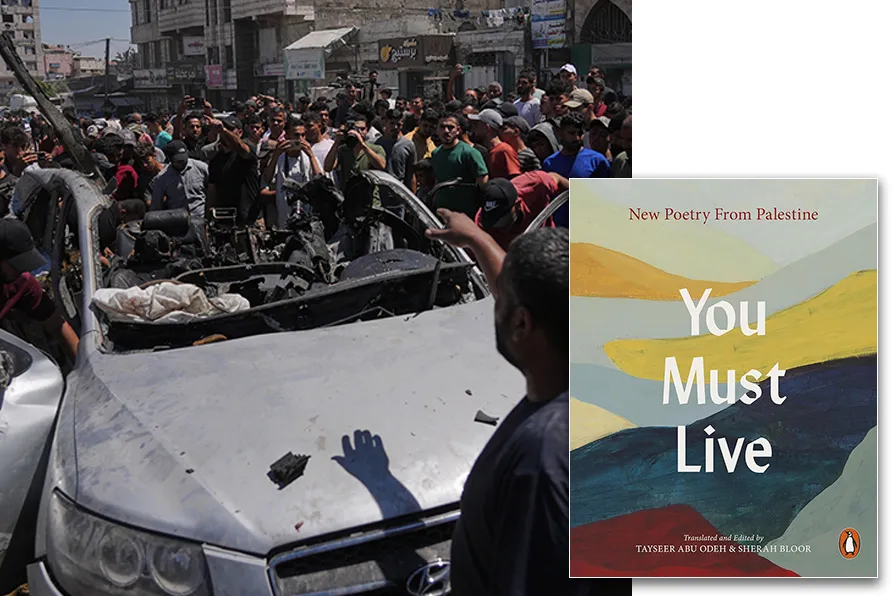 Palestinians gather around a car hit in an Israeli strike in Gaza City, Thursday, June 18, 2026. [Pic: AP Photo/Jehad Alshrafi]
MIK SABIERS revels in a band that ploughs an idiosyncratic furrow of expletive laden, guitar-driven alt rock
ANDY HEDGECOCK, MARIA DUARTE and ANGUS REID review Synthetic Sincerity, Our Hero, Balthazar, Heartstopper Forever, and A Year In London
The bard invites readers to a gig, raps for Clacton, and lays out the Burnham-Hurzeler conundrum
RON JACOBS recommends an important book that enhances the oppositional theories put forth by Fanon and, in doing so, remakes psychology itself
JAN WOOLF relishes an extensive history of our long relationship to trees in Britain that underlines the current emergency
DIANE WATT argues that while evidence of sex is not there, a 16th‑century lesbian poet could be Scotland’s answer to Gentleman Jack


You must live: New poetry from Palestine
Translated and edited by Tayseer Abu Odeh and Sherah Bloor, Penguin, £12.99
YOU MUST LIVE is an anthology of poetry from Palestine written by 30 poets from Gaza and four from the West Bank. What makes this collection of poems so remarkable is not just the harrowing content, but also the danger to the writers of getting their work out to the editors and to a wider English-speaking audience.
The poems arrived as text messages, screenshots, photographs of handwritten pages or e-mail. As the editors state in the introduction: “What we didn’t understand at first is that every time someone’s phone connected to the satellite, or received a message, they became a potential target. And to reply might entail life or death decisions: standing atop rubble, the signal is sharper but leaves one exposed.”
Reading that statement made it clear that these poets risked their lives to be heard. The anthology begins with the late Refaat Alareer’s poem If I Must Die (the anthology’s title is taken from its second line) and this poem acts as a dedication to all those poets the editors failed to reach in time. “Their poems, chalked onto collapsed walls, or on the blackboards of school-turned-shelters-turned bombsites, traced in sand, or shared in private messages, will never reach us.”
So, the poems here are “Living Poems,” with little time for a drafting process, but honest, raw screams. Bravery mixed with genius. However, this anthology differs from equally important ones such as Out Of Gaza: New Palestinian Poetry (Smokestack, 2024), edited by Atef Alshaer and Alan Morrison, where established Palestinian American poets write from exile. The poems from this anthology are, as the editors state: “Voices under threat of elimination” and “poetry of witness.”
The Arabic text is put alongside the English translation acting almost as a mirror image of the original.
For me the one of many poems that left an indelible mark on my mind was Waleed al-Aqqad’s I Have Never Seen A Corpse Intact. Waleed al-Aqqad was born in Gaza in 1992, he is a poet, playwright and short story writer. He states that “writing, for me is like breathing; an action of life and survival.” He sees his poetry as utopia and dystopia, wanting to “Immortalise the horror of Palestinian suffering and to resist oblivion.”
Immortalise he does with lines that describe “a body with its head crushed… Air passed in between bones,” while “Still we wanted to hold you. But you were coming apart/ into your own blood.” The terrible contrast of rearranging “your severed head across your chest” and covering “wounds with flowers” is almost unbearable to read, let alone imagine. Here the poet will not let you turn away from the horrors witnessed of “The corpse of a hungry child/ The world eats its flesh.”
The last line of stanza four sums up not just this poem, but the whole anthology: “What scared him most/ was being forgotten.”
Don’t let this happen. Buy this book. Buy this book for others. As the poet and human rights advocate Carolyn Forche states, the point is that these poems have been “miraculously composed in the midst of genocide.”
You will have nightmares. You will be angry and upset. But these poems MUST be read. The fact is that to hold a copy is life—affirming. Order copies now!
