STEPHANIE BROWN draws attention to the hidden labour of the female embroiderers, and how a 19th century replica made no such error


 Latest editorial
The myth of ‘cultural Marxism’
This right-wing conspiracy theory is used to justify the coercive measures against gender, race and labour rights that best serve capitalism, attests GAVIN O’TOOLE
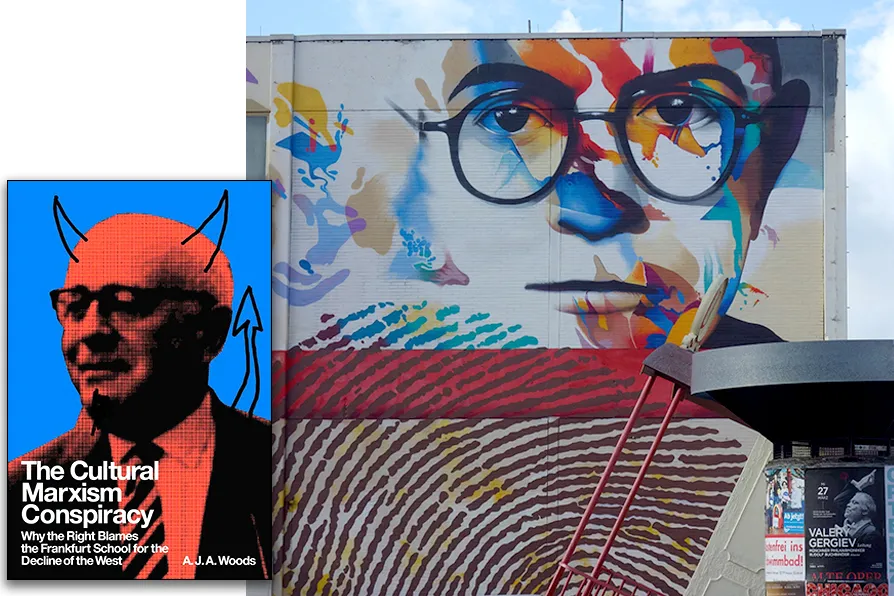 JUSTLY CELEBRATED: Mural of Theodor Adorno by Justus Becker and Oguz Sen, Frankfurt [Pic: Vysotsky/CC]
MIK SABIERS revels in a band that ploughs an idiosyncratic furrow of expletive laden, guitar-driven alt rock
ANDY HEDGECOCK, MARIA DUARTE and ANGUS REID review Synthetic Sincerity, Our Hero, Balthazar, Heartstopper Forever, and A Year In London
The bard invites readers to a gig, raps for Clacton, and lays out the Burnham-Hurzeler conundrum
RON JACOBS recommends an important book that enhances the oppositional theories put forth by Fanon and, in doing so, remakes psychology itself
JAN WOOLF relishes an extensive history of our long relationship to trees in Britain that underlines the current emergency
DIANE WATT argues that while evidence of sex is not there, a 16th‑century lesbian poet could be Scotland’s answer to Gentleman Jack


The Cultural Marxism Conspiracy: Why the Right Blames the Frankfurt School for the Decline of the West
AJA Woods Verso £16.99
WITH weary predictability, Sunday Telegraph editor Allister Heath revived the chimera of “critical race theory” in his toxic response to the “anti-white racism” he blames for Henry Nowak’s death.
This “far-Left, anti-white, post-modern ideology incompatible with Western civilisation” explains not only the police response to this incident in particular, he insisted, but the National Police Chiefs Council’s Anti-Racism Strategy in general, which was “written by woke fanatics.”
Heath’s puerile and equally fanatical insult to journalism does not befit a national newspaper editor, but is valuable for providing a textbook example of the mythical monster that, in its latest guise, his right-wing ilk wants us to believe stalks the free West: cultural Marxism.
The obsession of a feverishly conspiratorial US right since the 1960s seeking a culprit to blame for dramatic social change, an ungodly counterculture and new forms of resistance to oppression, cultural Marxism is an ideological fiction with a long lineage.
In this work of intellectual archaeology, author AJA Woods traces the etymology of this conspiracy theory to Nazi Germany and the subsequent (and antisemitic) hostility of right-wing US commentators to the political interventions of Frankfurt School philosophers.
The US right was the progenitor of what would become a global conservative fixation because its villains — figures such as Horkheimer, Adorno, Benjamin, Fromm, Marcuse and Habermas — had mostly decamped to New York after leaving Germany in 1935.
Woods has set himself the task of unearthing how the cultural Marxism conspiracy theory has been formulated in right-wing narratives.
This is the simultaneous story of how, in Gramscian terms, new forms of knowledge production and the intellectuals created by them have attained influence in the postwar era by concocting false coherence from motley theories in order to fashion a discernible enemy.
It would be wise for the left to understand the genealogy of this conspiracy theory and its relationship with capitalism because, as shown by Heath’s bandwagon-jumping nonsense, it continues to spawn new adversaries such as CRT, “gender ideology” and “wokeness.”
Woods explains how and why cultural Marxism has been constructed by the right in their efforts to blame the left for dramatic changes in Western societies over the past 60 years.
He shows how a broad spectrum of right-wing thinkers have argued that, with the aim of triggering the collapse of Western society, Frankfurt School philosophers invented all the “ideologies” they despise most: multiculturalism, feminism and environmentalism.
By catering to the demands of petulant minorities, Marxists who had failed to bring about a revolution through class struggle could simply do so by taking control of cultural institutions.
Woods begins his analysis in the tumultuous 1960s, when social protests over race, gender, sexuality, class and generation spawned bold movements for change that collided with the explosion of mass media and cultural consumption.
While this was a period of cultural dissent, it was also one of Establishment reaction in which extreme violence was just one of the tools deployed to conserve the social order.
Woods writes: “Various rightwing and reactionary political movements ventured into this conjunctural terrain to defend the existing hierarchies of a pristine Western civilisation … All cultural Marxism narratives derive from these efforts to resist and reverse the social changes that started to unfold in the long and global 1960s.”
The author argues that there is no single form of cultural Marxism, only variations on a theme formulated by different actors to suit the needs of the moment, and hence there is no clear definition or linear evolution of this idea.
He studies four main incarnations of the conspiracy: the cultish mission of Lyndon LaRouche to prevent a “new Dark Age”; the efforts of conservative writer William Lind to delegitimise liberalism; the Tea Party movement’s demonisation of Barack Obama’s reformist agenda; and the Trump-era culture warriors’ contemporary “war on woke” and CRT.
In the final analysis, what we witness is ultimately an effort by the forces of reaction to build a cultural narrative with concrete economic consequences, and able to justify coercive measures against gender, race and labour rights that best serve the expansion of capitalism.
