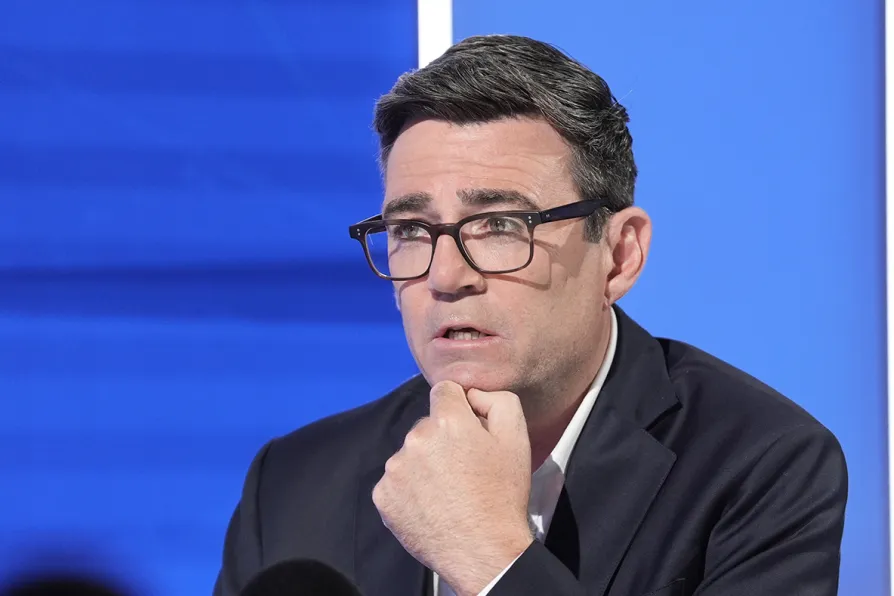
Andy Burnham’s message of hope will defeat Reform if Labour delivers the New Deal for Working People in full, says JOANNE THOMAS


 Latest editorial
Rising to the challenge – building a global majority against war and nuclear weapons
Build peace, not a new nuclear Europe, says SOPHIE BOLT of CND
 A mushroom cloud from a nuclear bomb explosion
The government’s latest asylum proposals abandon labour movement values and fuel division by aping Reform UK, writes DIANE ABBOTT MP
IAN LAVERY MP warns that decades of neoliberal policies have left former industrial communities behind — but a renewed Labour commitment to working people could change the political landscape
We need a government that invests in saving lives not destroying them, argues SOPHIE BOLT
HENRY FOWLER outlines the GFTU’s new 2026-27 education programme and argues that investing in trade union education is essential to building worker power, developing leaders and strengthening collective action
PAOLO SANTALUCIA reports on how an Italian region defies US pressure to end a Cuban doctors programme


WE KNOW that the world is at a crossroads. Alongside huge increases in military spending, the threat of nuclear weapons being used in war is growing.
Attempts to turn whole countries’ economies towards war are being justified by the continued war on Ukraine, and perceived threats that this devastating conflict will spread across the continent. However, far from preventing war, this preparation for it risks dragging Europe into a war that could go nuclear.
Since Russia lowered its nuclear-use threshold and placed nuclear weapons outside its territory in Belarus, it has now carried out successful test flights of new nuclear delivery systems, including the long-range, nuclear-powered Burevestnik missile which flew 14,000 kilometres.
A whole new generation of US nuclear weapons is now stationed at Nato bases in Belgium, Germany, Italy, the Netherlands, Turkey and Britain.
This nuclear upgrade has taken place alongside further Nato expansion to incorporate Finland and Sweden. This has doubled the length of Nato’s borders with Russia.
In March, President Emmanuel Macron announced not only an increase in its nuclear weapons but also formalised his “nuclear sharing” arrangement, arguing that Russia was a threat to Europe.
The new nuclear doctrine will mean nine other European countries being integrated into French nuclear operations.
This starts with nuclear exercises in preparation for French nuclear jets or nuclear-armed submarines are deployed to these countries’ military bases.
This French nuclear expansion is not to substitute for a withdrawal of US nuclear weapons. While the Trump administration is considering reducing some of its military contribution to Nato’s rapid response force, it is not withdrawing its nuclear B61-12 bombs.
In fact, Trump is in talks with European Nato states about expanding the number of countries hosting the nuclear-capable F-35A fighter jets that can launch these bombs.
This means, that on top of this US nuclear expansion, French nuclear-armed jets could be deployed to at least another five European countries including Greece, Denmark, Norway, Sweden and Poland. This would mean US and French nuclear weapons being deployed across Europe right up to Russia’s borders.
Alongside this nuclear escalation, debates are taking place about whether Germany should develop its own nuclear weapons. Chancellor Friedrich Merz has so far ruled it out. However, the government is taking a much more aggressive, leading role in European rearmament and has pledged to build Europe’s strongest army.
Last July it signed a treaty to increase nuclear co-operation with Britain. That same month Keir Starmer committed to expand Britain’s nuclear capability with 12 nuclear-capable fighter jets to strengthen Nato’s nuclear mission.
This acceleration of plans for nuclear expansion are only increasing tensions with Russia. Far from offering security to the populations of all these European states and the people of Ukraine, the war is yet again escalating, with the UN reporting that civilian casualties in Ukraine were the highest they have been since Russia’s illegal invasion in 2022.
Reports that European countries are considering restarting dialogue with Russia to end the war are welcome and absolutely vital. Only a diplomatic and political approach can create a sustainable security architecture that can ensure the long-term peace and prosperity for Europe, Ukraine and Russia.
This cannot be achieved by deploying troops from Nato countries into Ukraine, backed by the constant, looming threat of nuclear war. On the contrary, this will only prolong and escalate the crisis, and risk drawing Nato states into direct confrontation with Russia.
Central to this must be the withdrawal of all nuclear weapons in the region: getting the US weapons out of Europe and Russian weapons out of Belarus. Instead of pushing for more nuclear weapons, Britain and Europe should be supporting serious programmes to get rid of the world’s nuclear weapons.
We need co-ordinated action to make this happen. Opposition to war and nuclear weapons is growing. We take inspiration from the incredible demonstrations and strike actions building across Europe against militarism.
Here in Britain, opposition to Britain’s toxic military alliance with the US is growing. Seventy per cent oppose the war on Iran and over 60 per cent want US nuclear weapons out of this country.
Today, at this critical anti-war summit, we have a critical opportunity to redouble our efforts to halt this catastrophic drive to war. We all face the same interconnected crises of war, nuclear threats, climate breakdown, of worsening poverty and a rising far right.
Therefore, we must co-ordinate together to develop and win a majority in our countries for an alternative strategy to war and nuclear weapons. This must be rooted in human security and common security — prioritising diplomacy, global co-operation, conflict prevention, and investment in health, education, climate resilience, social care.
Co-ordinating and learning from our joint struggles, we can build a movement strong enough to halt the war drive and redirect these huge resources into securing the sustainable, peaceful future humanity so desperately needs.
Sophie Bolt is general secretary of CND. She is speaking at today’s Stop the War International Conference at Central Hall Westminster, Storey’s Gate, London SW1H 9NH on Saturday June 20. For more information visit stopwar.org.uk.
