HENRY FOWLER, assistant general secretary of the General Federation of Trade Unions (GFTU), reports on Day 2 from the GFTU’s residential Summer School at the Workers’ Retreat, Quorn Grange Hotel


 Latest editorial
Standing up to Trump's vision of endless war
In the wake of his recent humanitarian visit to Cuba, RICHARD BURGON points to the now urgent need to defend the island’s political sovereignty and its right to self-determination
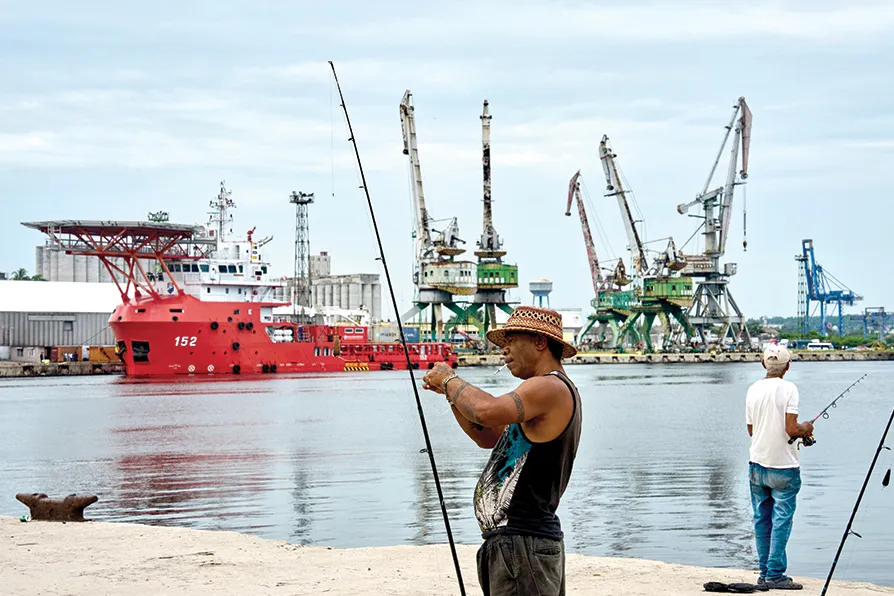 MORE SYMBOLIC THAN SUBSTANTIAL: Colombian Navy ship ARC Caribe in a deserted Havana port after delivering humanitarian aid last Friday, June 12, 2926

Assistant general secretary of the General Federation of Trade Unions HENRY FOWLER reports on day 1 from the GFTU’s residential Summer School at Quorn Grange Hotel
MPs and others called for the urgent release of tortured Palestinian doctor, Hussam Abu Safiya, held hostage by Israel and reportedly near death, reports LINDA PENTZ GUNTER
Strike Map co-founder HENRY FOWLER discusses the significance of today’s joint union letter to video game giant Rockstar, demanding trade union recognition for its workers. Their conversation highlights how our movement can harness its collective power to rebuild union power across the private sector
Capitalism has exploited — and polluted — our natural resources for too long, it’s time we treated our rivers as living beings, writes MIRIUM GAUNTLETT, LIAM SHAW and ROX MIDDLETON
The PM leaves office having squandered Labour’s electoral mandate and alienated its grassroots. He will not be missed, writes BRIAN LEISHMAN MP


TONY BENN once said that if we can find the money to kill people, we can find the money to help people.
Those words have been on my mind in recent days as we’ve seen a growing push for higher military spending, accompanied by calls for further cuts to public services and social security.
The reality is that the basic infrastructure of our country has already been stretched beyond its limits by years of underinvestment and austerity.
Our schools, hospitals, social housing and transport systems are under immense pressure and fall far short of what our communities need.
Of course, we must address the risks and threats facing our country. But that does not mean simply pouring ever more money into the military, which has already received significant funding increases in recent years.
Doing so would inevitably mean less money for the public services and infrastructure on which people depend.
Nor would it necessarily make us safer. The government’s own assessments identify pandemics, cyber attacks, failures of critical infrastructure such as the electricity grid, and climate‑related emergencies among the most serious threats facing Britain.
National security is broader than military security, and just because these other risks receive less media attention does not make them any less serious.
Addressing them requires major investment in the foundations of our society: public services, critical infrastructure and greater resilience so we can cope with crises and keep society functioning when they occur.
The push for ever‑higher military spending must acknowledge that it will not protect us from many of the most serious threats Britain faces.
These are exactly the kind is issues we need to debate across our movement. That is why this weekend’s International Conference Against War, organised by the Stop the War Coalition, is so important. It will bring together speakers and delegates from across Europe and beyond to discuss the challenges we face and how we build a more peaceful future.
I will be speaking about Donald Trump’s National Security Strategy (NSS) and what it means for the world — and especially for Cuba, following my recent visit.
This year began with Trump’s bombing of Venezuela and the kidnapping of its president. Since then, we have seen threats against Greenland, continued backing for Israel’s genocide in Gaza and bombing of Lebanon, and a devastating US war on Iran that has brought immense suffering to the Iranian people while driving up prices across the globe.
Some portray these as the actions of a madman. The reality is far more dangerous: they are part of a plan set out in Trump’s NSS.
At its heart is a view that might is right, and in which the UN Charter and the international rules established after WWII are discarded because they stand in the way of US power.
That post‑war system was far from perfect, but Trump’s alternative would make the world even more dangerous.
That includes Europe, where Trump has made clear his desire to see far‑right parties take power. We are already seeing multibillionaires using their wealth and influence to promote division and reaction to secure that.
But there is one region that Trump’s strategy places in its crosshairs above all others: Latin America.
Trump’s strategy is explicit. Its objective is to restore US dominance over the region. It states that the US will “reassert and enforce the Monroe Doctrine to restore American pre‑eminence in the Western Hemisphere.”
The Monroe Doctrine was repeatedly invoked in the past to justify US intervention across Latin America, which Washington treated as its “backyard.” So the recent attack on Venezuela was not simply about capturing the world’s largest oil reserves. It was the opening move in a wider attempt to reassert US control across an entire continent.
Cuba is next in line.
To control a region, you must first defeat those who have most consistently resisted domination. For decades, Cuba has been a beacon of independence, of national sovereignty over resources, and proof that a small country can refuse to submit.
That is why Cuba is deemed a threat. And why we must now build the broadest possible movement of solidarity with the Cuban people, just as they have always done for others.
Where Washington has sent bombs, Cuba has sent doctors. Where the US supports genocide, Cuba played a significant role in the struggle against apartheid in South Africa.
When I visited Cuba recently on a humanitarian delegation, not a drop of oil had arrived for three months because of Trump’s tightening of the blockade.
The cruelty of this was plain to see. But so too were the dignity and resilience of the Cuban people, who have withstood decades of US attempts to strangle the island.
Like all imperial projects, Trump’s ambitions will not stop with Cuba. He seeks to reverse all the changes that have transformed much of Latin America over recent decades.
Across the continent, governments and popular movements have sought greater control over their countries’ wealth and resources, using them to tackle poverty and expand public services. They have worked to strengthen co‑operation between Latin American nations and reduce their dependence on Washington.
For Trump, that is unacceptable. So his goal is not simply to remove an individual government but to ensure every Latin American country falls into line with Washington’s priorities.
To achieve that, I have no doubt Trump will back far‑right forces across the continent, attack democratic freedoms, undermine human rights and seek to crush popular movements.
We have seen this before. During the 1970s and 1980s, the US-backed military dictatorships and armed death squads responsible for terrible atrocities across the continent. Hundreds of thousands were murdered, tortured or disappeared. That should serve as a warning.
So the struggle for Cuba’s sovereignty is not only about Cuba. It is a struggle for the future of Latin America and for the right of nations anywhere to pursue an independent path.
The great Cuban poet and fighter for national liberation Jose Martí once declared: “Humanity is our homeland.” Today, standing with humanity means standing with Cuba. Defending Cuba’s sovereignty must be a central part of resisting Trump’s vision of endless war.
Richard Burgon is Labour MP for Leeds East.
The Stop the War International Conference takes place at Central Hall Westminster, Storey’s Gate, London SW1H 9NH on Saturday June 20. For more information and to book tickets visit stopwar.org.uk.
