HENRY FOWLER, assistant general secretary of the General Federation of Trade Unions (GFTU), reports on Day 2 from the GFTU’s residential Summer School at the Workers’ Retreat, Quorn Grange Hotel


 Latest editorial
Starmer quits 10 years after the Brexit vote that made his fortune – what can we learn?
Morning Star editor BEN CHACKO says assessing a Labour leader whose mission was to smash the left must involve addressing the delusions that fuelled his rise
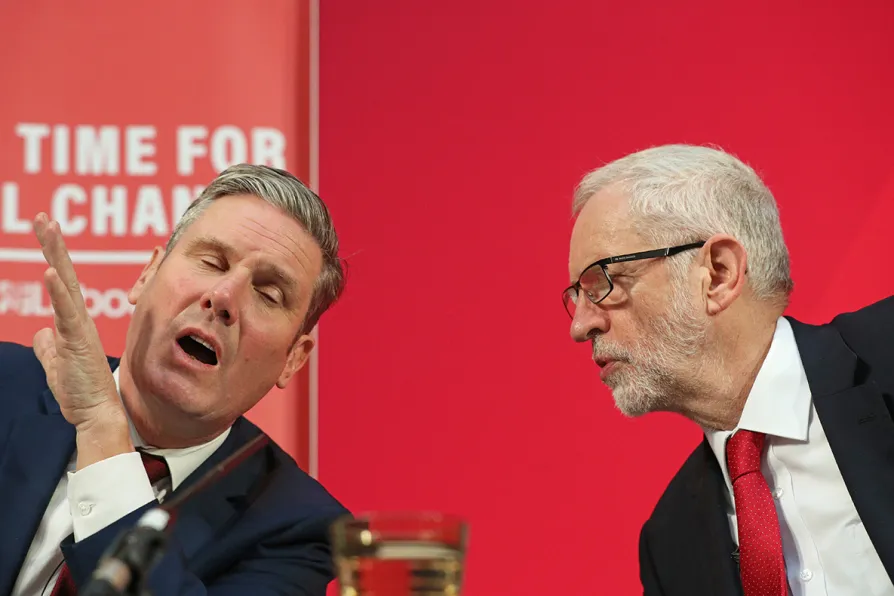 Then Labour Party leader Jeremy Corbyn (right) alongside then shadow Brexit secretary Keir Starmer during a press conference in central London, December 2019
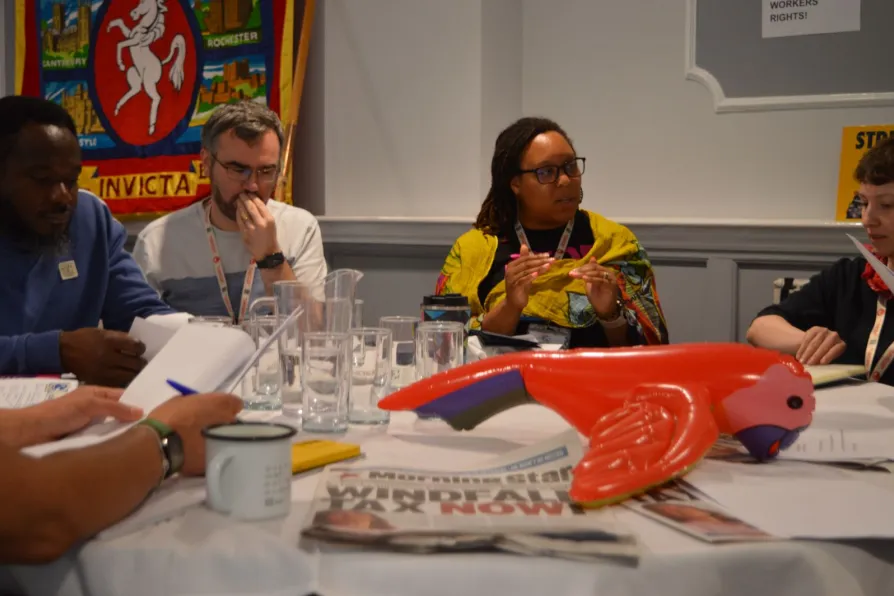
Assistant general secretary of the General Federation of Trade Unions HENRY FOWLER reports on day 1 from the GFTU’s residential Summer School at Quorn Grange Hotel
MPs and others called for the urgent release of tortured Palestinian doctor, Hussam Abu Safiya, held hostage by Israel and reportedly near death, reports LINDA PENTZ GUNTER
Strike Map co-founder HENRY FOWLER discusses the significance of today’s joint union letter to video game giant Rockstar, demanding trade union recognition for its workers. Their conversation highlights how our movement can harness its collective power to rebuild union power across the private sector
Capitalism has exploited — and polluted — our natural resources for too long, it’s time we treated our rivers as living beings, writes MIRIUM GAUNTLETT, LIAM SHAW and ROX MIDDLETON
The PM leaves office having squandered Labour’s electoral mandate and alienated its grassroots. He will not be missed, writes BRIAN LEISHMAN MP


THE end of Keir Starmer’s premiership comes a decade after the vote to leave the EU that made his political fortune.
Without the rift between Labour’s activist base and working-class voters exposed by Brexit, he could never have used the Continuity Remain cause to undermine the Jeremy Corbyn project, or built a profile — having only become an MP in 2015 — that enabled him to pose as a successful “soft left” candidate in the party leadership contest of 2020.
Starmer’s departure is a key moment because his whole political career was devoted to destroying the left, and on that measure it was quite successful.
He was key to shaping the policies that lost Corbyn the 2019 election, and then a ruthless suppressor of the left within the party — expelling socialists, rigging disciplinaries and selections, banning discussion of core political issues and suspending whole constituency parties when it suited him.
The mainstream media will echo Starmer’s own claims that this made the party electable, inconvenient details like its vote being smaller in 2024 than in 2019 regardless.
That’s nonsense, but the more important question is why he was able to inflict such a thorough defeat on what was, for several years, a mass movement of the left and whether a renewed left challenge for power can be built that avoids the same fate.
Many of the same dilemmas face us today — not least the question of the EU, with a concerted push to rejoin emerging in parts of the media (especially the Independent, the i and the Guardian) which has some trade union support (an outrider in the cause being Prospect’s Mike Clancy) and is likely to find sympathy with the biggest left-leaning party in England (the Greens) as well as the Scottish and Welsh nationalists and lots of Labour MPs.
Responses to Corbynism’s defeat have varied. Most left MPs have adopted a “weather the storm” approach, doubting the viability of alternative projects and hoping space for a left revival will open up under a more tolerant future leadership. Even Corbyn himself and Zarah Sultana, who went on to play roles in founding Your Party, took that plunge only after their exclusion from Labour was effectively forced.
Maybe their hopes will prove correct. Starmer has been a uniquely repressive party leader, so a change may give the left breathing space.
That said, Starmer’s extreme control-freakery was not just a personality quirk but an expression of ruling-class horror that a leading British political party could have fallen to a socialist and anti-imperialist like Corbyn: smashing that project to pieces was an imperative of the whole political, corporate and media establishment. Even if Andy Burnham or some other successor is less personally unpleasant they will be subject to the same pressures.
Allowing left MPs greater freedom to rebel or speak on social movement platforms is also a very limited win.
The big questions we face — defeating the far right, stopping the drive to war, replacing the rentier economy and ending the long-term immiseration of working-class people — are not answered by allowing the Labour left back into the tent with the sort of status it had under Ed Miliband.
The people are sick of the system and unless the left can plausibly confront it, that anger will keep channelling to the right. Left MPs are making solid policy recommendations, but need to work with unions on a strategy to see those adopted.
The bulk of Corbynism’s activist base has, by contrast, not remained in Labour. Many were forced out through Starmer’s purges, while even more resigned in disgust.
The hugely enlarged membership of the Green Party since Zack Polanski became leader and the tens of thousands who joined Your Party are comprised to a great extent of these people.
If Starmer’s big lie to win the party leadership was that he offered “Corbynism without Corbyn,” these approaches could be summarised as attempts to build “Corbynism without Labour.”
Many former Labour activists point to the sabotage of Corbyn’s leadership by the Labour Party machine, the hostile bureaucracy and mutinous parliamentary party, as the reason he couldn’t win. They hope a similar project could succeed if it wasn’t hamstrung from the start by internal treachery.
The sabotage was real, and the conduct of many Labour officials and MPs a disgrace. It undoubtedly did huge damage to the Corbyn project.
But the project itself continued to advance despite the saboteurs. In 2017 Labour didn’t win but the result was seen universally as a triumph for Corbyn, and in achieving the party’s biggest vote increase in seven decades and ridding the Tories of their majority it left the left stronger than before. The wall-to-wall media smears began in 2015 too and didn’t stop that.
The decisive factor in the demise of Corbyn-Labour was neither hostile propaganda nor internal sabotage but political error: specifically the response to the vote 10 years ago today to leave the EU.
In 2017 — when it was committed to respect the vote — Labour’s advance was general, with vote share rising sharply in big cities and deindustrialised towns, in old “red wall” strongholds (where it rose for the first time in decades) and in territory long dominated by the Tories and Lib Dems. That wasn’t repeated in 2019, as we know.
“Anyone but the Tories” resignation in parts of the labour movement and “stab in the back” fixations across much of the left distract us from the political impact of the campaign to override the Brexit vote.
It killed Corbyn-Labour as an insurgent party, aligning it with a trading bloc committed to prescriptive neoliberalism via treaties and regulations Tony Benn once termed “the only constitution in the world committed to capitalism.” The EU’s inflexible economic model is one reason its economy has performed so poorly in recent decades, not just compared to rising powers like China but by comparison with the United States too.
Instead of focusing on building the social movements it arose from, it tied the party leadership into endless parliamentary wrangling designed, in effect, to thwart the Leave vote.
Ten years on, the voices for rejoining the EU are getting louder. Many point to polls indicating the public feel buyer’s remorse for Brexit: but there were lots of similar claims between 2017-19.
The politics of Rejoin are reactionary: the i newspaper’s recent promotion of the case for re-entry has accompanied intensified coverage of the supposed threat Russia poses to Britain, promoting war fever.
That’s no surprise given militarisation is the political priority across the EU, which is more committed to endlessly prolonging the Ukraine war than the United States and is even more authoritarian today than it was in 2016.
Liberals still — as they did back in 2016 — present US President Donald Trump (a far more direct threat to our liberties through Washington’s huge influence over our government and his support for the far right on our streets) as a pawn or ally of Russia’s Vladimir Putin, so the EU can be held up as a shield against both.
That ignores the broadly antagonistic relations between the US and Russia — the US penalising countries like India for trading with Russia, or Russia being the only country so far to have breached the US oil blockade of Cuba — as well as the wider alignment of the EU with the United States in support of Israel’s occupation of Palestine or efforts to isolate China.
The EU is one issue. But it proved decisive in the defeat of the left because support for it involved subordinating an independent class politics to one of two rival ruling-class factions (that of globalisation rather than nativism).
Where left-right politics splits along such lines, culture wars drown out class politics and the left tends to lose.
The task is to rebuild class politics — socialist, anti-imperialist, anti-war and rooted in organised labour.
The fundamental weakness Starmer exploited to break Corbynism was the liberalism of the left — its failure to recognise the class character of institutions from the British state to the European Union and to approach them accordingly.
And support for a capitalist institution like the EU, a pillar of global imperialism and an enemy of the global South, is as widespread across today’s fragmented left as it was in Labour a decade ago.
Starmer could trick and then betray the left because of this confusion. Now he is on his way out. Can we learn from our mistakes?
