

 Latest editorial
Fifty years ago this month, Britain faced its hottest summer on record, as welterweight champion Stracey met his match in Mexico’s Palomino, writes JOHN WIGHT.
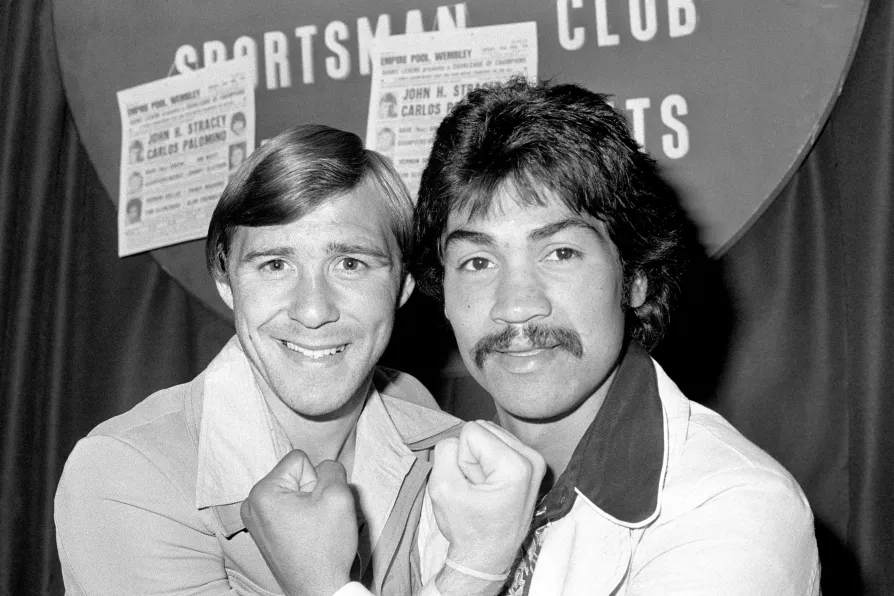 TWO OF A KIND: Welterweight champion John Stracey of Great Britain, left, with his challenger Carlos Palomino, USA.



ON JUNE 22 1976 John H Stracey entered the ring at London’s Empire Pool (Wembley Arena) to defend his WBC welterweight title against Mexico’s Carlos Palomino. It was a moment to savour for those in attendance and also the multitude watching at home, regaled as they were with the scintillating commentary of the BBC’s finest in the person of Harry Carpenter.
The backdrop to this world title contest was one of the hottest summers ever recorded. For 15 consecutive days the thermometer registered a temperature of over 30°C across Britain. Harvests were devastated with the result that the country was forced to import an extra million tonnes of grain. Food prices rose by 12 per cent in response. Taps and hosepipes ran dry while throughout the heatwave an average of 250 people perished from heat-related causes every day.
A country with an infrastructure ill-suited to extreme weather events, hot or cold, people across Britain did what they always do and just rubbed along. Kids colonised the nation’s rivers and lakes, and workers complained about the lack of ventilation in their factories, workshops and retail stores. Labour’s prime minister James Callaghan — Sunny Jim, as he was known in a nod to irony — invaded living rooms across the land to deliver, via rented colour television sets, a message of surety.
Despite the searing summer heat, a report published by the New Economics Foundation in 2004 concluded that 1976 was the happiest year for quality of life in Britain since WWII. It was a year of low crime, fewer cars on the roads, and accessible everyday costs — petrol was just 77p a gallon, a pint set you back 32p, and when your mum sent you to the shops, the loaf of bread you returned with will have cost 19p.
Culturally, 1976 was the year when Abba — who had just achieved worldwide fame after winning the 1974 Eurovision Song Contest with Waterloo — stormed to number 1 with their classic hit Dancing Queen. Theirs was music for the masses — benign and cheesy with an emphasis on melody over lyrics. By contrast, punk rock had begun to emerge as a rebellious counterweight.
The Sex Pistols had been formed the year before in 1975. In double-quick time they stormed the ramparts of the British music scene to provide the angry soundtrack to a growing iconoclastic youth culture, motivated by respect for nothing and disregard for everything. 1976 was the year of the Pistols’ classic hit, Anarchy in the UK, which included the following lyrics: “Is this the MPLA? Or is this the UDA? Or is this the IRA? I thought it was the UK. Or just another country. Another council tenancy!”
Other punk bands that broke through into mainstream consciousness in 1976 included The Clash, The Damned, Siouxsie and the Banshees, and The Stranglers.
By the time he climbed through the ropes to face Palomino, Stracey had attained the status of working-class hero, with his fights must-see events by arguably the most hard-to-please fight fans anywhere in the world in his native East End. This lofty status was well-deserved, given that Stracey fought like a man for whom the ring was more religious altar than sporting arena.
He had previously won his WBC welterweight title the hard way, defeating Cuban champion Jose Napoles by stoppage in Napoles’s adopted backyard of Mexico City in December 1975 in front of 40,000 fans. The Londoner’s victory, the blood and guts manner of it, succeeded in putting British boxing on the map, and so when he prepared to face Palomino for his second defence in London, he was justified in feeling confident of victory. Stracey’s confidence was shared by the bookies, who had him down as heavy favourite to emerge victorious.
Further afield, June 1976 was the month and year in which the Soweto uprising erupted in apartheid South Africa. The proximate cause was the attempt by the apartheid regime to force black students in the black township to study Afrikaans, the language of their oppressor. The uprising marked the beginning of the end for the apartheid regime, but at heavy cost. By its end in early 1977 over 500 had been killed, with many more wounded.
Elsewhere, on June 17 1976, Indonesia formally annexed East Timor. The colonial annexation of the Timorese by the Indonesians was marked by brutality, torture and wholesale summary executions. It would not be until 1999 that the small island state gained its independence. By then an estimated 183,000 Timorese had perished.
The home crowd that packed Wembley Arena to cheer on Stracey against Palomino paid £30 for a ringside seat, with the cheapest seats priced at £5 each. This was Stracey’s third-world title contest in just six months and it showed by the middle rounds.
The Mexican challenger spent most of the fight working on the Londoner’s body, repeatedly slamming in hard shots with both hands. Stracey, working behind his trademark educated jab, was unable to keep him off as the action went back and forth in relentless fashion. When the fight was stopped in the 12th round by referee Sid Nathan, after Palomino had first dropped Stracey to the canvas with yet another vicious body shot, neither the London crowd nor their man could have any argument with the title heading over to Mexico.
Stracey fought twice more before retiring from the ring in 1978. Still to this day his name is revered among the boxing fraternity in London’s East End, exactly as it should be. Boxing was his escape and through it and because of it, he was able to become more than his background dictated that he ever could.
As he said years later, from the vantage point of retirement: “It was a tough time just after the war — you’re still on rations, growing up on a council estate in Bethnal Green. I was always one of the lads getting in trouble. One thing you do is fight.”
On the night Stracey lost his title, sitting at number one in the charts was You to Me Are Everything by the soul band The Real Thing. It was the first single to ever make it to the top of the UK charts by a black British band.
All told, the summer of 1976 saw records broken outside the ring and hearts broken inside it. Fifty years on, with another heatwave upon us, it’s a case of though the faces change the game remains the same.
