While international actors discuss governance and reconstruction, Netanyahu has made it clear that Israel has no intention of ending its military occupation, says RAMZY BAROUD


 Latest editorial
When progressive ideas elsewhere take a beating Cuba’s revolution keeps evolving
ANGUS REID explains the significance of Cuba’s egalitarian in letter and spirit Family Code and the pertinent lessons it holds for democracies anywhere in the world
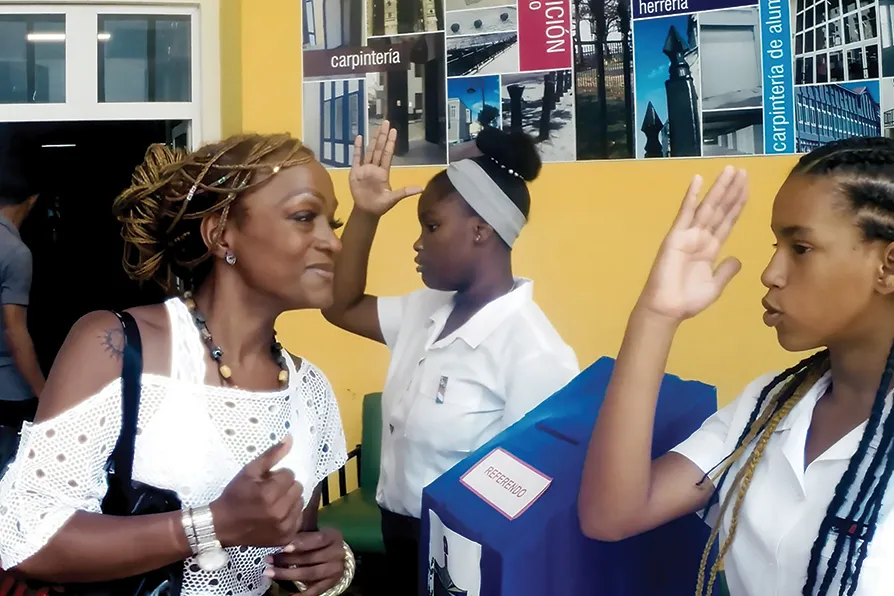 CENESEX (National Center for Sex Education) activist Naomi Ramirez casts her vote in the Family Code referendum, September 2022 / Pic: Courtesy of Speakeasy Pictures
NICK WRIGHT continues his series analysing the trends in European politics
We have the alternative economics, histories of our struggles and the confidence to change the world
General Federation of Trade Unions assistant general secretary HENRY FOWLER reports on the final day from the GFTU’s residential Summer School at the Workers’ Retreat, Quorn Grange Hotel
Capitalism has exploited — and polluted — our natural resources for too long, it’s time we treated our rivers as living beings, writes MIRIUM GAUNTLETT, LIAM SHAW and ROX MIDDLETON
Treating the Clacton by-election as a joke risks reinforcing the Reform leader’s claim to be the victim of an out-of-touch Establishment, argues JOHN McINALLY
MPs and others called for the urgent release of tortured Palestinian doctor, Hussam Abu Safiya, held hostage by Israel and reportedly near death, reports LINDA PENTZ GUNTER


IN 2019, after a new constitution was approved by an overwhelming majority public vote, the Cuban government legalised independent international co-production for the first time. In 2022 I took two cameras to the island to explore the political debate around another referendum: this time for a new Family Code.
To allow international co-production meant that I could just give a camera to a black Cuban film-maker, Hugo Rivalta, whom I had met at Havana Glasgow Film Festival and, in turn, he trusted me to edit the footage.
In itself, this was a remarkable step forward: for the previous 60 years, and in the knowledge of a relentless campaign to denigrate the revolution, it was essential to control and supervise the way Cuba’s culture was represented. But now new international partnerships were welcome, and they trusted me.
The days leading up to the referendum were highly charged throughout the island. Rivalta focused on political events and encounters in Havana in support of the code, and I took the temperature among ordinary people as we made a tour from Vinales in the west to Trinidad on the south coast.
The background is important: a clause proposing marriage equality for LGBTQ people had been part of the 2019 constitution, but it proved so controversial that it threatened to scupper the whole vote, and the government withdrew it.
This indicated an urgent social issue — of widespread social prejudice and a culture of discrimination — that needed to be addressed more thoroughly.
The socialist approach — refreshingly different from the one you find in capitalist democracies — was not to focus on a single issue (gay marriage) but to propose a comprehensive new settlement.
Heterosexual patriarchy clung to the family as the location of its entitlement; the revolutionary solution was to take the revolution into the family itself, and to change it.
The family is obviously an essential unit within society. When consenting adults make relationships they do essential work of significant social benefit. They look after one another, and others: children, the elderly and those needing care.
But within the patriarchal heteronormative family there is an immense potential for abuse. So, could that structure be dismantled, could the family be reimagined, and would the people agree?
This is a challenge that is shared throughout the world, and with the Family Code the Cubans pioneered a radical solution, that was developed through over 80,000 public consultations in 2022, wherein 50 per cent of the code itself was amended.
Although a complex and detailed piece of legislation, the Family Code rests on three major pillars.
One restates the classic socialist position, common to the family codes of the USSR, namely: wage equality. Family work (raising kids, cooking, cleaning, caring) is essential social labour with a social wage. Not a benefit, but a wage.
The other two were radical. First, the code gives all children a legal voice. In other words, the child has the legal right to protest against abuse and to be heard, and to leave an abusive family.
At the time, this was the most hotly debated and contentious part of the code, and I met a number of proudly socialist Cuban men who couldn’t stomach such a blow to their domestic authority.
And the other demonstrates a significant evolution in Cuban socialist thinking, namely: to remove all barriers to all and any adult partnerships and, in so doing, to recognise that society encompasses a huge variety of sexual and gender identities. The proposal was to let any partnership have all the rights: to marry, to adopt, to inherit.
This represents the recognition of a new reality after six decades of revolution. Che Guevara’s ideal of the “new socialist man and woman” — the generation of a productive and politically engaged population engineered by the revolution — has evolved after three generations into the confident embrace of many types, replacing the heteronormative straightjacket.
This throws the contemporary character of Cuban socialism into high relief: of course, to be homosexual in no way diminishes your value as a revolutionary; of course, you can be revolutionary first and trans second as Adela Hernandez declared when, in 2012, she was the first openly transgender person to be elected to public office, the municipal council of Caibarien in the Villa Clara Province.
And to put this to public referendum demonstrated a breathtaking confidence that secular, tolerant, and egalitarian values are shared throughout the population, whatever the churches might say. At the time, predictably, Catholic and evangelical Protestant congregations vociferously opposed the code, and this debate took place openly, with public advertising for both sides.
So, there I was, in the presence of a unique referendum on an ethical issue, wherein all the values of the socialist state were at stake. And this at a time when the embargo was causing regular power cuts, and everybody was feeling the squeeze. Given that referendums are an opportunity to vote against the status quo, it was a big risk.
It turned out that 75 per cent of the population voted (low by Cuban standards), and 66 per cent were in favour, meaning that 50 per cent of everyone over 16 voted for it. That might sound like a close call but consider this: such rights have never successfully been put to a popular vote anywhere else in the world.
And — and this is the glory of it — the majority vote is proof that the people are tolerant, and that homophobic, patriarchal and misogynist attitudes are only held by a minority. If you’re a homophobe you’re the minority, and you need to learn. That clarity erases discrimination.
In 2024 the Irish failed, with a less well prepared and less comprehensive proposition. But in 2022 the Cubans succeeded.
So, three questions.
Why is this historic achievement never mentioned when we speak of contemporary Cuba?
Whatever the outcome of the present crisis, it will always be a leading example of how to pass ethical, egalitarian legislation.
Next. Where in the coming Pride month, is the slogan, reviving the spirit of Mark Ashton, Lesbians and Gays Support Cuba?
And last, when the world, including Britain, regularly votes against the illegal US blockade, where is the practical support from governments — economic, diplomatic and military — when Cuba faces existential threat?
Where is the defence coalition? Why is Ramaphosa silent, when South Africa owes Cuba the debt of Cuito Cuanavale?
Is anyone at all — Corbyn, Lula, Rodriguez, Terrance Drew (St Kitts and Nevis), Mia Mottley (Barbados), Irfaan Ali (Guyana), Roosevelt Skerrit (Dominica), Melanchon, Xi, Mark Carney, Wagenknecht, To Lam (Vietnam), Ibrahim Traore (Burkina Faso) or the other Sahel revolutionary leaders — is anyone ready to put themselves in the line of fire and call the world from Havana?
Angus Reid’s film A Week In The Sun is available to watch, to screen and to share on YouTube.
