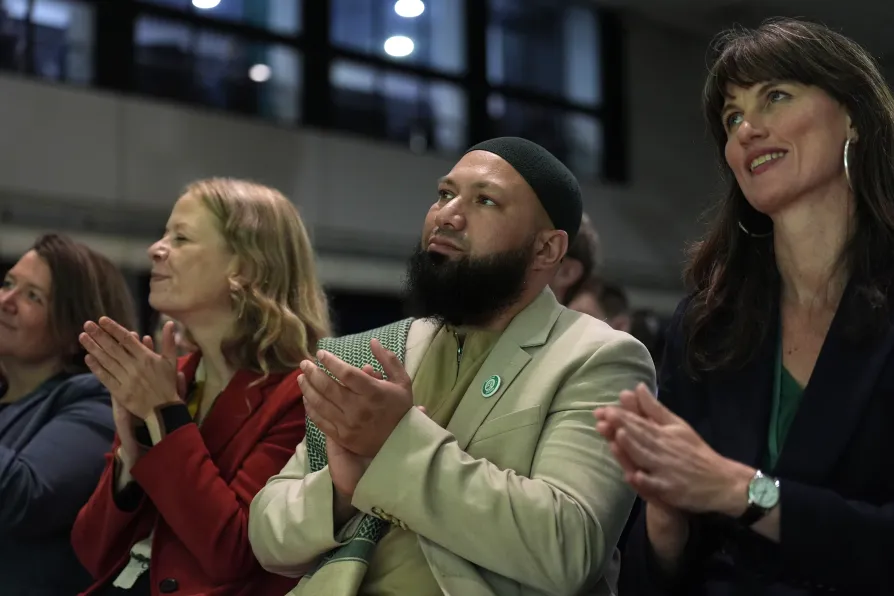
Green Party deputy leader MOTHIN ALI, who will speak at the International Anti-War Conference in London on June 20, says Britain needs to rethink its priorities – and its allies


 Latest editorial
Confronting the myth of Scotland's clean record on racism
Despite the reassuring fancy that Scots are free of prejudice compared to the English, Scotland has much modern racism to tackle, argues GORDON McKAY
 Scottish National Font endorsed Donald Trump’s presidential campaign in front of his golf course in 2016
From Global Counsel to Arden, SOLOMON HUGHES finds firms linked to discredited politicians are still calling the shots in Britain
KEVIN COURTNEY explains why Reform UK is no friend to workers or trade unions, but just another party of the super-rich
EMMA DENT COAD explains why she is stepping down from the council after 20 years and how the legacy of the fire still haunts the area
While international attention focuses on ceasefire frameworks, Israel is openly advancing plans for a permanent expansion of its control over Gaza, writes RAMZY BAROUD
Researchers PAUL HOLDEN and JESSICA MURRAY are calling for whistleblowers and documentary records to uncover how Labour Together helped build the parliamentary majority that now dominates the Labour Party


IN 2017 travel publisher Rough Guides issued the result of an online survey declaring Scotland the most welcoming country in the world.
This reflected the words of First Minister Nicola Sturgeon’s statement to the Scottish Parliament that Scotland remains an “open, inclusive, outward-looking nation.” It was the First Minister’s use of the word “remains” that grabbed my attention, the easy acceptance that “we’re a’ Jock Tamson’s bairns” and always had been.
I fell into conversation this week with a colleague over the word “remains” and was told he agreed with Ms Sturgeon, that Scotland had always been more welcoming and accepting to immigrant communities. I am guessing he quickly saw I was about to raise the issue of Irish immigration, as with only the minutest of pauses he said “I am not talking about Ireland.” Even as I write I still do not understand why Irish immigration is somehow “different” but I asked what made him think that historically Scotland was different from the rest of the UK?
His response was to describe events of our own lifetime. The high media profile and electoral surges of far-right political parties in England in the 1970s and ’80s, the vile racist abuse that sporting figures, particularly footballers such as Chelsea’s Paul Canoville, had received, and evidence of institutional racism in public bodies such as the Metropolitan Police – none of these, he said, had parallels in Scotland. I had been wondering where my colleague had been going with his argument, as when he reached his concluding sentence I was waiting for the ironic raise of the eyebrows which didn’t come.

Similar stories
Gisele Pelicot said ‘shame must change sides.’ We may think we agree, but, argues LOUISE RAW, society still has some way to go
Susan Galloway talks to ASH REGAN MSP about her “Unbuyable” Bill, seeking to tackle the commercial sexual exploitation of women in Scotland