A new generation of right-wing politicians have shifted from promoting deregulation to championing anti-migrant politics warns SOLOMON HUGHES


 Latest editorial

The far right turns crime into culture war
As protests erupt over Henry Nowak’s murder, ANDREW MURRAY argues that anger is being exploited to advance a wider racist and anti-immigration agenda
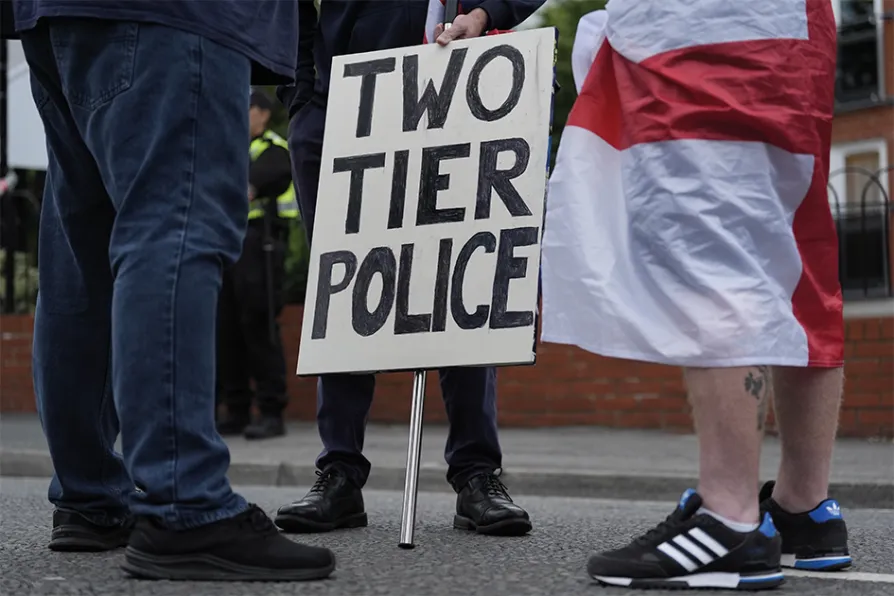 A protester holds a placard outside Portswood Police station in Southampton, Hampshire, during a protest following the death of 18-year-old student Henry Nowak
by the Greater Manchester Workers’ and Tenants’ Association
The US relationship with Israel has evolved into a strategic liability, argues RAMZY BAROUD
A champion motorcyclist, trade union organiser and communist, Clem Beckett went from Britain’s speedway tracks to the battlefields of Spain, where he gave his life resisting Franco’s forces at Jarama. GEOFF BOTTOMS pays tribute to this remarkable anti-fascist
The greatest threat to democracy may no longer come from political parties but from unelected tech oligarchs like Peter Thiel and his powerful Silicon Valley network, argues JOHN GREEN
Claiming to ease a fertiliser shortage, the Trump administration has suspended tariffs on Moroccan phosphate imports – deepening US support for the Morocco’s control over Sahrawi territory, writes LUKE ROTELLO


WHAT do those protesting long and loud about the police handling of Henry Nowak’s murder actually want?
After all, the murderer, Vickrum Digwa, has now been convicted and will serve more than 20 years in prison. The very evident failings in the police response, in particular their unwillingness to accept that Nowak had been stabbed and act appropriately, is rightly being probed.
Already one of the officers involved has apparently left the force. It would not seem that the wheels of justice have gone too far off the rails here, even if the constabulary clearly have questions to answer, as so often the case.
Digwa committed a terrible crime. It had nothing whatever to do with the Sikh religion, nor was the ceremonial sword Sikhism encourages its adherents to carry the murder weapon.
Thomas Hamilton committed an even worse crime when he killed 16 children and their teacher at Dunblane in 1996. The sensible response was tighter gun laws, not the demonisation of white Scottish men.
Does anyone now recall the name of Michael Ryan? He shot and killed 16 people in Hungerford in 1987. The upshot was, again, new gun laws as well as issues around police staffing and mental health. Young white men, as a category, were not blamed.
Derrick Bird, anyone? He murdered 12 people in Cumbria in 2010 — some were targeted, most random. Again, the focus was largely on Bird’s mental health, not his ethnicity or sex, although the latter seems a relevant consideration in all these cases and more.
None of these episodes led to rioting. Punditry focused on the perpetrator as an individual, not a type. Apart from the relatively uncontroversial issue of gun control no political mileage was found in these awful crimes.
So what is the demand today?
It seems to be this: that people complaining of racial abuse or assault to the police should not be believed. The assumption must be that they are making it up, perhaps to cover up their own crimes — like Digwa, who compounded his murder with mendacity.
When arriving at a crime scene, if in doubt arrest the black person. Such was one of the principles guiding Britain’s multi-tiered policing for generations — different rules for white and black, rich and poor, employer and trade unionist — still by no means discarded.
That is the golden era Reform, Restore, GB News and the Telegraph would return us too before the “woke” serpent poisoned their Eden.
And by their friends they should be known — you could have played dictator-wannabe bingo in Southampton on Wednesday evening.
There was Tommy Robinson, of course. And Laurence Fox (Reclaim Party), Paul Golding (Britain First) and Nick Tenconi (Ukip), all acting in the spirit of Ledru-Rollin who supposedly said during the French revolution of 1848: “There go the people. I must follow them for I am their leader.”
They all have an eye for the main chance, and this was too good to miss — a young white man killed by a non-white assailant.
As with Axel Rudakubana, the murderer of three young girls in Southport in 2024, this therefore plays into a crude racist narrative, in which white women and children need permanent protection from predatory ethnic minorities.
Disobligingly, neither Digwa nor Rudakubana proved to be Muslim, which would have hit the ethno-nationalist jackpot. Not that this would matter to the likes of John Ashby, who raped a Sikh woman in her own home in the Midlands on the misapprehension that his victim was Muslim.
Ashby is another case from which no right-wing commentator has drawn any sweeping conclusions whatsoever, despite several immediately coming to mind.
Nor has his crime caught the attention of the Trump administration, which has weighed in over Nowak’s killing. An official State Department statement blamed “two-tier policing” while Vice-President JD Vance pointed the finger at mass immigration.
Trump and his acolytes are the main driving force behind neofascism internationally. Alas for them, they are also unpopular even among European nativists, mainly on account of their destructive wars.
At any event, no-one was chanting Trump’s name in Southampton. Or Nigel Farage’s come to that. Rupert Lowe, once chairman of the football club thereabouts, now the leader of Restore, was the apparent idol of the lynch-mob as they surged towards the home of the Digwa family.
Lowe has not disappointed them. Restore would “put to death” Digwa, he announced. It is already committed to the deportation of millions of legally resident ethnic minorities, including those having the temerity to live in social housing.
And he has put the wind up Farage. As in the Southport case, the Reform leader noisily lights the blue touch paper and then retires from view, his arsonist work accomplished, while everything kicks off.
As others have pointed out, Farage was only a voice for calm when the victim was Sarah Everard, cruelly murdered by a police officer. Then he was an advocate of the “one bad apple” approach to police violence in a case where the cop was the killer rather than merely a bungling post-hoc accessory.
Nor has he weighed in on the interesting fact that one in five of those arrested in the 2024 riots, doughty fighters for “our women and children,” have since been reported for domestic abuse.
They purportedly wish to spare their families the very remote danger of being attacked by a stranger on the street the better to preserve them for the very real and intimate likelihood of violence in the home once their man gets back from trying to set fire to a migrant hostel.
In both cases he will most surely be in the grip of the “cold pure rage” Farage enjoined his followers to embrace.
A further point of interest from Southampton — the protesters were chanting “no justice, no peace; racist police off our streets.” Whether they were consciously mimicking innumerable anti-racist protests or simply co-opting slogans with which they would have had a familiarity can’t be asserted.
But if social disintegration finds different targets according to political or class perspective, it also finds the same ones too on occasion.
The alienation from the state, from public power, is pervasive. The controversy turns on what that power is understood to serve — a liberal elite or a capitalist class?
Here is a clue — Standard Chartered chief executive Bill Winters announced last month that his bank was cutting nearly 8,000 jobs through the deployment of AI.
This he described as “not cost-cutting. It’s replacing in some cases lower-value human capital with the financial capital and the investment capital we’re putting in.”
Does the public power in Britain serve the finance capital of Mr Winters or the interests of the “lower value human capital” he can do without? We know the answer and those rioting in Southampton probably intuit at some level that Winters is talking about them.
The actual function of the Robinsons, the Farages and the Lowes is to keep them in a lather about Sikh ceremonial swords instead. It is not a new trick, and it is no surprise that tech and crypto-billionaires turn out to be funding it, nor that Tony Blair is to be found endorsing it.
Despising Keir Starmer is also common ground. The premier deploys as a shield the appeals for calm and unity from Nowak’s dignified family, using their suffering as a stand-in for substantive political argument — don’t be divisive, because the family don’t want you to be.
Who can tell what Starmer would have said had the Nowaks been more vengeful and less conciliatory?
The Prime Minister has, in any case, long since lost the audience. His pious admonishments go mostly unheard. But at least the post-McSweeney penny appears to be dropping — the hard right threatens democracy and the Trump administration is not his friend.
It will fall to Starmer’s successor to turn these belated insights into a new political strategy for the Labour government, presently in a state of stasis extraordinary when one recalls its massive parliamentary majority is less than two years old.
Waiting for Andy Burnham is, on all available evidence, not much of a plan. Giving practical concrete expression to the fighting united front against austerity, racism and war and for democracy is the class answer.
It may never stop random violent crime on the streets entirely, but it will block the way to those for whom state violence is a system and a fetish and are making the running right now.
