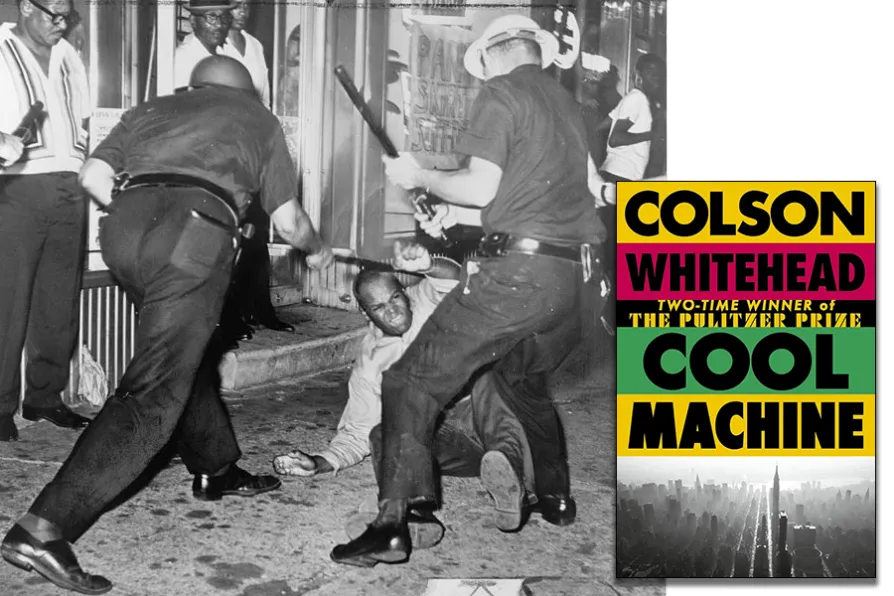
DOUGLAS FIELD relishes the hard-boiled language, satire and humour of the third and last of the Harlem trilogy


 Latest editorial
Class war games - a proposition for TUC training
Is this the way to rehearse industrial relations? SCOTT ALSWORTH immerses himself in a roleplay game that is being offered as an education tool to unions
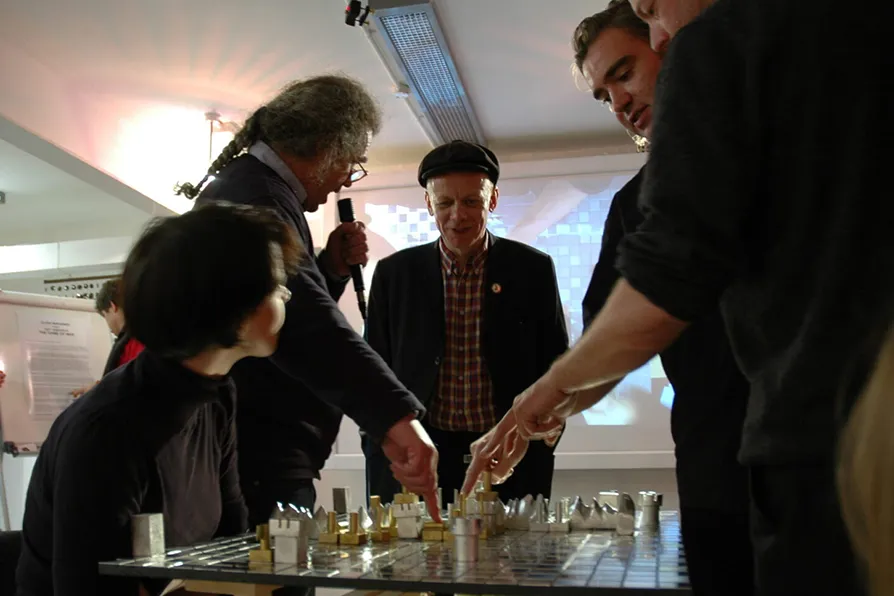 A Class Wargames session in progress [Pic: Courtesy of Classwargames.net]
STEPHANIE BROWN draws attention to the hidden labour of the female embroiderers, and how a 19th century replica made no such error
MIK SABIERS revels in a band that ploughs an idiosyncratic furrow of expletive laden, guitar-driven alt rock
ANDY HEDGECOCK, MARIA DUARTE and ANGUS REID review Synthetic Sincerity, Our Hero, Balthazar, Heartstopper Forever, and A Year In London
The bard invites readers to a gig, raps for Clacton, and lays out the Burnham-Hurzeler conundrum
RON JACOBS recommends an important book that enhances the oppositional theories put forth by Fanon and, in doing so, remakes psychology itself


IN the basement of a community hall, somewhere in Walworth, London, the CEO of RenewBlades is fixing me with a cold, hard stare.
“On your head be it,” he says, dismissively.
“On my head be it.”
The negotiations are over. I’ve just declared strike action. I stand up and leave without a handshake. If there were a door to his office, I’d have slammed it. Instead, I leave the table, the two chairs, and a jesting Pilate, pretending to busy himself with papers on his desk.
I worry I’ve made a miscalculation. RenewBlades, a producer of wind turbines and an anchor company in the Welsh town of Trefhywl, is apparently in financial distress. Gig workers have been fired, wages have been withheld, and pay cuts are about to be announced. But I’m suspicious. I don’t believe the numbers. Bosses can make their profit and loss sheets do anything. I’ve seen it before, and this time, I’ve called it.
In a vegan cafe, I check in with an official from another union, handling logistics for RenewBlades. If they’ll stand with us, it’s possible we could end things quickly. The company relies on its overseas shipments. Solidarity here might give us extra leverage. Yet, would that be against the rules? Thatcher criminalised sympathy strikes, but if two unions share the same employer, is it still illegal?
There’s a slow clapping of hands and I’m back in a room full of strangers. The effect’s probably similar to waking up after being hypnotised at a party. But even if I’m feeling sheepish, no-one’s noticed. Everyone’s too focused on reading the next chapter of the narrative — what the designers at Class Wargames call “injections.” Across from me, the CEO, actually a young woman, playing her part spectacularly, is laughing, momentarily breaking character.
“Form a picket line, then!” shouts the group’s co-founder, Richard Barbrook. It’s obvious he’s enjoying the playtest every bit as much as the participants around him.
“This is something you only get with analogue games,” he explains. “People coming together. Learning together. We prefer not to do videogames, we spend far too much time in front of screens as it is.”
I ask him if he considers himself a “ludic subversive,” like it says on the Class Wargames website. He chuckles and confesses the overtures are a little tongue-in-cheek, but assures me his interest in Guy Debord, the French Marxist and celebrated lodestar of the Situationist International, is entirely genuine.
An impromptu history of the movement ensues and Barbrook concludes at a critical juncture: a tabletop wargame conceived by Debord himself to teach dialectics and strategy, Le Jeu de la Guerre. The Game of War. In fact, much of its popularity today can be chalked up to the activists at Class Wargames themselves, who have toured Europe, Asia, and South America, hosting participatory play sessions.
And it’s not just for fun, although, that’s definitely a huge part of it. The idea is to investigate gaming as a metaphor for social relations under repressive neoliberalism, to re-enact the proletarian struggles of the past in ludic form, and to train militants for a “cybernetic” communist revolution.
What’s going on now is less world-shaking, but no less important.
The project has been commissioned by TUC Wales with involvement from Trademark Belfast, an independent social justice organisation, better-known for its anti-sectarian and anti-racist work, and Jarrow Insights, a class-conscious campaign agency, established in 2019 by its digitally savvy Director of Strategy and Development, Danny Scott.
“The long-term goal is to deliver Trefhywl as modular courses,” says Scott. “To take it mainstream. Class Wargames will host sessions and we’ll run others through our Worker Academy — a joint initiative with Trademark Belfast, which any trade union is free to sign up to.
“We want to engage young workers and inspire them to demand political education from their unions. We’re essentially calling on them to treat this as a core activity, rather than an optional extra. For ourselves, if we ignore an emerging demographic, we risk our movement ageing-out. With the far-right on the march, sowing division and hate, we need to offer up a vision, bold alternatives, and accessible education using the language of class.”
Asked whether or not he thinks the game can benefit those in other industries, such as delivery drivers and retail workers, he replies: “What we’re trying to explore are general themes. Experiences that connect to a broader curriculum, to labour organising as a social phenomenon.
“I’m not sure we can instruct union reps for every industry, but there’s valuable lessons we can introduce through play. And these are real lessons, based on actual case studies. For example, Unite workers fighting for their jobs at Rolls-Royce.”
“It’s a ‘serious’ game,” adds James Moulding, another member of the Class Wargames collective. “You might be more familiar with the term ‘megagames’? That’s Trefhywl’s roleplay, with flexible rules.
“Together with Jarrow Insights, we’re trying to encourage workers to problem-solve and rehearse disputes that might arise in the workplace. To better understand their employment rights, to see things from different sides, and gain confidence should there be a need for direct action.”
While sceptical at first, I’m convinced by the final turn. The method’s effective. Almost embarrassingly so — at certain moments I felt actual anger and trepidation. To the point I had to stop myself from apologising as everyone filed out to the pub.
I’m not too sure what happened, or how I got quite so lost in my role, but I’m certain there’s potential in what Class Wargames are up to. As Debord would have it: “Play, radically broken from a confined ludic time and space, must invade the whole of life.”
Class Wargames is on display as part of Play Power at the Sainsbury Centre, University of East Anglia, until October 4. For more information see: sainsburycentre.ac.uk
Class Wargames can be contacted at classwargames.net
