The social base of the old Tory Party has disappeared as surely as that of Labour, argues ANDREW MURRAY – today’s right are the debased offspring of a capitalism that speculates without investing and profits without producing


 Latest editorial
Universities are neglected – but defence spending is booming
Thousands of jobs are at risk across higher education, yet government funding appears only when universities can be linked to military objectives, says JO GRADY, in the run-up to the Stop the War International Conference this Saturday
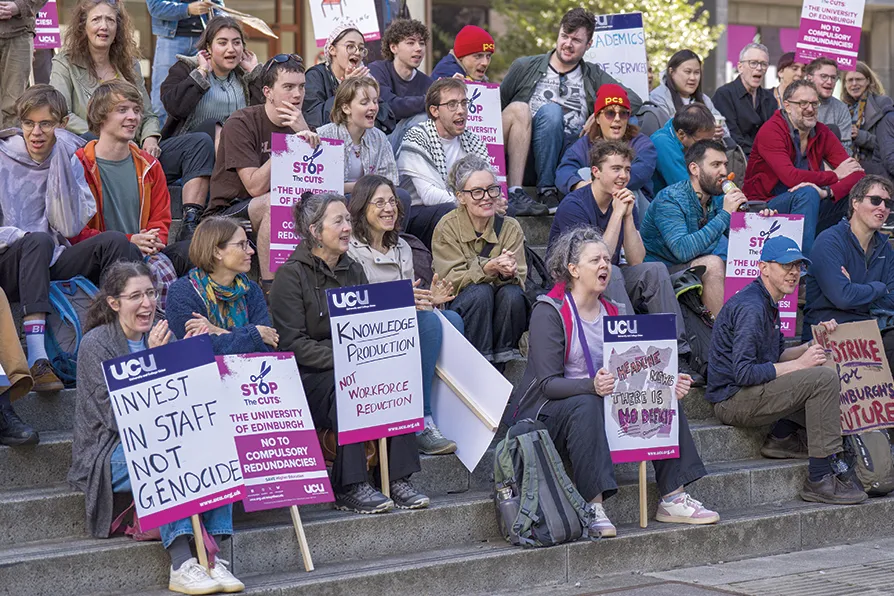 UCU members at Edinburgh University on a five-day walk-out in a dispute over plans to cut £140 million from the university budget, September 2025

SEVIM DAGDELEN says European Nato states are escalating ever closer to direct conflict with a nuclear power, and sacrificing welfare states built up over a century to finance it
KENNY MacASKILL says the lines between party, government and Civil Service in Scotland have been blurred and we need a thorough investigation into how
IAN SINCLAIR examines the curious memory lapses across liberal media when it comes to British government crimes
STEPHEN ARNELL looks at some of the notorious political corruption cases from British history
ENRIQUE SANTIAGO ROMERO says the Colombian far-right’s election victory is deeply suspect — and the United States has its fingerprints all over it
History suggests apartheid ends not through appeals to conscience alone but through sustained economic and political pressure, says HUGH LANNING


BRITAIN is in a state of disrepair, with no sign yet of the decade of national renewal we were promised by Labour.
Our public services were wrecked by austerity and rebuild has not yet begun. Major national infrastructure projects like high-speed rail, completed like clockwork elsewhere, here are a (non) running joke.
And workers continue to pay the price of our national malaise, with living standards squeezed as the wealthy keep getting wealthier. The future, in other words, seems increasingly bleak.
Our higher education sector crystallises many of these grim trends. Universities don’t only enrich the whole of society and anchor many communities economically — they are also this country’s last truly world-leading asset.
But with the way things are going, they won’t be for much longer.
The sector is facing its worst-ever crisis, with tens of thousands of jobs at risk, departments disappearing at institutions like the University of Sheffield and the University of Nottingham, and academic jobs as we know them looking like they will cease to exist at all save for a tiny handful of elite universities.
As with other exemplars of national decline, Labour is steadfastly refusing to act to deal with this crisis.
In washing their hands of responsibility for the higher education disaster, the government has for all intents and purposes adopted a policy of approving the disintegration of our great universities.
It seems, however, that there is one way to get the government to cough up cash. Take a sector such as higher education whose struggles have otherwise been concertedly ignored and associate it somehow with the supposed bolstering of “defence” or the satisfaction of demands from warmongering generals and Ministry of Defence officials. Then, then the coffers open.
This explains how, last week, Labour suddenly found money to invest in higher education. Not to save existing jobs. Not to financially stabilise some of our leading universities. Not as part of a plan to stop the sector sliding from world-leading status to second-rate.
No, tens of millions is to be handed to select universities to “strengthen [the] UK defence industry.”
It’s a perfect illustration of why we in UCU, joined by NEU, CWU, FBU, Aslef, TSSA, PCS, Equity, BFAWU and POA, launched the Wages not Weapons campaign last year: there’s never money for us, but there’s always money to be found for sabre-rattling.
In September, we moved to overturn the TUC’s position of support for “immediate increases in defence spending” and to assert that our movement’s priority is wages and welfare, not weapons and war. A decisive majority of delegates to TUC Congress, representing millions of workers, backed us.
That was a huge moment for the trade union movement, putting us back on the right side of history and sending a signal that will defend the interests of the working class as a whole.
Unfortunately, the debate on so-called defence spending in Westminster has only gotten worse since then. It is, really, a non-debate driven by a whole series of unchallenged assumptions, foremost among them that increasing such spending to a percentage of GDP arbitrarily set by Donald Trump is the right thing to do.
There are many important differences between Andy Burnham and Wes Streeting, for example, but here neither depart from the underlying logic. When it comes to fulfilling the demands of the arms industry and the military, the questions asked are always “how and when,” never “why or really?”
That’s why we are carrying the Wages not Weapons campaign on throughout this year — amid the Labour leadership debate and in the run-up to TUC Congress and party conference season 2026.
With war hawks happy for ordinary people to suffer so long as they can play tough with Russia and China dominating the national conversation, it is more urgent than ever for the trade union movement to stand tall and defend our interests.
I’m excited to be speaking at the International Anti-War Conference in London on Saturday, where I will use my speech to lay out some more of the Wages not Weapons campaign’s arguments.
There are two things I believe it is especially important our movement gets across: that military spending today weakens Britain rather than strengthening it, and that “defence” is a rather strange thing to be talking about given the state of things.
It is clearly extreme self-sabotage, for instance, to be buying aircraft carriers while the country and its most important institutions crumble around us.
It boils down to this: what exactly are we defending? Surely the top priority should be making Britain — from tip to toe — a place in which people can afford, and enjoy, to live. We need to focus on rebuilding something worth defending.
Jo Grady is the general secretary of the University and College Union (UCU).
The Stop the War International Conference takes place at Central Hall Westminster, Storey’s Gate, London SW1H 9NH on Saturday June 20. For more information and to book tickets visit stopwar.org.uk.
