IAN LAVERY MP warns that decades of neoliberal policies have left former industrial communities behind — but a renewed Labour commitment to working people could change the political landscape


The labour movement must have the courage to stand up for women’s rights
Despite forming most of Britain’s trade union membership, women continue to endure harassment, inequality and minimal support for their sex-based rights, warns VALERIE COULTAS
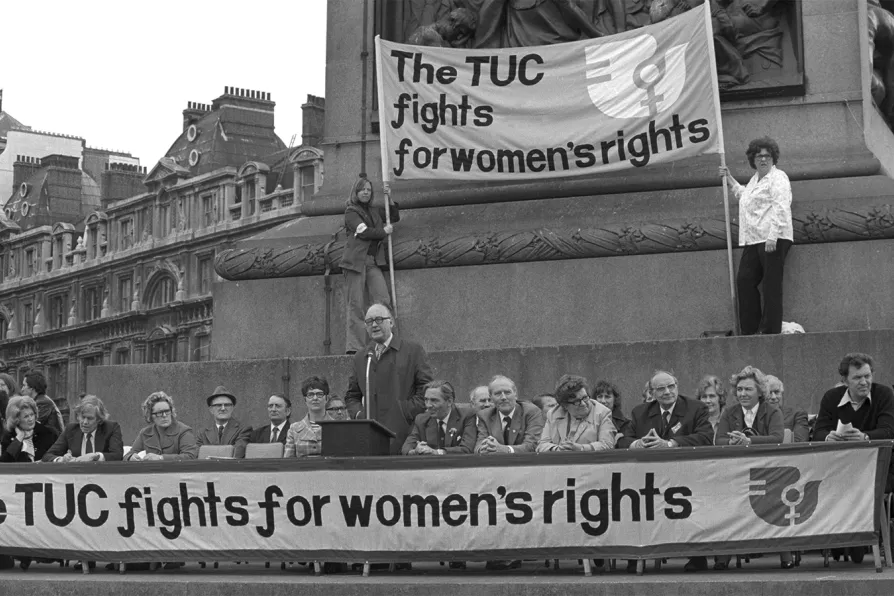
 The Trades Union Congress hold a rally in Trafalgar Square, London, in support of International Women's Year. The demonstration followed a march by about 6,000 people, mainly women, 1975
PAOLO SANTALUCIA reports on how an Italian region defies US pressure to end a Cuban doctors programme
HENRY FOWLER outlines the GFTU’s new 2026-27 education programme and argues that investing in trade union education is essential to building worker power, developing leaders and strengthening collective action
We need a government that invests in saving lives not destroying them, argues SOPHIE BOLT
More expensive by weight than gold, saffron is surprisingly simple to grow. MAT COWARD explains
The public inquiry is the result of more than a decade of determined campaigning. Now, those who fought for justice want the full story of government involvement and police conduct to be told, says KATE FLANNERY
The Durham Miners’ Gala is a celebration of working-class culture, but also a call to action — to rebuild workers’ collective strength, says KIM JOHNSON MP


OF THE 6.4 million employees who are trade union members in the UK, 3.7 million are female. This makes women the majority of trade unionists in Britain today.
However, according to Maternity Action, 77 per cent of women suffered negative experiences due to being pregnant or taking maternity leave. In a 2023 TUC poll of over 1,000 women, 60 per cent said they had experienced sexual harassment, bullying or verbal abuse from men at work.
Women also suffer from male violence in domestic settings and on the streets. Racist attacks by the far right combine sexism and racism, for example by harassing and attacking women in Muslim communities who wear head scarves or full body coverings.
In Israel’s war on Gaza we also see deliberate attacks on Palestinian women and children because the right-wing Israeli government is particularly afraid of the reproductive powers of Palestinian women and is happy to commit femicide as part of its ethnic cleansing project in Gaza.
Many of the demands of the women’s liberation movement are yet to be fully established. The right to control our own bodies was a key demand. Abortion rights are formally established in Britain but in the US they are under threat and we now see anti-abortionist zealots outside abortion and healthcare clinics harassing women with offensive literature.
Nursery care has gradually become privatised and is often extremely costly for all parents with young children. In fact it has become so expensive that one parent, often the woman, will opt to give up their job to look after the children without remuneration.
This means that aspects of ordinary women’s lives are therefore becoming more burdensome and single parents will be experiencing even greater difficulties. The attachment of all the main parties to neoliberal economics have persistently eroded the welfare state principles that attempted to provide care throughout people’s lives.
But unfortunately, although there are many women in the trade unions, women’s rights and women’s voices seem to be less of a priority than they were in earlier times. The unions do not seem to be as concerned with defending women’s sex-based rights as they should be.
The right for women to control their own bodies is a sex-based right. The right to have state provision for childcare is a sex-based right. The right to have maternity leave without having negative experiences at work is a sex-based right. The right to walk freely in the streets, the workplace or live in your home without being harassed or abused is also a sex-based right, as women are often the targets of male violence.
The unions should prioritise these issues, but over the recent period we have not seen these issues prioritised as much as they should be.
And, appallingly, even large sections of the left and socialist movements seem to wish to prioritise trans rights over women’s rights rather than try and reconcile them. There are some really shocking examples of women being no platformed and denied the right to express their own opinions on sex-based rights without abuse, accusations of transphobia, attempts to bully women into silence. Obviously there are also those who support trans rights who would not condone this bullying.
But the Green Party and the Scottish National Party have both had purging policies that attempt to silence the dissident voices of women members and representatives who dare to speak up for women’s rights. And although the first Your Party conference in Liverpool was opened by an excellent speech in support of women’s liberation, there were members booing a speaker who, in a later discussion, dared to question why the trans liberation resolution was making a somewhat questionable comparison between the plight of the Palestinians in Gaza and the struggle for trans liberation.
There have been rather more accurate comparisons made between the attempts to silence critical thinking women today and the terrible struggles of the Suffragettes to get their voices heard on the right to vote. As a reviewer of the book The Women Who Wouldn’t Wheesht, that documents the rise of the women’s movement in Scotland, in the Morning Star points out, “the prices of heresy were high: they were vilified, censored, careers destroyed, ostracised, physically assaulted by young male activists.”
We also find in the trade union and labour movement some instances of women being deplatformed and dismissed as bigoted transphobes needing “re-education” if they try and assert women’s sex-based rights and defend the right of women to fight for their access to safe spaces and dignity.
However, as a result of the valiant struggles of the Scottish women, the Supreme Court has confirmed that the word “sex” means biological sex in the Equality Act 2010. This law is backed by the public and allows for the lawful provision of single-sex spaces in some contexts such as hospital wards, refuges, hostels and prisons. The law also protects the rights of trans people, for “gender reassignment” is a protected characteristic in the Act.
Therefore it is clear that there does not have to be a clash between these two oppressed groups as the Equality Act stands against all forms of oppression. Trans people and women should be allies not enemies and the labour movement and socialists should seek to unite these groups, highlighting their common class interests.
But it is only possible to do this if the material biological basis of women’s oppression is fully understood, and this is where political education is really crucial. For you cannot fight for women’s rights effectively if you fail to understand the crucial role that women’s different biology, and their ability to reproduce, plays in their lives.
And particularly the way in which the control and expropriation of women’s reproductive powers coincided with the rise of class societies and the patriarchal family. Women’s reproductive powers are undervalued in all class societies and in contemporary society. Only in exceptional circumstances does society notice the social and economic value of the reproduction of the labour force as in the example of Gaza referred to earlier.
It’s therefore particularly disheartening to see some on the left and in the labour movement also denying the intrinsic relationship between women’s biology and their role in reproduction, dismissing the class basis of women’s oppression and replacing this analysis with a post-modernist inspired notion of gender ideology that rejects the biological realities of sex. And it’s no threat at all to trans rights to accept the class analysis as all socialists will stand up against acts of discrimination against trans-identifying men and women whenever they are directly under attack.
As Simone de Beauvoir’s book title suggests women are still “the second sex” and even today, although formal rights are greater, full equality for women, and particularity working-class women, has yet to be secured. The labour movement has been persuaded successfully to stand up for women’s rights in the past and it has to have the courage to continue to fight for all aspects of women’s rights in the future, even if it’s not such an easy battle on this issue today.
Valerie Coultas is a member of Your Party women’s forum-unofficial and Lambeth Your Party proto branch.
