

 Latest editorial
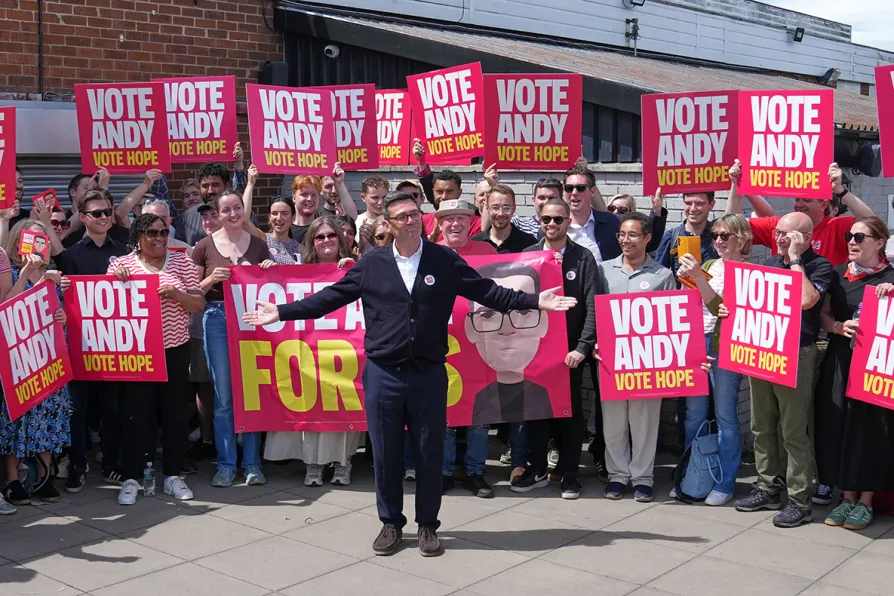 Andy Burnham stands in front of supporters during the by-election in Makerfield, England, June 18, 2026


ANDY BURNHAM is on course to be Prime Minister within a few weeks after Sir Keir Starmer finally bowed to the inevitable and resigned as Labour leader today.
The only other declared contender to succeed the hapless Sir Keir, former health secretary Wes Streeting, announced that he would back Mr Burnham for the job, turning the prospect of a leadership contest into a coronation.
No other figure looks likely to secure sufficient backing — 81 MPs — to contest Mr Burnham.
Sir Keir drew down the curtain on his premiership after a weekend in which he had lost most of his remaining support in the Cabinet and among Labour MPs, despite having vowed as recently as Friday to fight to stay in post.
His departure was broadly welcomed on the left and in the trade unions, despite anxieties as to what a Burnham premiership will be like.
Mr Burnham himself arrived in London by train, fresh from his big victory in the Makerfield by-election, which established him as the only politician popular enough to potentially revive Labour’s fortunes and block the way to a hard-right Reform-led government.
He was introduced to the House of Commons as a new MP, yet looks certain to progress from MP to PM in a matter of weeks, an unprecedented scenario.
The Prime Minister was conspicuously not on hand to welcome Labour’s newest MP, while some unidentified Tory wag drew on Monty Python after calling out that “he’s not the messiah” as Mr Burnham took the oath.
Sir Keir, in a typically self-righteous and self-pitying resignation address in Downing Street, indicated he would quit by the end of the parliamentary session in mid-July if there was no requirement for an internal election to choose his successor.
Mean-spirited to the last, he did not miss the opportunity to snipe at his predecessor Jeremy Corbyn who, holding those qualities of honesty and consistency that Sir Keir notably lacked, polled better in both his elections as Labour leader.
Sir Keir, forced out after less than two years in office despite his huge Commons majority, said: “The question being asked now is not who was best placed to change the Labour Party, to take us into power and to begin the vital work of improving lives for millions of people. Those questions have been answered.
“The question my party is asking now is whether I am best placed to lead us into the next general election.
“I have heard the answer of my parliamentary party to that question, and I accept that answer with good grace.
“Every decision I’ve taken has been about putting the country I love first. That is why I will resign as leader of the Labour Party.”
Mr Burnham, for the last nine years mayor of Greater Manchester, immediately made clear he would stand as Labour leader.
He said that Sir Keir’s “decision marks the beginning of a transition and it is important that this process is conducted in an orderly and responsible way.
“I will put myself forward as part of this process. Our priority must be to work together to get the country back to where we all want it to be.
“People want to see progress on economic growth, cost of living, public services, housing and opportunities for the next generation.
“The labour movement has always been at its strongest when it looks forward with confidence and purpose. This is what we will do from here and we will make sure this transition is a positive process of renewal for our party and our country.”
Mr Burnham will become Britain’s seventh Prime Minister in 10 years, an unprecedented whirligig which speaks to the depths of the political and economic crisis he will inherit.
Politics will now enter a curious interregnum with a premier without authority and a successor waiting in the wings whose agenda is enigmatic.
Mr Burnham will have to choose his cabinet, with the main controversy being over his pick as chancellor.
He is known to favour former Labour leader Ed Miliband, who is opposed by Unite the union on account of his opposition, as Energy Secretary, to new drilling in the North Sea.
The likely-to-be-replaced incumbent, Rachel Reeves, was seen out for a jog in Westminster while Sir Keir was making his resignation speech.
Mr Corbyn responded to his successor’s departure by saying: “Keir Starmer could have ended child poverty, homelessness and the grotesque levels of inequality in this country.
“Instead, he abandoned those in need, destroyed our civil liberties and facilitated genocide in Gaza.
“That is how this prime minister will be remembered — and that is the legacy of moral and political bankruptcy he leaves behind. The crises in our society are not going away.
“Neither are we — and we will keep fighting for a more equal, peaceful and dignified society for all.”
The Socialist Campaign Group of left MPs has been debating whether to simply endorse Mr Burnham — it has no possibility of advancing its own candidate — or whether to set out a series of policy issues on which to press the new leader first.
The group’s secretary Richard Burgon said: “Keir Starmer squandered much of the hope people placed in us at the general election that Labour would deliver real change — and opened the door to a Reform government.
“We now need to deliver real Labour values with policies that show we are on the side of ordinary people.”
The other putative successor to Sir Keir, the Blairite Mr Streeting, speedily bowed to the inevitable, angling instead for a key role in Burnham’s team.
He said he was convinced the incoming premier would be receptive to his ideas, which have mainly concerned “progressive capitalism.”
Mr Burnham “is committed to building an inclusive party that draws on the best of our political traditions” and “he can win the fight of our lives against the forces of nationalism,” Mr Streeting said.
Left MP Jon Trickett said that “Keir Starmer has largely squandered Labour’s first two years in power by failing to deliver for working-class people.
“However, Labour still has time to deliver for working-class and hard-pressed families by rupturing with our failed economic and political system,” he said, calling for a wealth tax to fund public services, the return of utilities to public ownership and a repeal of anti-union laws.
