DOUGLAS FIELD relishes the hard-boiled language, satire and humour of the third and last of the Harlem trilogy


 Latest editorial
Understanding Erdogan
BRENT CUTLER welcomes a thoughtful analysis of the Erdogan regime, viewed through the evolving history of a neighbourhood in Istanbul
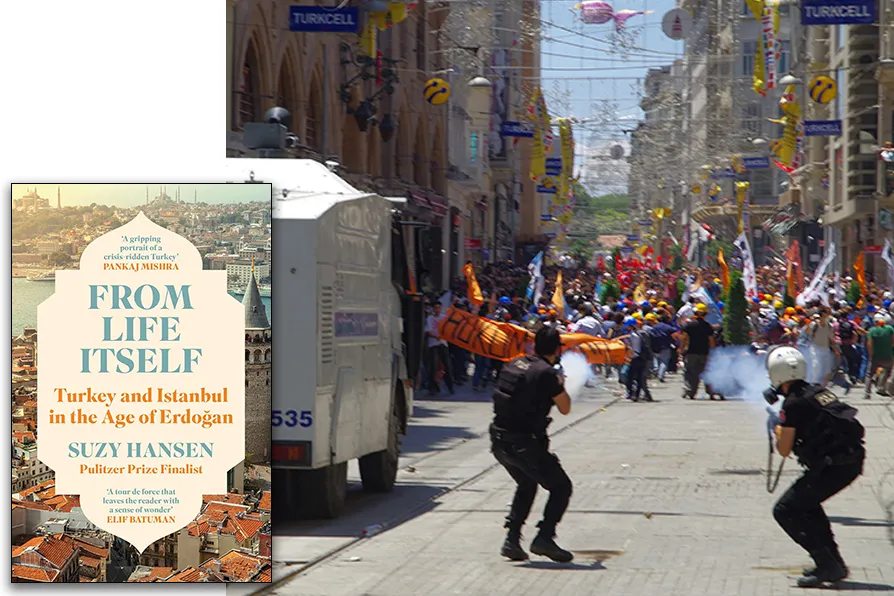 BRUTE FORCE: Tear Gas used on Istiklal Caddesi near Taksim Square, Gezi Park protests, Istanbul, June 2013 [Pic: Alan Hilditch/CC]
STEPHANIE BROWN draws attention to the hidden labour of the female embroiderers, and how a 19th century replica made no such error
MIK SABIERS revels in a band that ploughs an idiosyncratic furrow of expletive laden, guitar-driven alt rock
ANDY HEDGECOCK, MARIA DUARTE and ANGUS REID review Synthetic Sincerity, Our Hero, Balthazar, Heartstopper Forever, and A Year In London
The bard invites readers to a gig, raps for Clacton, and lays out the Burnham-Hurzeler conundrum
RON JACOBS recommends an important book that enhances the oppositional theories put forth by Fanon and, in doing so, remakes psychology itself


From Life Itself – Turkey and Istanbul in the Age of Erdogan
Suzy Hansen, Profile Books, £12.99
RECEL TAYYIP ERDOGAN and his Justice and Development Party (AKP) have dominated Turkey for over 20 years. He became prime minister in 2003 and had been president since 2014. In her book, author Suzy Hansen tells the story of his reign.
The book covers the Erdogan years, mainly through the prism of the Istanbul neighbourhood of Karagumruk and its local Muktar Ismail. A Muktar is a neighbour fixer, whom locals often come to for advice; interestingly Erdogan once referred to himself as Muktar of Turkey.
The author covers the changes to Istanbul over this period, which includes a real-estate boom, which has changed the appearance of the city.
In 2013 Erdogan faced criticism from architects over the destruction of Gezi Park with a view to turning it into a shopping mall in the style of an Ottoman Military barracks. This led to protests sparked by criticism from architects; in typical far-right populist fashion Erdogan claimed to be standing up to elites. Meanwhile the construction boom led to serious imbalances in the Turkish economy, which led to economic problems in 2018.
Early in the book Hansen gives historic reasons for the success of Erdogan and the AKP. In 1955 Istanbul suffered a series of anti-Greek riots, which led to an exodus of Greeks from Istanbul and other Turkish cities. They were replaced by conservative migrants from the countryside, some of whom had a poor understanding of city life. Ismail recalls a new arrival depositing soil on his balcony with a view to planting tomatoes and water pouring into his flat below.
In the proceeding years the descendants of these people established small to medium-sized businesses and became keen supporters of the AK party. Erdogan also created an alliance between Islam and capitalism based around state sponsored construction projects. And during this time, the existence of a highly conservative and religious minded grouping in Turkish cities may have also impeded the growth of the Turkish left.
In the 1960s the left flourished in Turkey as in much of Europe, often among radicalised students. However, this was not as successful among the urban working class, many of whom may also be descended from rural migrants.
The author charts the changes in the nature of the AK party. In its early days it favoured a form of Pan-Islamism, but has now moved toward an aggressive form of Turkish Nationalism with an innate hostility to the Kurds. This can be partly explained by the coalition government that the AKP formed with the far-right National Movement Party (MHP). The MHP supported the establishment of an executive presidency, known as the super-presidency. This further concentrated power in Erdogan’s hands and has allowed him to label even liberal opposition to his regime as terrorism.
The earthquake of 2023 sent shockwaves through Turkish society. It was pointed out that while many of the buildings constructed during his tenure had survived, nevertheless the question was raised concerning the unsafe buildings that were destroyed, especially in a country prone to earthquakes. Considering that Erdogan and his party have been in power for the last two decades, they were responsible. But despite this he was still able to survive and there is even talk of changing the constitution to allow him to remain in office after 2028.
Erdogan’s success may be down to a weak opposition, who engage in politics on his terms, or simply the repressive nature of the Turkish state. Hansen, an American academic, views the world from a liberal perspective, focusing on the subjective experience of individuals. However, this does not mean that her work should be dismissed or ignored.
