US-based labour and social movements authors and organisers Robert Ovetz and James Tracy interview DANIEL GROSS about his new book, Unions of Our Own: Eight Building Blocks to Change Work and the World


 Latest editorial

The divided politics of Europe’s rearmament
The drive to strengthen European defence is reshaping relations between France, Germany, Italy and Britain, says NICK WRIGHT
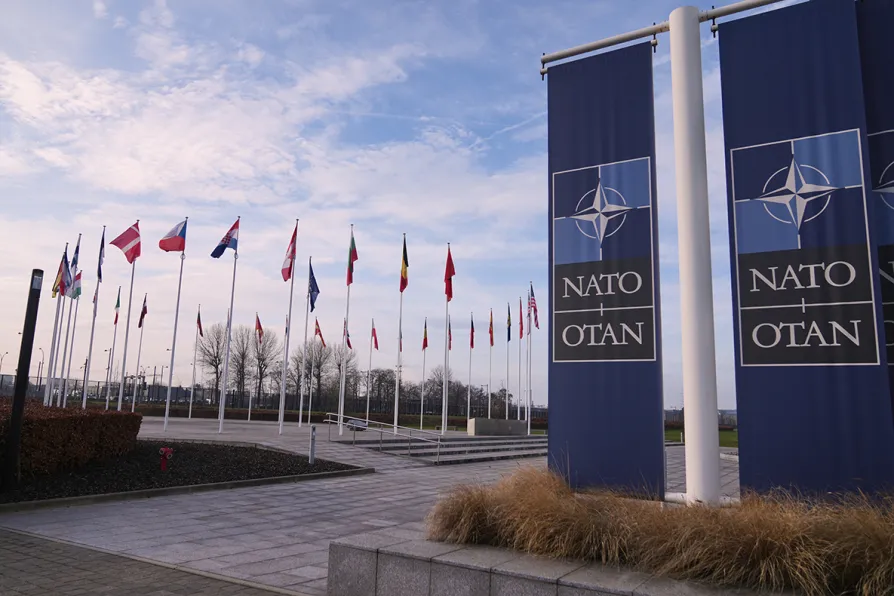 Flags flap in the wind outside Nato headquarters in Brussels, January 19, 2026
JOHN CALLOW introduces the work of Geoffrey Trease, who placed ordinary people at the centre of his historical fiction for children, creating adventurous stories to inspire the possibilities of social change
The Isle of Wight’s Victorian holiday boom drew visitors from across Europe, including the founders of scientific socialism, writes KEITH FLETT
The campaign against the Bank of England’s ongoing theft of Venezuelan gold is gaining support across the labour movement and beyond, writes MATT WILLGRESS
Unless ministers match reform with investment, the profession and the people it serves will continue to bear the cost, says KATE RAMSDEN
Claims that Nicaragua has abolished elections followed a headline that stripped Daniel Ortega’s remarks of their historical and political context. The full speech tells a different story, says BECCA RENK FOSTER


THE path to a full-scale rearmament of the European Union/Nato war-fighting machine is not a smooth process. Britain’s role in this fiesta of profiteering by the big arms and aerospace companies is skewed by two factors.
One is the ever more complicated relationship between a habitually supine British government (of all persuasions) and the Trump regime. The second is the difficulty, within the Labour government, of reconciling a ramped-up arms expenditure with the social spending necessary to recover a chance at forming the next government.
But relations between Germany, the main driver of European rearmament, and Italy and France, both with domestic difficulties in the procurement field similar to Britain, are complicated by the grab for profits that taxpayers throughout the EU and in Britain will be paying for.
Germany and France have fallen out over over a longstanding prestige project to build a new fighter jet. This itself is a factor in the subterranean battle between Europe and the US over which country will supply the fleets of fighter jets that now function in a radically different battle space to the one envisaged before the Ukraine war changed its contours.
I was travelling from Italy to France last week — just as Giorgia Meloni returned from a meeting with France’s President Emmanuel Macron that focused on military matters.
Meloni, having lost a critical constitutional referendum, is somewhat on the back foot, with divisions in her own Fratelli di Italia party and similar stresses in her principal right-wing electoral allies, Lega and Forza Italia.
Repairing her fences with Macron is part of a rebrand. At the beginning of the year she and German Chancellor Friedrich Merz were bidding to put themselves in the leadership of all those European elements who were most committed to repairing the relationship with Trump.
But the US and Israeli attack on Iran runs counter to Meloni’s approach to the situation in west Asia and one of her own measures to appeal to a sceptical Italian electorate is to challenge Trump.
Typically, his crass, misogynistic put-down of Meloni, who rather skilfully mobilises her own version of feminist rhetoric, has aided this reorientation.
France and Italy are committed now to a bilateral programme of military co-operation agreed to last until 2031 and focused on measures to guarantee their joint security interests in the Mediterranean. On the agenda for an immediate exploration are joint efforts to develop a Franco-Italian air defence system and joint production an renewed interceptor missile system.
With a presidential election nearing, Macron is keen to burnish his image which, with his polling figure in the doldrums, is badly in need renovation.
As soon as I crossed the border, my social media feed filled with stuff, clearly heavily promoted, of Macron looking solemn, even tearful, as a French military choir invoked the Chant de la Resistance:
Oh friends, do you hear
workers, peasants, in your
ears alarm bells ringing?
Tonight all our fears will
be turned to tongues of
flame in our blood
singing!
Climb up from the mine,
out from hiding in the
pines, all you comrades.
Take out from the hay all
your guns, your
munitions and your
grenades…
This solemn incantation is heard in the squares of French towns and villages every time the victory over fascism is marked.
Burnishing his Republic credentials is part of Macron’s strategy to gain advantage over France’s own post-fascist formation, Marine Le Pen’s Rassemblement National, thus his invocation of those two sections of the French people — ouvriers et paysans — less likely to heed his neoliberal message
Part of the former National Front’s appeal to workers in regions deindustrialised by the neoliberal economic strategies which membership of the EU has entailed for generations now has been the protection of France’s extensive, and thus expensive, system of pensions and benefits.
Within Rassemblement National the struggle between the old-guard tendency and the new elements around the putative presidential candidate Jordan Bardella is presently centred on the future, under an RA government, of the pension system.
Le Pen opposed Macron’s pension reform but Bardella, who has emerged as a supporter of the the EU’s neoliberal economic regime and markedly less inclined to anti-EU rhetoric than Le Pen, has hinted at support for tightening pension rules to make it more difficult to retire at 67 for many.
French workers can retire from between near 63 or at 64 if they have met the 42 years contribution requirement.
Parti Communiste Francais rejects calls to fall in behind Melenchon
France’s communists argue that replacing class politics with appeals to ‘the people’ weakens the left’s ability to challenge capitalism
ON THE left the French Communist Party (PCF) and the Greens have rejected an “invitation” from Le France Insoumise, Jean-Luc Melenchon’s political vehicle, for a single candidate of the left in the presidential election.
There is an element in the PCF that is willing to submit to a Melenchon candidacy but Fabien Roussel, the party’s general secretary, was able to unite his tendency and much of the party apparatus with various left trends for the party to stand a candidate in its own name in the election.
The PCF allows for differing platforms to be put before congress delegates and presently the leadership carries the endorsement of 61.38 per cent of the delegates.
While this represents a mandate for Roussel, it is a significant drop in support for his platform, which won over 80 per cent at the previous congress.
In France elections are in two stages. The legend has it that in the first round you vote with your heart for the candidate you most agree with; in the second you vote with your head for the candidate with whom you have the fewest disagreements.
Naturally, in the second round there is strong tendency to vote for the strongest left candidate in the spirit, not always universally followed, of Republican unity.
In the recent past a broad front that included La France Insoumise, the PCF, various green and ecological formations and the Parti Socialiste performed impressively in legislative elections.
Melenchon’s hegemonic delusions drive a certain tendency to take allies for granted even when he denigrates them. In the very recent past his approach rendered both the Greens and the PCF invisible in the election campaigning.
In the meantime the Parti Socialiste has broken with Melenchon and possibly even the prospect of co-operation with the left. While this reflects a sense among Socialist Party leaders and members that they have recovered somewhat from their almost complete electoral destruction — and that the possibility of a rapprochement with Melenchon is impossible — it really represents a return to the neoliberal politics of class collaboration that typifies this trend in European politics.
At local level, the configuration of forces produces a different dynamic. There the Parti Socialiste co-operates with other forces, usually although not exclusively, to its left.
The PCF is particularly well organised at the municipal level, with over 100 mayors elected, and exercises an influence greater than their performance at national level might suggest.
But apart from the annoyance at Melenchon’s self-regarding personal style and his high-handed treatment of allies, there are significant policy disagreements with LFI, particularly around energy and industrial policy. With the orientation of a substantial part of the party’s base to trade union politics and the continuing influence of the more Marxist-Leninist tendencies in the party, the drive for an independent presence in the presidential election is compelling.
One of bases of opposition to a complete subordination to LFI lies in the ideological basis of Melenchon’s personal style with its emphasis on “the people” as the decisive actor in the struggle for a new society.
While it has a certain radical appeal, especially to the diverse mass of people drawn to LFI by its oppositional stance, there are substantial ideological problems associated with this kind of politics, typified in recent years by the Syriza debacle in Greece and the unfulfilled promise of of Spain’s Podemos.
One critic put the question thus: “By substituting the people for classes, this conception neutralises the central contradiction between capital and labour. It transforms the structural balance of power into a simple electoral aggregation. However, the history of modern societies shows that the decisive transformations are born of organised class conflicts, and not the arithmetic addition of votes.
“The substitution is not neutral: it shifts the terrain of the struggle from the social field to the institutional field, where the economic balance of power is already largely crystallised.”
It is around the notion that class struggle — at the point of production and in the systems of distribution and public administration; along with the social struggles to defend the social wage, health, social security, education and housing — is decisive that an ideological critique of the limitations of the LFI approach are developed.
The obvious parallels with the British experience where illusions about the transformative power of an electoral victory are built into the thinking of the left — for some, with this power situated in the EU’s institutions; for others, in a parliamentary majority — are obvious. These illusions rest on the assumption that the institutions of the state are ready-made for a government of the left. Liz Truss learnt quickly what Jeremy Corbyn would have confronted if he was not to have been robbed of his victory. Class power does not reside in Parliament.
The bourgeois state and the nominally sovereign institution of political and economic power exist within a structure of economic, social and international determinations that constitute a brake on the exercise of such autonomous power that electoral victory confers.
The state is a site of class struggle and French communists are deeply conscious of the 1981 experience of the governmental Common Programme when PCF ministers were present in Francois Mitterrand’s administration: “…despite a solid political majority and a programme of partial rupture, structural transformations were quickly contained by the constraints of national and international capital.”
