In his fortnightly column MARK SEDDON reflects on the death of Major Oak and why such ancient trees matter to us


 Latest editorial
Forgotten heroes and victims
Historical shame prevents the International Brigades and those Spaniards who supported the Republic from being properly recognised and honoured, writes NOELIA SANCHEZ
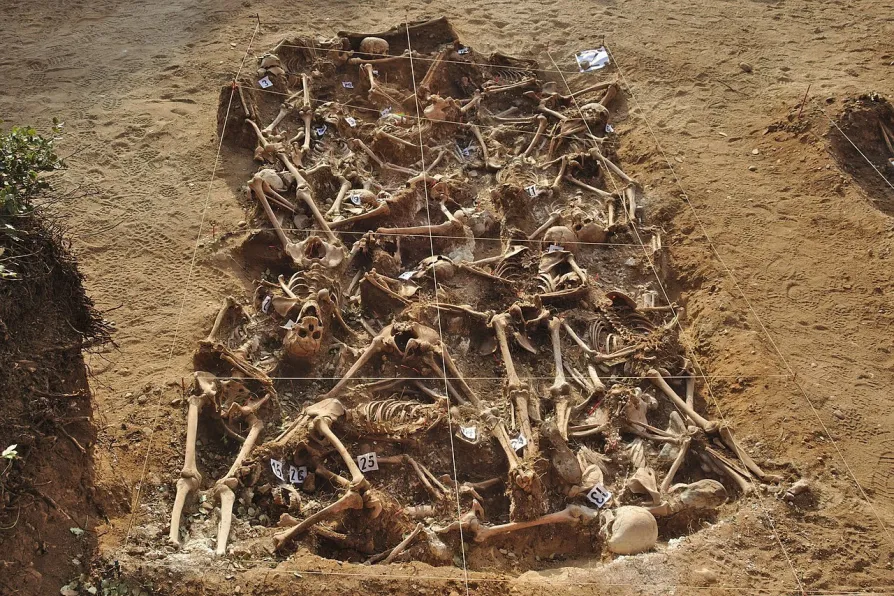 Exhumation of a mass grave of 26 Spanish Republicans killed by the fascists at Estépar, near Burgos. They were among an estimated 2,500 executions carried out in the area [Pic: Mario Modesto Mata /Creative Commons]
The world’s largest communist party marked its 105th birthday this week — and remains true to its principles and firm in its course, says OLIVER VARGAS
The left has become too reliant on persuasion and too detached from the workplaces and communities it seeks to represent, argues NICK TROY
RAMZY BAROUD highlights how Israel’s ambassador sought to shut down UN officials documenting sexual violence and abuses against Palestinians
The US-Israeli conflict with Iran has had far-reaching consequences, including a boost to Pakistan’s regional standing, argues ROGER McKENZIE
The recent heatwaves revealed how ill-prepared Britain remains for a hotter future – and how unequal the ability to cope with it has become, write ROX MIDDLETON, LIAM SHAW and MIRIAM GAUNTLETT
The drive to strengthen European defence is reshaping relations between France, Germany, Italy and Britain, says NICK WRIGHT


ON JULY 18 1936 the Spanish civil war erupted as a consequence of a fascist coup d’etat. The international context of the period was not altogether different from the one we are witnessing today: a profound systemic crisis accompanied by the rise of fascism across Europe.
During the years of the Spanish Republic, however, there was also a powerful atmosphere of social and political transformation — a struggle led by the working class for emancipation, the advancement of women’s rights and the dismantling of the historic privileges held by the landowning oligarchy, the monarchy and the church.
It was precisely these aspirations for social justice and democratic reform that inspired thousands of young people from abroad to leave their homes and come to Spain in defence of those ideals.
If we conceive of the period simply as a confrontation between fascism and Western democracy, it becomes difficult to understand why the International Brigades remain among the great forgotten actors of modern history. Why have they not received the recognition they deserve in their own countries, despite many of those countries having later joined the struggle against fascism during the second world war?
This omission becomes more comprehensible when one considers the role played by the Western powers during the Spanish civil war and, subsequently, throughout Franco’s dictatorship.
The reality is that, despite their opposition to fascism, Western governments did not support the Spanish Republic.
The Republic represented, not merely a parliamentary democracy, but a profound social project aimed at dismantling entrenched systems of privilege — privileges that many of the Western democracies themselves had little interest in challenging. In this sense, the Spanish case exemplifies the paradox that everything must appear to change so that, ultimately, nothing truly changes.
While the Western powers were fighting to free the world from fascism, they were also negotiating with Franco.
Britain did this by agreeing to the withdrawal of Franco’s Blue Division from Eastern Front in exchange for non-intervention in postwar Spain. In order to acquire an ally in Europe, the US ignored the help Franco was giving to Nazis escaping to the US or finding refuge in Spain.
In this historical context, it’s no surprise that both the Brigades and the Republicans murdered during the 40 years of dictatorship are being forgotten — because they are proof of a shameful episode in history.
More recently, through Royal Decree 1022/2025, the Spanish government has established a legal framework enabling the direct acquisition of Spanish nationality by the children and descendants of members of the International Brigades.
This measure represents an important initial step towards acknowledging and honouring those men and women who travelled to Spain in defence of liberty, democracy and social justice during one of the darkest periods of European history. Nevertheless, it should not be regarded as the conclusion of that process of recognition, but rather as its beginning.
It remains imperative that future generations are made fully aware of the events that unfolded in Spain during the civil war and the subsequent dictatorship, and that this history be incorporated rigorously into educational curriculums.
Historical memory constitutes not only an act of justice towards the victims, but also a democratic necessity: societies that fail to confront their past risk allowing its tragedies to re-emerge. Even today, thousands of individuals who were executed during the repression remain buried in unmarked mass graves, deprived not only of life, but also of justice, dignity and public recognition.
Regardless of the efforts made to obscure, minimise or consign these events to oblivion, the crimes committed in Spain constituted a campaign of systematic political extermination. Its consequences continue to demand truth, justice and historical accountability.
Such crimes cannot simply be erased by the passage of time, nor can historical memory be indefinitely suppressed. The PCE Communist Party of Spain will not forget.
We remain committed to ensuring that the memory of the International Brigades and of those who defended the Republic lives on across generations. We will continue this struggle until they receive both the justice denied to them for decades and the rightful place in history they unquestionably deserve.
In our own modest way, the PCE branch in Britain is honouring the memory of the Brigades. We adopted the name of Brigadista and artist Felicia Browne at our 2025 AGM at the Marx Memorial Library in London and are now known as the PCE-GB Felicia Browne Branch. We hope to live up to her name.
Long live the International Brigades! No pasaran!
Noelia Sanchez is a committee member of the PCE-GB Felicia Browne Branch.

Similar stories
![Richard Baxell speaking at the Marx Memorial Library in London [Pic: Karl Weiss]](https://morningstaronline.co.uk/sites/default/files/styles/desktop/public/2026-07/RichardBaxell22Jul23.jpeg.webp?itok=HCh8iPRb)
Driven by anti-fascism and anger at Britain’s policy of non-intervention, thousands volunteered to fight in the Spanish civil war. Historian RICHARD BAXELL reflects on their sacrifices and enduring significance
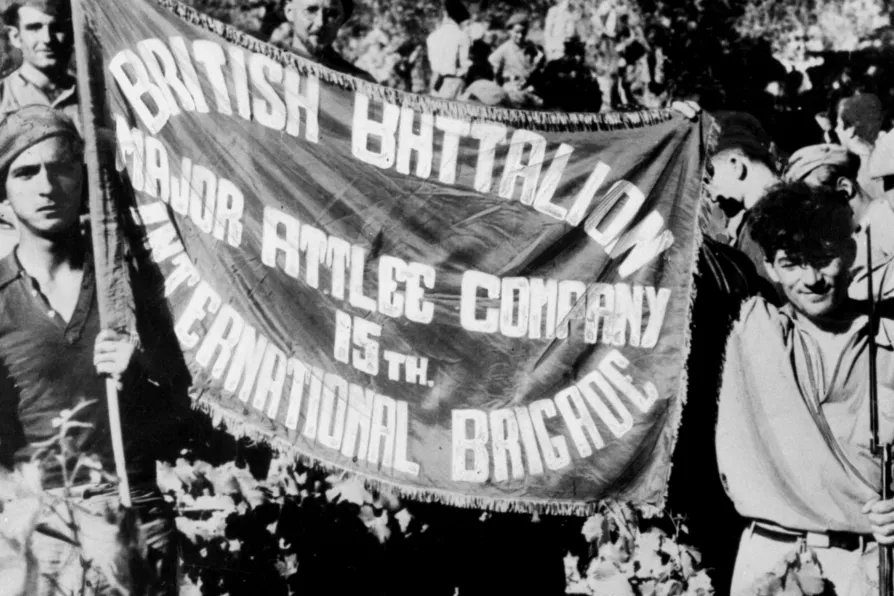
MAXINE PEAKE says the warnings of the International Brigades ring true today
![Harry Pollitt (right) with International Brigade volunteer David Guest, who was killed at the Ebro in July 1938 [Pic: Marx Memorial Library]](https://morningstaronline.co.uk/sites/default/files/styles/desktop/public/2026-07/a-2_a_50b_Harry%20Pollitt_David_Guest.jpg.webp?itok=Ag0u-8n5)
ALEX GORDON applauds the leading role played by Harry Pollitt and the Communist Party in the fight against fascism in Spain and salutes the memory of the International Brigades
![Meirian Jump with MML archivist Matt Dunne [Pic: Marx Memorial Library]](https://morningstaronline.co.uk/sites/default/files/styles/desktop/public/2026-07/image.png.webp?itok=EO4HHX_7)
The Marx Memorial Library’s Spanish Collection remains a powerful tool for the working-class movement today, writes MML director MEIRIAN JUMP