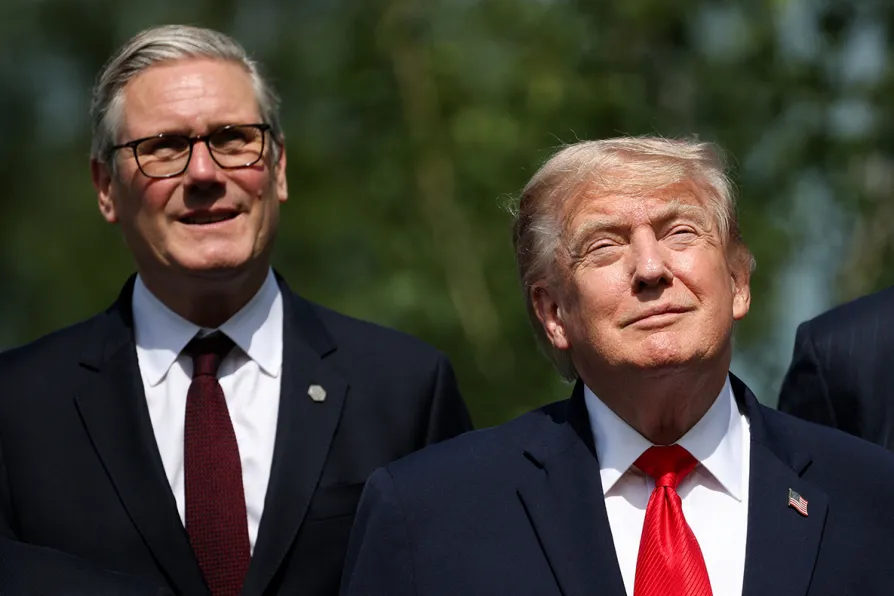
 Prime Minister Sir Keir Starmer (left) and U.S. President Donald Trump pose for a family photo during the G7 summit in Evian, France, June 16, 2026



BRITAIN will lose about £600 million in tax each year due to a US exemption from a landmark international tax commitment, the public accounts committee (PAC) said today.
It confirmed HMRC estimates that exempting large US multinationals from the minimum effective corporate tax rate of 15 per cent would reduce Britain’s take to £1.6 billion.
The PAC also warned there are still “significantly high” risks with HMRC’s approach to multinationals diverting profits across borders.
Of the £70.1bn of tax under consideration in 2025 as part of investigations into large businesses, HMRC estimates around £21bn faces international risks.
Committee deputy chair Clive Betts MP said: “Britain still risks bleeding a significant amount of its tax take overseas through the cross-border diversion of multinationals’ profits over borders.
“HMRC should be bearing down on work to understand how companies are complying with new rules on international minimum rates for corporation tax, particularly in light of the parallel agreement with the US exempting their own companies from these rules.”
Tax Justice UK policy and advocacy manager Joe Wright told the Star: “In 10 years they have never once used their powers to sanction any large company and instead have opted for a kid-gloves approach.
“With 5,500 new compliance staff on the way, but almost none of them heading for the large business compliance team, it’s clear HMRC needs to start using the stick as well as the carrot.”
The Organisation for Economic Co-operation and Development (OECD) finalised the global tax commitment aimed at preventing international companies shifting profits to jurisdictions with lower taxes. It was agreed by nearly 150 countries in January.
“It’s also painstakingly clear the OECD is no longer functioning as a forum for agreeing international tax rules, with the US administration strong-arming all other member states and forcing carve outs for its own companies,” said Mr Wright.
“The government should look instead towards the United Nations Tax Convention negotiations, as a truly ambitious and inclusive forum with the potential to establish an equitable global tax system that ensures the wealthiest and most powerful individuals and corporations pay their fair share.”
The HMRC said Britain continues “to lead the way internationally in making sure that multinational businesses pay the tax that’s legally due.”