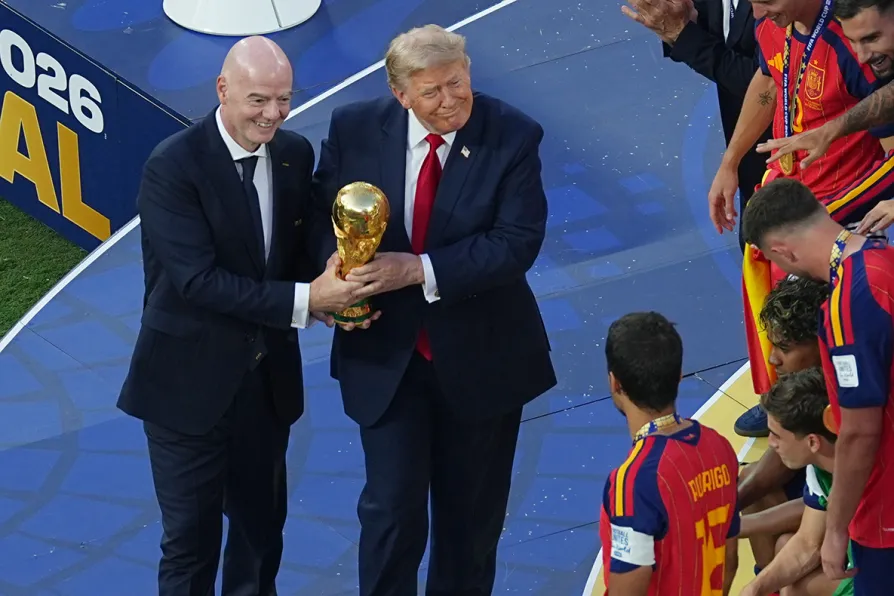
A World Cup full of memorable moments was also marked by exclusion, exploitation and unprecedented political meddling, writes JAMES NALTON


 Latest editorial

Belfast’s boxing legacy transcends the divide
From Barry McGuigan and Carl Frampton to Tyrone McKenna and Lewis Crocker, the city’s fighters carry a complex history into the ring, writes JOHN WIGHT
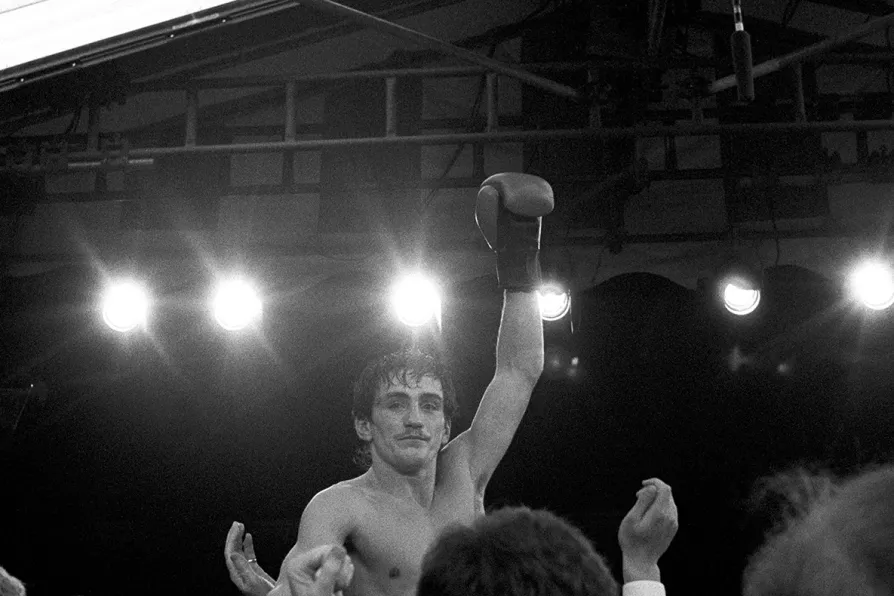 Boxer Barry McGuigan celebrates after beating champion Eusebio Pedroza during the World Featherweight Championship, at Loftus Road Stadium in London, June 1985


BELFAST is a part of the world where at any bus stop, on any given day, a higher level of political discourse unfolds than any you will find at Oxford or Cambridge. This though should come as no surprise, given that Belfast is a town steeped in politics, existing as it has and still does at the coal face of the primal passions inflamed by a prolonged history of enmity.
This particular history has ebbed and flowed throughout — sometimes hidden and sometimes open, per none other than Karl Marx.
Today in Belfast, an absence of conflict exists where previously it had informed the lived experience. However, it would be folly to confuse an absence of conflict with peace.
Leaving no doubt of this is the abundance of ironically named “peace walls,” acting as both a physical and ideological barrier between two communities that remain steadfast in their refusal to compromise when it comes to their respective renderings of the past, present, and vision of the future.
Murals paying tribute to and marking tribal and ideological differences abound beyond the environs of Belfast’s bustling city centre. Walk down the republican Falls Road in West Belfast, or along loyalist Sandy Row in South Belfast and you are regaled with the evidence of two competing and antagonistic working-class cultural-political identities.
Boxing has, in Belfast, proved one of the few passions that has informed a commonality of understanding where normally there has been none to be found. The roll call of legends of the ring from Belfast, or who made the town their boxing home, is as good as any that any town anywhere could boast.
When Barry McGuigan was flying the flag of British-Irish boxing in the 1980s, the Troubles were raging. Yet such was McGuigan’s force of personality, and such was the wondrous sensibility of a young man who refused to allow himself to be defined by hate, that whenever he climbed through the ropes, he did so in the name of unity rather than division.
In this vein, after each of his fights at Belfast’s iconic and now defunct King’s Hall, he took the microphone and invited the crowd to join him in a rousing rendition of the Irish folk song Danny Boy, a glimpse of a future underpinned by hope rather than despair held sway.
Carl Frampton, from North Belfast’s Tiger Bay, ended his own ring career as a former two-weight world champion, first at super-bantamweight then at featherweight. As with McGuigan before him, he flew the flag of Northern Irish boxing with distinction, amassing along the way a cult-like following of true believers.
Frampton’s big nights in Belfast unfolded primarily at the old SSE Arena, though his popularity was such that his last outing in Belfast in 2018 saw him sell out the town’s Windsor Park football stadium, home of Linfield FC.
Tyrone McKenna is a 36-year-old veteran of the game who made his professional welterweight debut back in 2012. A tall, rangy southpaw who fights with his heart on his sleeve, McKenna has to date had 32 fights. Of those he has won 25, lost six, with one draw topping things off.
McKenna was involved in a classic domestic affair in late 2023, when he entered the ring to challenge the unbeaten record of fellow Belfast native Lewis Crocker, in a fight for the WBA European Continental belt. Billed as the Battle of Belfast, those fortunate to get their hands on a ticket at the sold-out SSE Arena that night were treated to one of the fiercest contests to ever unfold in a boxing ring anywhere on these islands.
Bad blood had been evident between both fighters in the build-up to the fight, elevated perhaps by the wider context of a town long divided along the cultural and political lines already described.
As an amateur, for example, Lewis Crocker brought legal proceedings against the Ulster Boxing Council, alleging that religious and political discrimination had informed the decision to leave him out of Northern Ireland Commonwealth Games youth boxing squad in 2015, held in Samoa.
The result was an out-of-court settlement of £85,000 landing in the fighter’s account in 2018.
Lewis Crocker, it should be noted, hails from the aforementioned loyalist Sandy Row in South Belfast, while McKenna is a native of republican West Belfast.
It was Crocker who emerged victorious from the back and forth affair with McKenna in 2023, proving too fresh and too clinically aggressive throughout the 10-round duration. Looking back at the fight today, it was only a surplus of pride that fuelled the latter’s refusal to succumb, such was the sustained torment endured. Indeed, such was the brutal character of the fight that night that Tyrone McKenna announced his retirement immediately thereafter.
In the summer of 2025, Tyrone McKenna traded West Belfast for the West Bank for a number of weeks. During his trip there he spent time training young boxers at the ACLAI Palestine Community Gym, located within the Aida refugee camp.
Established in 1950 by the United Nations (UNRWA), Aida refugee camp is today home to a population of 7,000 whose ancestry is that of Palestinians forced from their original villages during the Nakba (catastrophe) of 1948.
McKenna made the trip at his own expense and risk. In the multiple interviews he’s given about the experience, he has made clear his sense of shock at the conditions endured by the Palestinians he met. He has also since returned to the ring, and is set to face Paddy Donovan at Dublin’s Croke Park in September.
Lewis Crocker, meanwhile, does not at this time of writing have a future fight scheduled, having lost his IBF welterweight crown to Australia’s Liam Paro in Queensland at the end of June. The stage is set, surely, for a rematch between Crocker and McKenna at some undefined point in the future.
From opposing sides of a working-class divide, in a town whose identity has quite literally been forged in battle, Belfast made them both and both have, in consequence, more in common than many from either community would care to admit.

Similar stories
FRANCIS DEVINE introduces a new collection of essays that draws on Pease McKenna’s example to indicate future paths for the movement
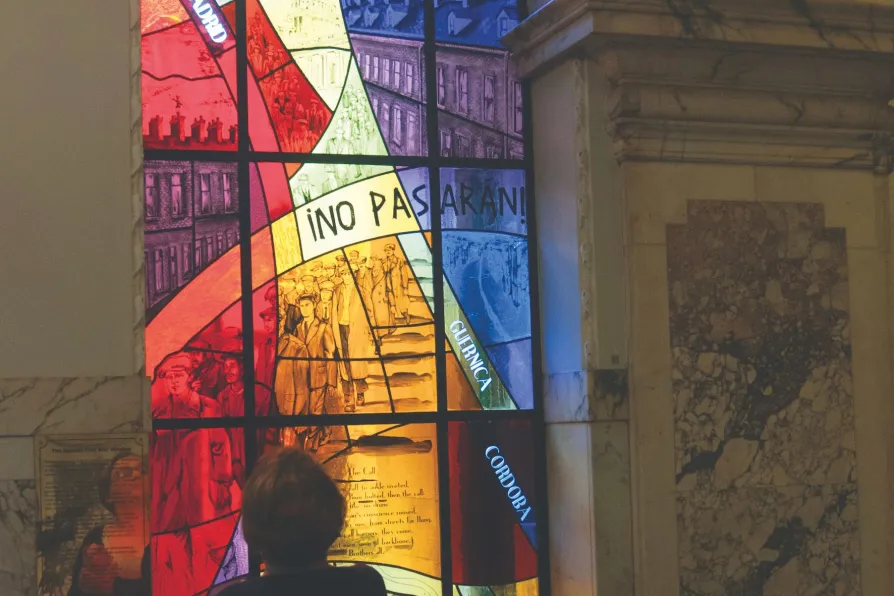
JIM JUMP looks forward to the International Brigade Memorial Trust AGM taking place in Belfast later this week where the spirit of solidarity will be rekindled
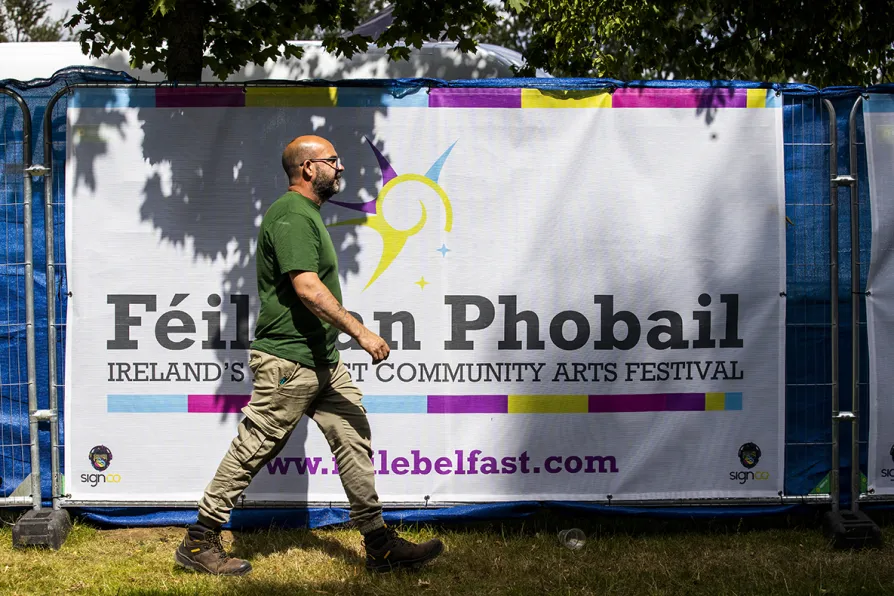
Why not pay a visit to Feile an Phobail, a people’s festival of community arts with roots in the days of internment without trial, and where the spirit of solidarity remains undimmed, says LYNDA WALKER