Ron's rages are sincere and — according to his wife — healthily cathartic. But can these splenetic outbursts loosen the grip of capitalism at its most monstrous?


A Universal Comrade: Pearse McKenna
FRANCIS DEVINE introduces a new collection of essays that draws on Pease McKenna’s example to indicate future paths for the movement

ANGUS REID considers the power of the podcast as a vehicle for consensus building in opposition to mainstream media narratives
GLENN FOSBRAEY recommends a biography worth reading for both existing George Michael fans and those yet to be converted
KEVIN DONNELLY and MARIA DUARTE review Shoot the People, The Last One For The Road, Rosebush Pruning, and Moana
JAMES WALSH recommends an exceptional documentary about the experience of Western doctors in Gaza


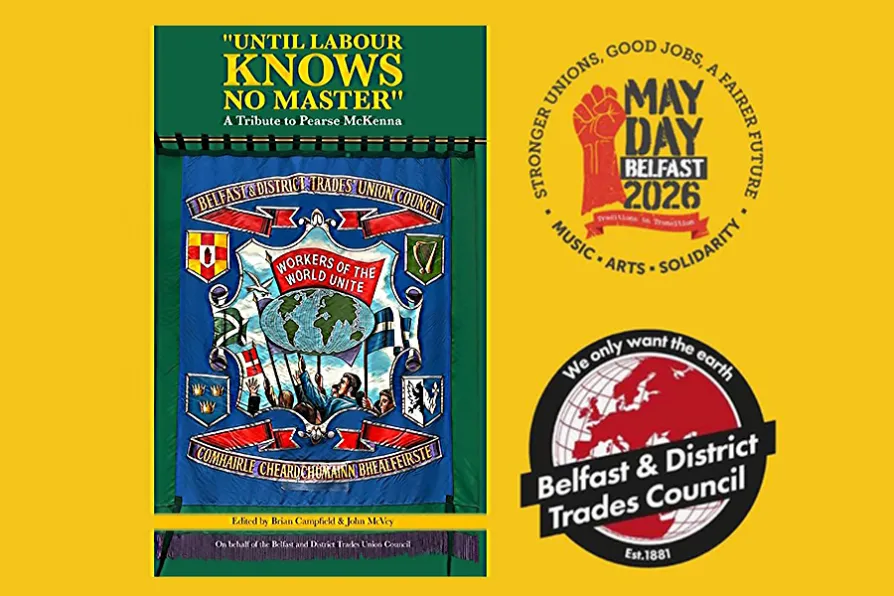
Until Labour Knows No Master: A Tribute To Pearse McKenna
Edited by Brian Campfield & John McVey, BDTUC, £10 + P&P
CONNOLLY thought that “there can be no dignity in labour till labour knows no master.” Belfast & District trades union council (BTC) have produced a challenging tribute to Pearse McKenna, their former secretary. The BTC banner on the book’s cover, cries “Workers of the World Unite.” McKenna opposed sectarianism, racism, neocolonialism, imperialism and oppression. He was, in essence, a universal comrade. The essays are accessible, solidly researched and offer guidance for forward strategies.
McKenna was born in Belfast’s Falls on August 3 1945. It took courage to oppose division and promote unity to advance class politics. In 1976, McKenna led protests against the Provisional IRA after they shot a manager in his workplace, Peter Pan Bakery. Active in the ATGWU (Unite), in 1990 he moved the BTC motion at Congress that led to the creation of Counteract, the groundbreaking workplace campaign designed to tackle sectarianism, racism, and right-wing extremism in the UK and Ireland.
In 1991, the Ulster Freedom Fighters (UDA) attempted to assassinate him after he, as shop steward, led demands for the removal of Orange flags in Ormeau Bakery “to secure a neutral, non-partisan workplace.” McKenna’s insights improved Counteract training modules and workplace strategies.
John McVey, NIPSA Research Officer, offers strategies to oppose the “dominance of anti-migrant rhetoric in local, national and international politics.” The growing repressive economic and social agenda impedes attempts “to move beyond the politics of hate.” The “vanguard of our movement was once unashamed of making the case for peace and socialism as the real cures for war, exploitation and displacement that capitalism, and its highest form imperialism, create.” We need “to reconnect and nurture such core beliefs — for social justice, class solidarity and internationalism,” sentiments rooted in McKenna’s life.
Active in the Communist Party of Ireland (CPI), McKenna contributed articles to the Morning Star, campaigned for peace and disarmament, supported liberation struggles and offered solidarity wherever needed, as with the £1,000,000 suitcase that he carried to Dublin to circumvent NUM sequestration. He promoted Irish unity, defended Neutrality and opposed anti-trade union legislation. He was active in the International Brigades commemoration committee, promoted the cause of the Palestinian people, and welcomed a growing Irish language revival.
Vijay Prashad of the Tricontinental Institute for Social Research, examines “hyper-imperialism on hyper-drive,” noting the failure of social democrats to solve unemployment and rising criminality; the widening division of wealth; destruction of instruments of supposed global security and creation of new standards of amorality; the growing politics of fear and its violent consequences directed against the most vulnerable; the rising impact of digital disinformation generating an “informed ignorance”; and American/Israeli hegemony through financial controls, military force and intimidation. He implores “Forward ever, backward never,” a sentiment that drove McKenna’s life.
John Pinkerton, Queen’s University, explains the dynamics of internal politics and pressures on the ANC. External economic and fiscal pressures — part of the North’s global strangulation of the South — handicap progress and ambitions, leading to the conclusion that “there has been, and there is no straight forward winning game plan.” The ANC’s political struggle has much to teach those involved in class politics in Ireland. Currently Neutrality must be defended. Taoiseach Martin’s craving to be “playing with the big boys” is oblivious to Niamh Ni Bhriain’s analysis that “make no mistake, Europe is preparing for war.”
The recent street violence in Belfast contrasts with the lack of response — on occasion no response at all — to the brutal murders/mutilation of women. Helen Crickard observes that in 2024 Northern Ireland was the “second most dangerous place in Europe for women with the highest number of femicide per head of population.” She identifies “armed patriarchy,” embedded misogyny, under-acknowledgement of psychological abuse and ineffective actions/plans to end violence against women. Women “need men to call men out” which “does not need resources, only the desire for men to demand better and not accept the misogynistic attitudes that allow ‘toxic’ masculinity to thrive.”
John Barry and Shatha al-Azzeh examine the largely unacknowledged environmental destruction by Israel — uprooting of olive trees, slaughter of livestock by “settlers” or IDF scorched-earth tactics. They champion ecological resistance by Palestinian communities in the flourishing of rooftop gardens in al-Azzeh camp.
Mary McVeigh examines the arrival of the Workers’ Union (GMB today) in Armagh in 1918, a forgotten episode in labour history and Charlie McGuire outlines the life of the “forgotten revolutionary,” Dubliner Sean McLoughlin, whose socialist politics exiled him from the “Free State.” Brian Campfield, former ICTU president, shows us McKenna’s personal, family and sporting lives.
In response to the challenges that face socialist activists, in Ireland and across the globe, Prashad cites Palestinian poet Bassel al-Araj, 1984-2017, that “if you don’t want to confront oppression — your role as an intellectual is pointless.”
Readers will be rewarded by incisive writing and challenging ideas, honing sets of socialist tools to fashion change, the hope of the planet.
For a copy of the book please write to [email protected]

Similar stories
A new group within the NEU is preparing the labour movement for a conversation on Irish unity by arguing that true liberation must be rooted in working-class solidarity and anti-sectarianism, writes ROBERT POOLE
The independent TD’s campaign has put important issues like Irish reunification and military neutrality at the heart of the political conversation, argues SEAN MacBRADAIGH
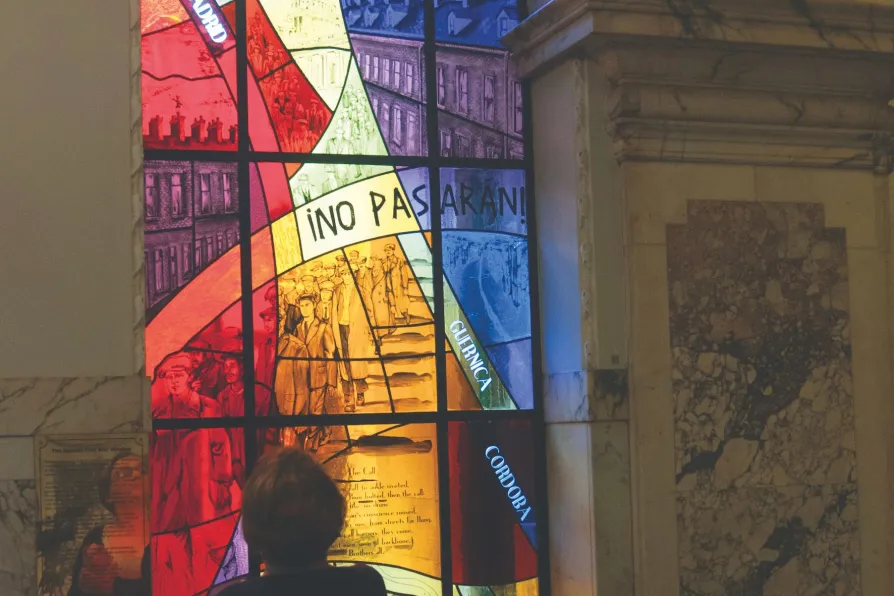
JIM JUMP looks forward to the International Brigade Memorial Trust AGM taking place in Belfast later this week where the spirit of solidarity will be rekindled