
ANDY HEDGECOCK, MARIA DUARTE and ANGUS REID review Synthetic Sincerity, Our Hero, Balthazar, Heartstopper Forever, and A Year In London

Berlin: the bitter end
WILL PODMORE admires an account of the liberation of Berlin that overthrows the conventional US army-inspired account
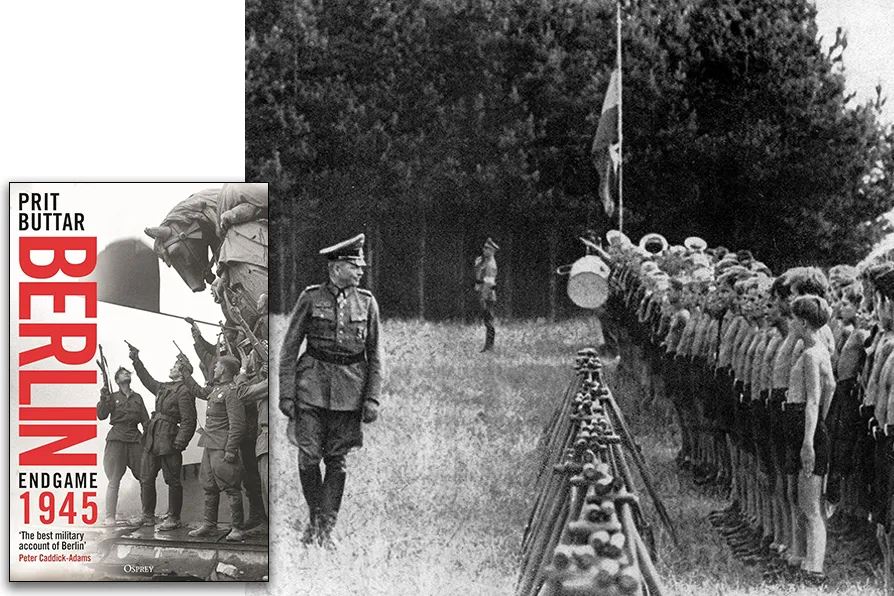
 DOOMED YOUTH: Generaloberst Heinz Guderian inspects the Hitlerjugend, East Prussia, September 1944 [Pic: Scheerer/CC]

KEITH RICHMOND relishes a superbly conceived modern version of Aeschylus’ drama of murderous family succession
MICHAL BONCZA recommends a minimalist installation that prompts intriguing connotations
FIONA O’CONNOR questions the achievement of this year’s Orwell prize winner for political fiction
LEO BOIX reviews two powerful Latin American novels in which myth and crime fiction expose the deadly consequences of patriarchy, clandestine abortion and state violence
New releases from Laura Veirs, The Waterboys, and Yard Act
Ron's rages are sincere and — according to his wife — healthily cathartic. But can these splenetic outbursts loosen the grip of capitalism at its most monstrous?


Berlin: Endgame 1945
Prit Buttar, Bloomsbury, £30
THIS fine account of the liberation of Berlin includes many first-hand accounts written by soldiers on both sides, and by Berlin civilians.
Buttar spells out how the Red Army improved its performance throughout the war. Innovation and flexibility on the battlefield were increasingly common. The army’s equipment was far better in almost every respect. For example, the concentration on a small number of tank designs resulted in greatly improved availability of replacement parts.
He contrasts the leaderships of the two sides: “By 1945, although the overall improvement of command arrangements in the Red Army had been fairly modest, it nonetheless resulted in a far more effective approach to operations than had been the case in earlier years.
During those years, the Wehrmacht evolved in the reverse direction. Hitler imposed increasingly rigid top-down control, eroding and almost eliminating the freedom to improvise and make decisions on the ground without first seeking permission.”
Buttar notes how, after the war, some criticised the Soviet leadership. For example, Colonel General Vasily Chuikov, commander of the Eighth Guards Army, wrote: “If Stavka [the Soviet High Command] and the Front headquarters had organised supplies properly, and had managed to deliver the required amount of ammunition, fuel and food to the Oder on time; if aviation assets had time to relocate to the Oder airfields, and the bridging units could ensure the crossing of troops over the Oder, then our four armies — Fifth Shock, Eighth Guards, and First and Second Tank — could have developed a further attack on Berlin in February, advanced another 80-100km, and completed the gigantic operation by capturing the German capital.”
Buttar comments: “This was little more than wishful thinking. It was physically impossible for supplies to be organised in the manner that Chuikov acknowledged was necessary; in the absence of such supplies, a further advance was simply impossible.”
Others too tried to rewrite history.
Generaloberst Heinz Guderian surrendered to US forces on May 10. The Soviet Union asked for him to be handed over to face war crimes charges relating to his time on the Eastern Front in 1941, but the US government refused. Along with other senior German officers, he joined the US army historical division to help it in writing accounts of the war.
Buttar comments: “These invariably attempted to show the Wehrmacht in the best possible light, fighting a highly skilled war and losing only because of Hitler’s interference and overwhelming enemy numbers. Much of the post-war ‘whitewashing’ of the Wehrmacht — the attempt to exonerate it of any war crimes and to place all blame for such events on parts of the SS and rear area organisations — originated with the group working for the US army.”
As Buttar observes: “Every branch of the German military machine was involved in war crimes.”
Guderian claimed that Germany had been fighting for its very existence and had been the bulwark of Europe against the evils of Bolshevism. Buttar comments that his claims “now seem to be little more than post-facto rationalisation.”
As the war in Europe was ending, Churchill was looking towards a new war. He “actively considered the possibility of British forces fighting alongside German units against the Red Army.” He ordered his joint planning staff to work out how an attack on the Soviet forces in Europe might unfold.
The planning staff, after considering the forces available and the strength of the Red Army, reported on 22 May that: “Without the help of US forces, Britain alone would find it beyond our power to win a quick but limited success and we would be committed to a protracted war against heavy odds.”
They were told to rewrite the plan to include US forces: 47 British and US divisions were to attack the Red Army in central Germany, backed by ten rebuilt German divisions, with a proposed implementation date of 1 July 1945. Soviet resolution and strength prevented Churchill’s plan’s implementation. The plan was quietly dropped and remained classified until 1998.
Buttar does not downplay the genocidal crimes of the Nazi regime, but he does not whitewash the Wehrmacht which, later and virtually untouched by de-Nazification, became a pillar of Nato. He does, however, overthrow the conventional US army-inspired account that the Nazis lost only because of Hitler’s failings and the Soviet Union’s superior numbers.

Similar stories
Poland’s anger over Ukraine’s celebration of the Nazi collaborationist UPA reflects more than historical grievance, says KENNY COYLE
MARJ MAYO sees the contemporary relevance of this account of the consequences of a society’s accommodation with evil
After NGOs and the EU, UN condemns Germany’s crackdown on Palestine Solidarity, writes LEON WYSTRYCHOWSKI
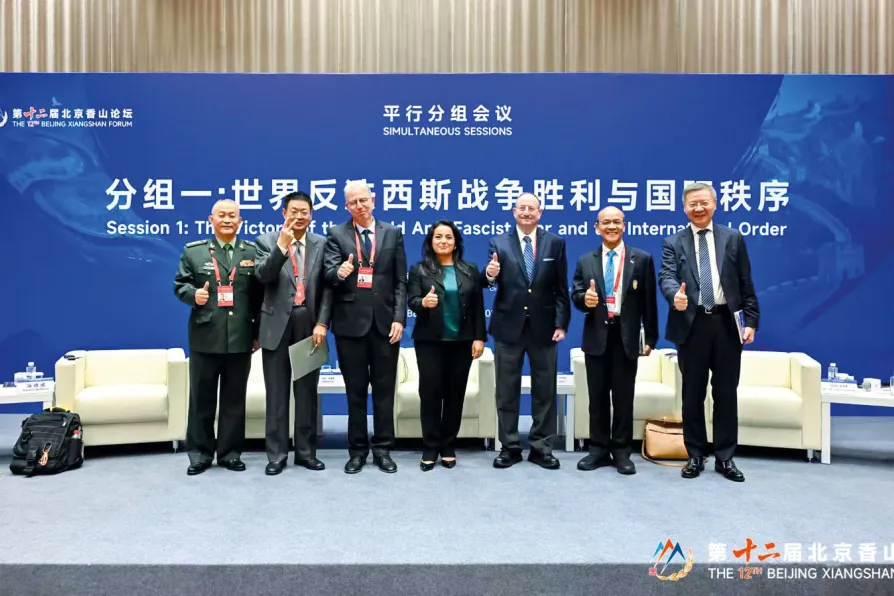
In a speech to the 12th Xiangshan Forum in Beijing, SEVIM DAGDELEN warns of a growing historical revisionism to whitewash Germany and Japan’s role in WWII as part of a return to a cold war strategy from the West — but multipolarity will win out