JAMES WALSH recommends an exceptional documentary about the experience of Western doctors in Gaza


Ron Gaskill versus Late-stage Capitalism, by Martin Pearson
Ron's rages are sincere and — according to his wife — healthily cathartic. But can these splenetic outbursts loosen the grip of capitalism at its most monstrous?
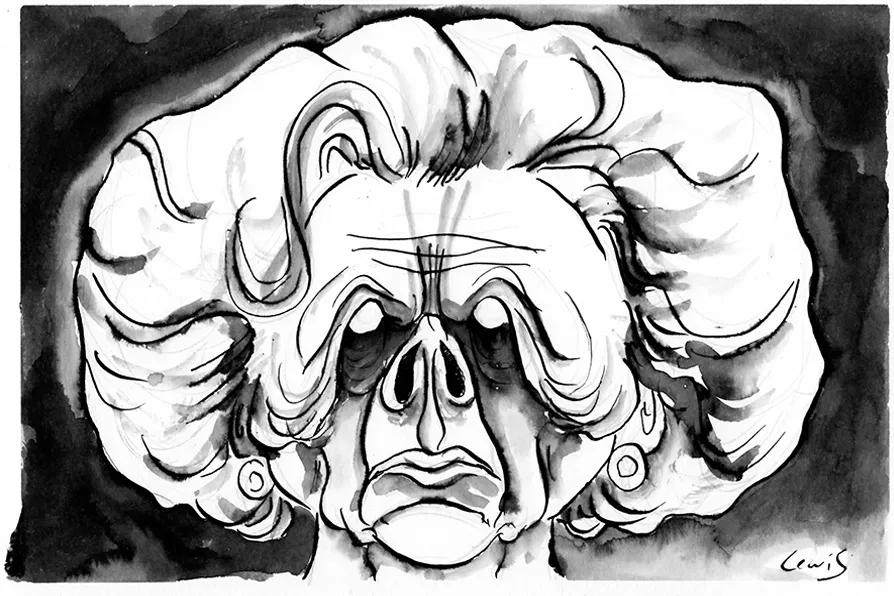
 Illustration by Lewis Marsden

KEVIN DONNELLY suggests that the task of transforming cultural spaces is far from over and that photography still has a key role to play
RITA DI SANTO talks to Scottish-Irish filmmaker MARK COUSINS about his new panorama of world cinema The Story of Documentary Film
ALAN MORRISON welcomes a new collection from the most imaginative and committed ecopoet of our time
CAL McBRIDE relishes the lyrical truth of an unstable identity in an over-tidy and conventional social realist treatment
New releases from Shearwater, Florry, and Navy Blue
CHRIS SEARLE welcomes a startling vision of contemporary Newport from a veteran photographer of the British working class


IF you’re joining for the first time, you’re probably wondering who the hell Ron Gaskill is. Well, he’s me. I’m Ron Gaskill and I “do” rants.
Now, I don’t mean I do rants like that bloke off the telly, you know, the one on the panel show. He does rants for comedic effect; and when he goes off on one it’s a full-on effort that lasts for ages, and at the end he gets a round of applause for his wonderfully entertaining fake outrage.
I’ve never had a round of applause for any of my rants, and if I ever did get one, I’d consider it extremely patronising because my rants — which may last for even longer than what’s-his-name’s — have the key ingredient of genuine outrage.
So, what sort of outcome would I like for my rants?
Well, obviously a paradigm shift that returns the world to one where people are not depersonalised on a daily basis, for a start. My wife says that’s a bit much to hope for, and I should be satisfied with simply getting things off my chest, so I don’t end up with an ulcer or something worse. And also, can you find some other way of letting off steam, because I’m getting tired of listening to it all?
So here we are, and if you’ve got this far, you’re probably of the same generation as me — Generation X, apparently, or Generation X-Ray in my book, as all we ever talk about these days is each other’s symptoms.
And when did they decide to change the number of years in a generation anyway? It was always 25 when I was growing up, but there’s been about three more generations since then and I’m only 62. Strictly speaking, I’m really in the Baby Boomer category, but at the very end of that. Sort of “late-stage Boomer.” “Gen X” sounds more exciting and cool anyway, if not like a drug of some sort.
I’ll get onto the whole “late-stage capitalism” nonsense in a moment, because that’s the massive sh*tstorm we’re experiencing these days and I can tell you the lid’s about to be blown off my particular pressure-cooker any day now.
But apart from their general confusion about which generation they might belong to — and, let’s face it, these days the goalposts can be shifted retrospectively at the drop of a hat — the main problem facing younger generations is that they never experienced Thatcher.
Okay, yes, that’s a rant for another time, except to say her statue in Grantham has had to be put on a much taller plinth and is constantly monitored by security cameras in an effort to prevent any further vandalism by outraged folk of my own generation. It probably looks like some installation thing that Bansky bloke would do.
There is an exception to those who never experienced Thatcher, of course, and that’s everyone who lives or has lived in Grantham since that awful monolith was erected. I’ve been on the train that stops at Grantham and you can see it in the faces of passengers getting on and off there. They know all about it. Honestly, if I had my way, I’d be laying on a free bus service so those poor sods could get off at the next stop without shame.
The point is those generations who didn’t experience Thatcher just seem to blindly accept the ever-greater erosion of personal service and human interaction in every area of everyday life. It’s been happening ever since her advent as prime minister of this green and pleasant land.
Image
The particular example I want to bring to your attention takes place at that cathedral of greed known as the supermarket. I’m sure you’re way ahead of me on this one.
There we were, last Wednesday, and it went like this; somehow, half-way round, the trolley develops a dodgy wheel, causing the damn thing to intermittently veer to one side. Meanwhile, I’m needing A Level Maths to work out if the offers are worth it, because these marketing spivs are more cunning than a gang of foxes. Bunch of bandits in my book.
I asked what looked like a 14-year-old shelf-stacker where I could find a can of Angst Repellent, but they just looked at me and shrugged their shoulders.
Eventually we get to the checkout lanes, and yes, you’ve guessed it, they’re a barren, unpopulated country and we’re left to face the horror of self-scanning a trolley more heavily laden than a camel on a desert safari. I experience a sudden spike in anxiety only matched by my rising anger at this desperate situation. The question: “How has it come to this?” flashes through my mind.
Again, I look towards the tills — from whence comes my salvation — but there’s no-one around, so I am forced to accept this fate. I sense a rising disorientation and feel dreadfully conspicuous as we’re surrounded by others with their baskets of eight items or less or whatever.
My wife says: “Come on, let’s just get on with it.”
I mean the whole thing about self-scanning is against my conscience, it’s a moral outrage, it really is, but there I am, reluctantly placing the first item on the metal surface. “Wait for assistance” the screen tells us, but somehow, as the assistant approaches, the machine senses her authority and has suddenly changed its instruction to “Add item to bag.”
The assistant touches the screen while uttering some strange retail incantation to reset the machine’s errant ways, before wandering off. But her efforts prove futile as “Wait for assistance” appears each time as we try to scan our way out of this dreadful transactional limbo where you are kept until all your sinful, angry, anti-capitalist thoughts are burned away in the supermarket manager’s refining fire.
“I really object to this whole thing,” I say to the weary assistant. “I object to giving my free labour to Fairway.”
Then my wife suggests this is taking far longer than it would if we’d gone through the main till, so the self-scan has already defeated its own purpose in terms of time. But we all know the real purpose of self-scan is to shed checkout jobs while increasing profits through the free labour of customers – because that’s cynical late-stage capitalism.
“You can ask for a checkout lane to be opened, you know,” says the assistant.
“No, I didn’t know that.”
“Oh yes,” she goes on, “they like you to ask, and then they’ll open one for you.”
But was there anyone to ask? No, not a single employee in sight and if they really wanted you to ask, wouldn’t they have a few signs up to that effect? By this stage, I am at the limit of my frustration.
“Even this trolley’s not working properly,” I complain to the assistant.
“Oh, they go like that sometimes,” she says in a world-weary voice. “Right pain they are.” And she kicks the dodgy wheel through a hundred and eighty. “There, that should do it.”
I am embarrassed by how easy it was to fix and let out a long low groan of angst-ridden desperation. As we leave the building I drink in some much-needed fresh air.
“Bloody late-stage capitalism,” I curse.
My wife sighs. “Late-rage capitalism, you mean.”
She expresses concern that any day now I might go the way of Michael Douglas’s character in Falling Down. I think that day is fast approaching. Where can I lay my hands on a rocket launcher?
Martin Pearson is a retired art teacher, now devoting himself to painting and writing.
Stories, of up to 1,600 words, should be submitted to: [email protected]

Similar stories
Gisele Pelicot said ‘shame must change sides.’ We may think we agree, but, argues LOUISE RAW, society still has some way to go

Austerity in a red tie is still austerity, warns RAMONA McCARTNEY of the People’s Assembly – rally with us to demand different choices
MATT KERR charts his bike-riding odyssey in aid of the Royal Marsden charity and CWU Humanitarian Aid
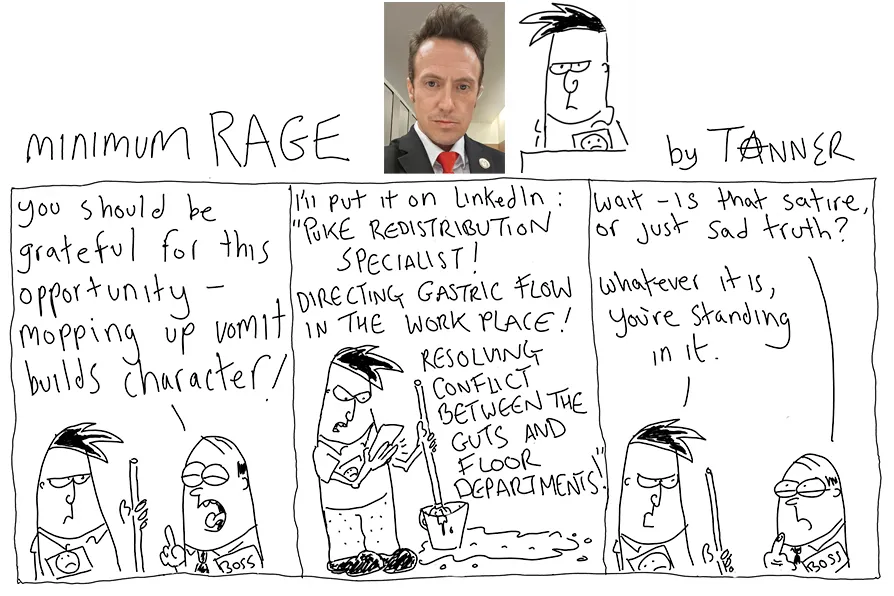
Strip cartoons used to be the bread and butter of newspapers and they have been around for centuries. MICHAL BONCZA asks our own Paul Tanner about which bees are in his bonnet