In the wake of Ann Widdecombe’s murder, JOHN GREEN wonders whether the government will really get to grips with the root cause of these attacks on our MPs


 Latest editorial
A comrade remembered: Dr Ricardo Figueroa
19.01.1930-23.04.2026
Kate Clark pays tribute to Ricardo, whose life spanned the hopes of Allende’s Chile, the horrors of military dictatorship and decades of campaigning for justice in exile
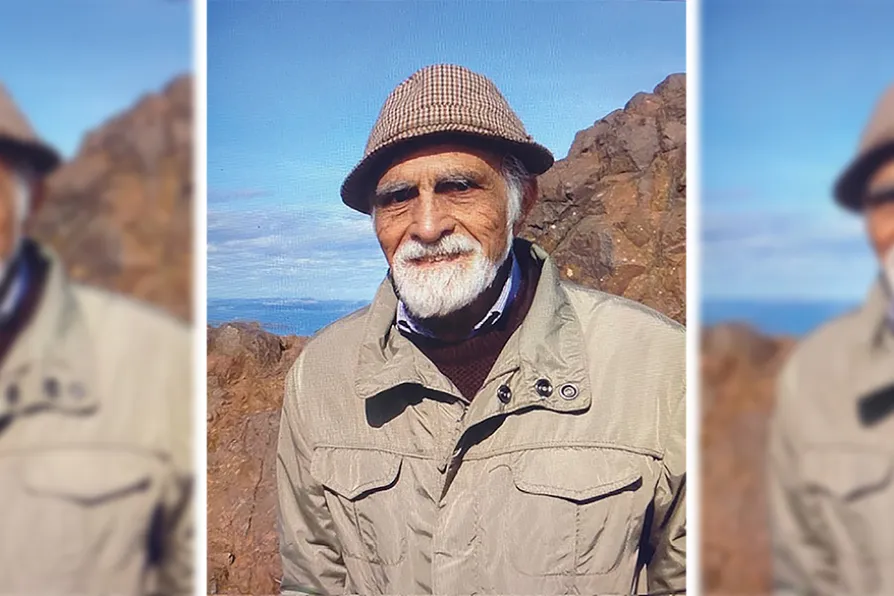 Dr Ricardo Figueroa
Despite the screeching from the right-wing media, Burnham’s speech chimed with the public mood - and socialists should take advantage, says Morning Star editor BEN CHACKO
Nature as well as society works dialectically, asserts the Marx Memorial Library and Workers’ School
Rising temperatures and human activity are making life far harder for these vital pollinators. ALEX DITTRICH explains
Lesbians and Gays Support the Miners co-founder MIKE JACKSON talks to Matt Kerr about the enduring power of Pride, protest and trade unionism
Behind the language of military strategy is a confrontation that risks drawing the wider Middle East into war, says STEVE BISHOP


I MET Ricardo in Moscow in1967, on a year-long Russian language course at MGU, Moscow State University. He was a lecturer in English and American literature at the University of Chile, who spoke no Russian. I was a Russian studies graduate, versed in Tolstoy and Dostoyevsky, but with little conversational Russian.
During that year, as well as improving my Russian, I learnt much about Latin American politics. I was impressed by Ricardo’s love for his country and his hopes for a progressive programme of change to lift Chilean workers and peasants out of poverty. Ricardo himself was from a humble background, brought up till the age of five by a single mother, and then by his disciplinarian policeman father. As an excellent student, he won a grant and was able to go to university in the capital, Santiago.
The desired-for programme of change was imminent by the time I arrived in Chile in 1969. In 1970, a socialist president, Dr Salvador Allende, was elected, heading an alliance of left parties called Popular Unity, on a revolutionary programme of economic and social transformation to nationalise the country’s main natural resource — copper — and introduce a land reform to give the peasants rights over the land they farmed.
Nationalisation of Chile’s copper, hitherto owned by big US companies, had become so popular that the reformist Christian Democrats and even the main right-wing party had to support the measure, and it was passed unanimously by Chile’s Congress in 1971.
This showed US imperialism that Allende’s Popular Unity government meant business. US president Richard Nixon met security boss Henry Kissinger and the order was given to “make the Chilean economy scream.” From then on, the CIA financed right-wing media and anti-government political groups and did everything they could to destabilise and unseat Allende.
Yet the popular government, led by the two main left parties — the Socialist and Communist Parties — increased its vote to 43.4 per cent in parliamentary elections in March 1973, despite the deliberately manufactured chaos and strife, like the lorry-owners’ boycott which paralysed much of the country in 1972.
Ricardo, who was already a regional Communist Party leader when I met him, was soon put forward by his party to lead the university reform in the province of Nuble, where we both worked at the state University of Chile, which had branches in all the main cities. The aim was to turn the university from a seat of learning solely for the elite into one accessible for the children of less well-off sectors of the population.
Ricardo was a charismatic leader whose academic background and experience thrust him into the limelight, and he was soon elected vice-chancellor of the university in that province. He liaised with government ministers to win new halls of residence for the students, and negotiated with a prominent local landowner for him to donate to the university enough land to build a new campus for the burgeoning university.
As vice-chancellor, he welcomed Popular Unity’s Culture Train to the regional capital, Chillan, organising a conference of poets, staging dance, film and theatre workshops both at the university and in rural areas, where cultural provision was zero. Chile’s great Nobel-prize-winning poet, Pablo Neruda, came to recite his poetry in front of massive crowds, as did Salvador Allende himself. It was an exciting time of awakening, of realising what “ordinary people” are capable of once they are given the opportunity by a government they knew was on their side.
It is amply documented how, in September 1973, reactionary forces in Chile together with the US and the CIA brought down Allende’s Popular Unity government in a bloody military coup which massacred, tortured and disappeared many thousands of Chileans and forced an estimated 200,000 into exile. President Allende was killed in the Moneda palace, which was bombed by Chile’s own air force using British Hawker Hunter jets.
Ricardo would not be spared. Soldiers hammered on the door of our little bungalow one night after curfew, they forced him out and up into the back of a truck full of other detainees.
He, together with another 14 leaders, including three of the province’s governors, appointed by Allende, were sent to the infamous naval base on Quiriquina island.
Only recently, on reading the tribute written for Ricardo after his death by a dear friend and university colleague, did I find out for the first time the kind of barbarous torture he and the other so-called “big fish” endured on that island concentration camp.
Later he was brought back to the local prison, where we were able to marry in December 1973, much to the fascist prosecutor’s annoyance, when he found out days later. The civilian prison governor had allowed the ceremony without asking permission from the military authorities. Due to the subsequent intervention of the British Foreign Office, the military had to set Ricardo free and we arrived in Britain in March 1974, moving to Edinburgh in September with a job found for Ricardo by Academics for Chile, an organisation he helped to set up to help imprisoned and sacked academics in Chile.
Some readers might remember Ricardo speaking at one of the many trade union conferences he was invited to speak at in the ’70s and ’80s. Because he spoke good English, he travelled the country and Ireland giving talks to political, trade union and human rights organisations to raise solidarity with Chile, suffering under the iron dictatorship of General Pinochet.
At the same time, he wrote his doctorate on the writings of the Marxist and anti-war writer, Lewis Grassic Gibbon, whose book A Scots Quair he had read before leaving Chile. Unfortunately, severe hearing loss from otosclerosis hampered his possibilities of finding academic work at that time.
Later his party took him to Moscow where the leadership in exile was based. Among other organisational work, he collaborated with Escucha Chile (Listen, Chile) a radio programme broadcast daily on short wave for the Chilean resistance inside the country, alongside his day job as style editor for a Spanish-language journal Socialism Theory and Practice. In 1989 he represented his party at its XVth Congress held in Chile clandestinely.
By the 1990s Ricardo had become profoundly deaf. Fortunately he was given a cochlear implant by the NHS in 2010 and spent his later years living in Derbyshire, which reminded him of his native southern Chile, enjoying frequent visits by our family. Here he researched and wrote his book, Tarkovsky al Trasluz (Tarkovsky through the Light), published in 2014, about the Soviet film-maker (Solaris, Stalker) whose profound humanity and spirituality he admired.
The Communist Party of Chile’s tribute to Ricardo reads: “His life is a reflection of the history of Chile in the XXth century and an example of dedication to the working class. He was respected not only as an intellectual and leader, but as someone who had a deep love for humanity.”
More about Ricardo and our life together can be found in Kate Clark’s two books Chile in my Heart (2013) and Twilight of the Soviet Union (2023). Copies are available from from [email protected].

Similar stories
CJ ATKINS commemorates one of the most dramatic moments in working-class history
Far-right forces are rising across Latin America and the Caribbean, armed with a common agenda of anti-communism, the culture war, and neoliberal economics, writes VIJAY PRASHAD
The creative imagination is a weapon against barbarism, writes KENNY COYLE, who is a keynote speaker at the Manifesto Press conference, Art in the Age of Degenerative Capitalism, tomorrow at the Marx Memorial Library & Workers School in London