The Tories introduced the 50% strike ballot threshold to make industrial action harder. MATT WRACK argues that a Labour government has no justification for leaving it on the statute book


 Latest editorial
Crunch time for Labour in Makerfield
A former mining seat has become the focal point of Britain’s political drama, with Labour’s future, Reform’s advance and Andy Burnham’s leadership prospects all on the line. ANDREW MURRAY reports
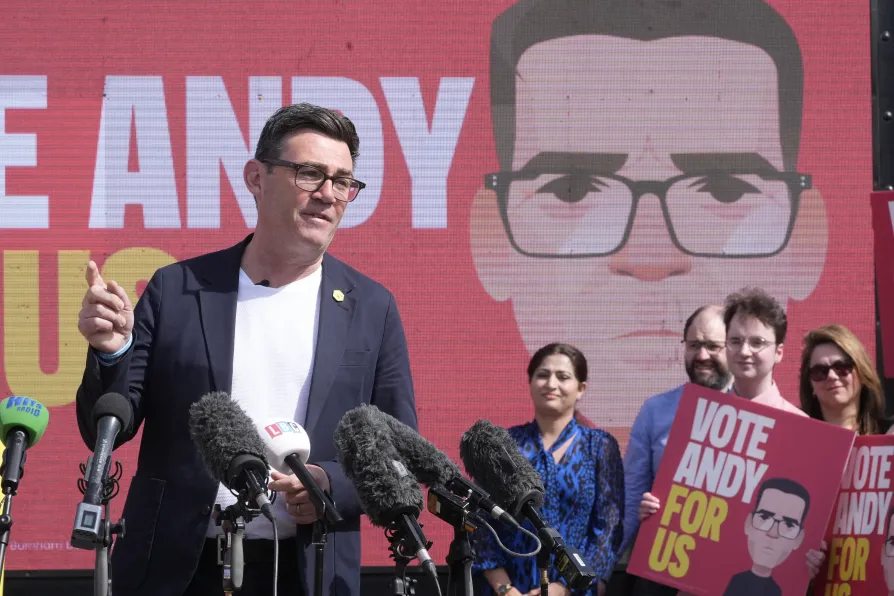 Andy Burnham makes a speech surrounded by supporters at the launch of his campaign as Labour's candidate for the Makerfield by-election during a press conference at Stubshaw Cross Community and Sports Club in Ashton-in-Makerfield, May 22, 2026
In the wake of Ann Widdecombe’s murder, JOHN GREEN wonders whether the government will really get to grips with the root cause of these attacks on our MPs
The new PM’s opening addresses offered hope, council homes and reform — but little detail on how any of it will be delivered, warns CLAUDIA WEBBE
Despite the screeching from the right-wing media, Burnham’s speech chimed with the public mood - and socialists should take advantage, says Morning Star editor BEN CHACKO
Scotland's Labour leader cannot continue to evade responsibility for the party's decline, argues LAUREN HARPER
Nature as well as society works dialectically, asserts the Marx Memorial Library and Workers’ School


IT BEGAN in fraud and deception, and it ends here, on the streets of Makerfield.
However the people in the communities of this Lancashire constituency, once a centre of coalmining, vote in the by-election on June 18 it will hasten Keir Starmer on his way out of the leadership of the Labour Party and of 10 Downing Street.
They may return Manchester Mayor Andy Burnham to the Commons — a man on a mission to challenge Starmer for the top job. His election will reactivate the political crisis started and then suspended, pending the vote in Makerfield, after Labour’s local election annihilation last month.
Or they may back Robert Kenyon, the local plumber chosen to represent the hard-right Reform party.
Kenyon needs to overcome the backlash to the emergence of a collection of his crude and misogynistic social media posts, including an unfortunately memorable one concerning TV presenter Carole Vorderman.
If he brushes past that embarrassment and prevails, he would become the first MP from a bourgeois party to represent the constituency, previously Ince, since Henry Blundell-Hollinshead-Blundell was evicted as Tory incumbent by Labour in 1905, long before people shared their darker fantasies with the world via the internet.
Losing a seat held by Labour without a break for more than 121 years, including in the most dismal general elections for the party, would further underline how Starmer has destroyed the party’s political base.
The challenge already mounted by former Health Secretary Wes Streeting would surely be renewed, with others entering the fray, even if Burnham couldn’t.
So there is really no good outcome from Makerfield for the wretched Prime Minister.
Burnham is, of course, the Labour candidate, but you would have to squint hard to realise it driving through the tidy streets, many displaying a modest prosperity, of the constituency. All the Burnham placards say “Vote Andy For Us” with no mention of his party — there seem less than a handful reading “Vote Labour.”
The Manchester mayor has serendipitously landed on the sweet spot in a political environment divided between those who want to rid the country of Starmer at all costs, and those who prioritise beating the Farage crew by voting for whoever is the most plausible alternative.
Burnham is both. A win for him would be a jolting setback for Reform, which comfortably won every ward in the constituency in the May local elections and regards “red wall” communities like Makerfield as their happy hunting ground.
Losing would intensify the squeeze on Farage, who needs Tory votes to advance further while avoiding losing on his other flank to Rupert Lowe’s semi-fascist Restore Britain, also a presence in the Makerfield placard wars.
And a Burnham victory would also put the skids under Starmer. Once returned to Westminster, a leadership challenge in the febrile parliamentary atmosphere would not long be delayed, and all polling shows Burnham prevailing handsomely in any Labour membership vote. So whatever your problem, affable Andy is the solution.
One step at a time, however. Even taken together the “Andy For Us” and Labour placards are somewhat outnumbered by Reform’s. Long rows of bungalows — likely inhabited by older people — in Bryn, leading into Ashton-in-Makerfield, display Reform favours every other door.
Taking the temperature on the streets is challenging, not least because around one person in four appears to be a visiting reporter — the first to be approached by the Star proved to be a Dutch journalist up from London for the day.
And in the Robin Hood, on Ashton’s pleasant high street, the drill was clear — “have a drink but don’t interview the customers.” Makerfield is not exactly basking in the attention.
Still, some were prepared to share their opinion. Karen has “not voted for a while, because Labour always get in.” She will back Burnham on the 18th, however “because I do not like Reform one bit.”
Claire is not really Claire because, she says, her actual first name is so distinctive that she would be readily identifiable. She is definitely going for Reform.
She objects to the fact of a by-election caused by the outgoing MP, Josh Simons, standing down less than two years into the job simply to make way for Burnham.
Burnham, she fears, is only using them to become prime minister. Anyway “Labour and Tory have had their time” Claire says, although she has previously voted Tory and likes Kemi Badenoch.
“We have had a lot of good from immigration,” she volunteers, “but it is out of control now. People come over here and claim benefits when veterans should be our priority.”
Lisa has always voted Labour and is not going to change now, whereas Brian had been planning to switch from Labour to Reform “but I will vote for Burnham.” Others declare a militant indifference.
That Burnham is vastly more popular than his party is patent. Had Starmer allowed him to stand in the Gorton and Denton by-election in February, the Green’s Hannah “The Plumber” Spencer might now not be in the Commons.
By the time the egregious Simons, notorious for his leadership of the Labour Together faction when it started snooping on and smearing journalists probing its law-breaking, quit to give Burnham a leg-up Starmer had bled too much authority to pull off a repeat veto.
Burnham’s prospects may turn in part on the hard-right vote being split between Reform and Restore. A win which left him behind the combined votes of the two hard-right outfits would feel distinctly pyrrhic.
Anyway, the polling makes it most likely that Burnham will take a big step towards Downing Street next Thursday.
But is Burnham the saviour, or just a relatable bloke? His Commons career — he was an MP from 2001 to 2017 and in the Cabinet under Gordon Brown — covered most points of the party’s political compass.
He stood unsuccessfully for leader in 2010 and again in 2015, when he blew an initial front-runner position by tacking sharply right in a party moving left, opening up the space for Jeremy Corbyn to make history.
He did not join the fiasco of the shadow cabinet coup against Corbyn a year later and stayed loyal until he left for the Manchester post in 2017.
Yet his much-vaunted “Manchesterism” defies easy definition beyond platitudinous formulae about “everyone pulling together.”
The mayor has rowed back from his menaces to the bond market, has backed Home Secretary Shabana Mahmood’s hard line against migrants, supports increased military spending and has said next to nothing about Palestine.
His present orientation seems to be towards seeing off Reform in a “red wall” seat, a formula which will not on its own be a recipe for national success.
It is true that our likely next prime minister has said the country has been on the wrong track for the last 40 years, the Thatcher-New Labour neoliberal era. He has thus upset Tony Blair, surely a precondition for earning a political hearing.
But what programme might that insight be translated into? Forty years ago there were still mines around Makerfield. They, and the culture they sustained for so long in an area which replaced Blundell-Hollinshead-Blundell with a miner called Walsh, are not coming back in anything like the old form.
It has to mean more than a better bus service — Burnham’s signature triumph in Manchester — but so far it is all vibes and vapour.
There are even alarming rumours that Burnham as premier may retain Rachel Reeves, the City’s favourite, as Chancellor and still worse ones that he may have a top job in mind for the appalling Simons, who deserves, at best, never to be heard from again.
Unsurprisingly, political enthusiasm of any kind is hard to find in Makerfield. Symbolism, however, is not in such short supply.
Opposite the Robin Hood stands the Cross Keys. From a distance it looked like a pub with a “Vote Andy For Us” poster in the window.
Closer up it is clear that the Cross Keys is a pub no more, since every window on every floor was filled with identical Burnham publicity, turning it into a marketing monolith for the mayor.
Yet peer through the gaps in the windows between the Burnham-mania posters and there was nothing within but empty rooms in a state of dereliction. We have seen the future, and it may very well not work.
