

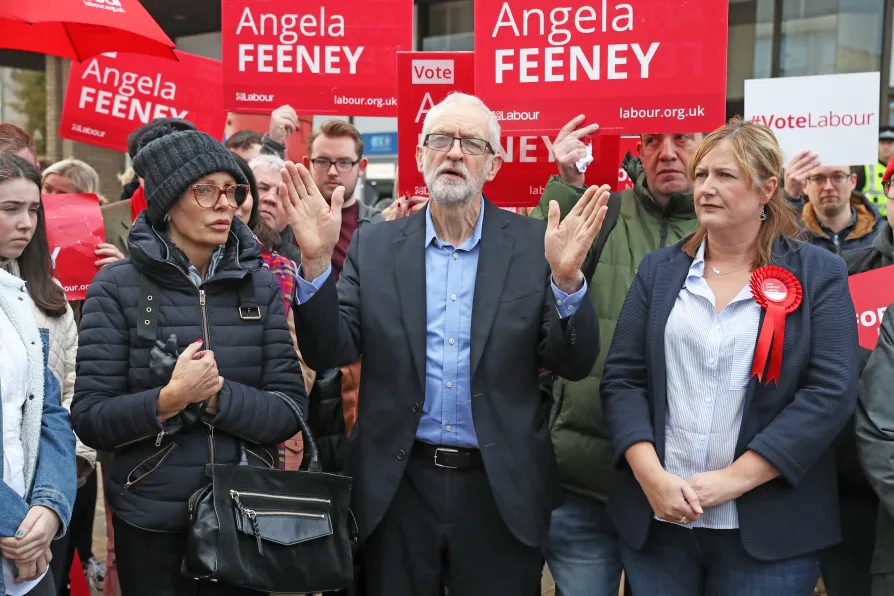
 Labour leader Jeremy Corbyn speaks at an activists training event at the GLO Centre in Motherwell, Scotland


LABOUR’S decision to abstain in this evening’s vote on a December general election suggests that the parliamentary party (PLP) is dictating strategy to the leadership.
Back in September, the confidence of the labour movement was at a high point.
At TUC Congress earlier this year barnstorming speeches by Jeremy Corbyn and shadow employment rights minister Laura Pidcock detailed the changes a Labour government would make to reshape the workplace in the interests of workers.
Labour conference itself was a showcase of the mass force the party has become, setting the agenda on a green new deal, confronting big pharma and backing transformative action on housing and education.
Indeed, Corbyn’s speech to conference promised to make Boris Johnson “the shortest-serving British prime minister in history” and to fight “the biggest people-powered campaign this country has ever seen.”
Since then we’ve seen one of Britain’s biggest Labour-affiliated unions, the CWU, smash aside Tory ballot thresholds to win an overwhelming mandate for a national strike.
We’ve seen London shut down repeatedly by Extinction Rebellion’s Autumn Uprising, with thousands braving mass arrests and a police ban on protests only serving to swell their size.
As Tony Benn once reflected, Labour’s problem is not that it is too radical for the public mood — it is that it is too timid.
Corbyn’s conference speech put one caveat in front of support for an immediate election. It was that a no-deal Brexit had to be “off the table” first.
Even then the explanatory footnote tended to muffle Labour’s call to arms.
Rejecting an election in September made no sense, as the offer of an October election would have allowed Labour to win government and avoid a no-deal Brexit if that was its wish.
Once Johnson struck a deal with the EU, it made even less sense to use the “no-deal” bogeyman to put off an election. And now the EU has granted an extension to Article 50 — meaning we will not have left the EU 43 months after having voted to do so — Johnson’s proposed election on December 12 would give Labour over a month-and-a-half in office to avoid no-deal if it won the election.
But Labour abstains on an election even while the SNP and Lib Dems are now also proposing a December vote.
The SNP-Lib Dem move is hardly principled. Their Bill aims at forcing an election with a timetable that would prevent Johnson’s exit Bill becoming law, so we could not have left the EU by the time of the election.
It shows scant respect for the referendum result, but at least it accepts that the next elected government should determine the country’s course.
Labour figures seeking to indefinitely bind the hands of future governments are playing a dangerous game.
Some are afflicted with defeatism, assuming the Conservatives will win re-election and hoping, on obscure grounds, that the European Union will go against its entire historic record by protecting workers’ rights from them.
Others, more cynical, undoubtedly fear the radicalism of a Corbyn government and want to ensure sufficiently binding exit terms from the EU (if we have to leave it at all) that any such government’s economic room for manoeuvre is limited.
These are not counsels the Labour leadership can afford to heed. They may have prevailed among some of the leader’s allies, but the arguments are those of a Labour right that has lost no opportunity to unseat him and remains bitterly opposed to the prospect of a socialist, anti-imperialist Britain.
If Labour continues down this path, the more time its right wing has to construct an impenetrable wall between the party and millions of Leave voters and the less likely the party is to prevail when an election is eventually forced on it.
If the leader has been cornered in the PLP, the membership and the movement need to force a change of direction.


With ‘Your Party’ holding its founding conference in Liverpool this weekend, JEREMY CORBYN speaks to Morning Star editor Ben Chacko about its potential, its priorities — and a few of its controversies too
A ‘new phase’ for Starmerism is fairly similar to the old phase – only worse. ANDREW MURRAY takes a look
Labour must not allow unelected members of the upper house to erode a single provision of the Employment Rights Bill, argues ANDY MCDONALD MP

Starmer sabotaged Labour with his second referendum campaign, mobilising a liberal backlash that sincerely felt progressive ideals were at stake — but the EU was then and is now an entity Britain should have nothing to do with, explains NICK WRIGHT