CJ ATKINS takes a closer look at Trump’s recent spate of red-baiting speeches and asks why the authoritarian president is running scared


 Latest editorial
The terrifying cost of the new nuclear arms race
Expanding Britain’s nuclear capability increases the risk of nuclear confrontation. It does not keep us safe – it makes us a target, argues CAROL TURNER
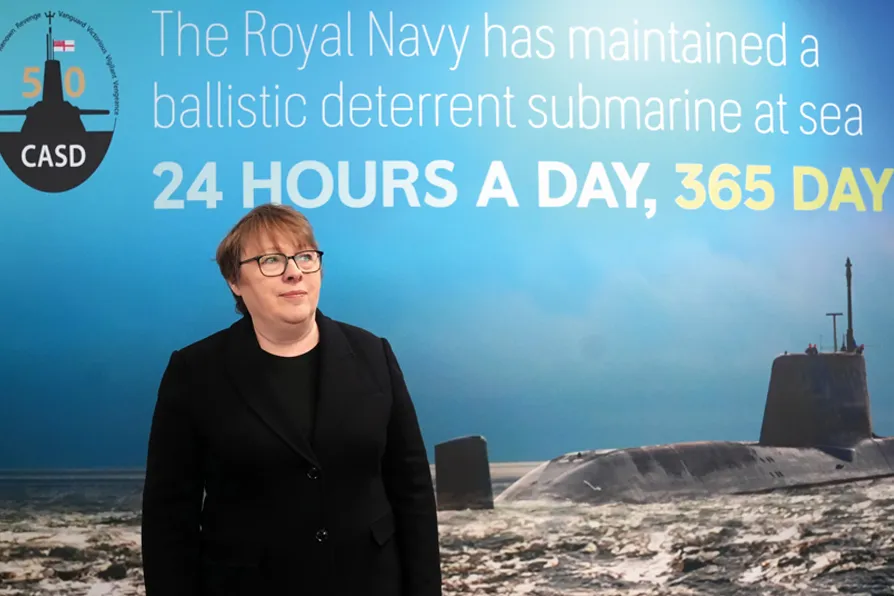 At the time Labour minister for defence procurement and industry, Maria Eagle opens Rolls-Royce Submarines office in Glasgow which will deliver the Dreadnought and Aukus programmes, November 2024

JOHN McINALLY sees little chance of change at Westminster, and calls on the left to get serious about building a real alternative
With the centenary of the UN Slavery Convention upon us, ROGER McKENZIE argues much needs to be done to rid us of all its contemporary manifestations
SEVIM DAGDELEN says European Nato states are escalating ever closer to direct conflict with a nuclear power, and sacrificing welfare states built up over a century to finance it
CLAUDIA WEBBE says the horrific price British patients will pay for this NHS deal is now clear — and there’s time to get out of it, if MPs will only force the issue
KENNY MacASKILL says the lines between party, government and Civil Service in Scotland have been blurred and we need a thorough investigation into how


JOHN HEALEY’S resignation as secretary of state for defence on June 11 delivered the latest in a growing list of challenges to Keir Starmer’s premiership.
In the wake of arguments between the Ministry of Defence (MoD) and Treasury over the long-delayed Defence Investment Plan, Healey accused the Prime Minister of failing to protect Britain’s interests.
An equally excoriating attack came days later, from Strategic Defence Review co-author and arms industry consultant George Robertson, who charged Starmer with “corrosive complacency” over defence.
Both views represent the interests of the military-industrial complex, not the British economy or the majority of people whose standard of living continues to decline.
The military budget is already bloated and putting pressure on the public purse. Investing more on big projects such as expanding Britain’s nuclear capability will not produce the same as results for the economy as investments in health, education, housing or transport.
Britain’s nuclear weapons programmes account for around 14 per cent of the MoD’s budget, according to ICAN, the International Campaign to Abolish Nuclear Weapons. Their recent report deserves more consideration.
Premeditated: Nuclear Weapons Spending in 2025 highlights a spectacular rise in global nuclear spending by the nine nuclear weapons states — including Britain overtaking Russia to become the third-highest nuclear weapons spender.
Rapid rise in nuclear weapons spending
The report documents the exorbitant waste of public funds by the nuclear weapons states that have allocated almost half a trillion dollars of government money to maintaining and upgrading their nuclear arsenals.
Between 2021-25, the nine spent £356 billion on nuclear weapons, with little if any democratic oversight or public scrutiny.
In 2025, spending rose by £90bn, a 19 per cent increase on the previous year. In rank order, they are the US, China, Britain, Russia, France, India, Pakistan, Israel and North Korea. The US leads the pack, as it has for almost 50 years. The US spends more than the combined amount of all other nuclear weapons states.
Congress devoted £52bn to its nuclear weapons programmes in 2025. US nuclear spending rose by 22 per cent, an increase of £9.4bn compared to 2024. This increase in US nuclear spending was almost as much as the entire amount of £10.1bn allocated to its nuclear programme by China, the second-highest nuclear spender.
Building, deploying and maintaining a nuclear weapons system is always a long-term project. ICAN’s report also outlines nuclear developments over the next decade: “Nuclear-armed states are currently planning to build new nuclear weapons systems that will be in operation through 2100.”
Winners and losers
The report also illustrates which pockets are being lined by this increase, and how much government lobbying they engage in to keep the nuclear budget growing. At least 25 companies involved in nuclear weapons projects earned a minimum of $38bn in 2025. They also hold at least $401bn worth of ongoing contracts according to ICAN estimates. These include:
- BAE Systems which designs and manufactures Britain’s nuclear-powered submarines, including Trident Vanguard and Dreadnought class submarines. The company earned more than £1.113bn for all its nuclear weapons work in 2025, 3.7 per cent of total revenue.
- Rolls-Royce Submarines which manufactures the nuclear reactors that propel the Trident submarine fleet. The company also earned more than £1.113bn in 2025, 5.6 per cent of total revenue.
- Babcock International which maintains and refits Trident submarines at the Faslane naval base. The company earned more than £0.98bn for nuclear weapons work in 2025, 20.6 per cent of total revenue.
- Lockheed Martin UK, a British subsidiary of the US aerospace giant, which supplies and supports Trident’s ballistic missiles. The parent company earned more than £3.4bn for all its nuclear weapons work in 2025, 9.6 per cent of total revenue.
While the nuclear industry is booming, the overwhelming majority of people throughout the world are facing a future of growing impoverishment and scarcity — from the spiralling cost of living in the global North, to famine, disease, health crises and water shortages in the global South.
ICAN illustrates what might be contributed to diplomacy, education, health, climate protection, and more if governments redirected the money they spend on nuclear weapons.
… and what the media doesn’t tell us
The real choices governments make are rarely examined from this perspective by the mainstream media of the global North. It spearheads European rearmament, which is a de facto war drive. It justifies military alliances and nuclear weapons by focusing on the counter-factual assertion that only democracies can be trusted to keep the peace.
The underlying narrative is fed by daily news: threats by authoritarian China to democratic Taiwan; the US-Israel war to prevent Iran, a theocratic regime, achieving nuclear capability; and the need for Europe to rearm against rapacious Russia, a military superpower led by an authoritarian president.
Indeed, the case for European rearmament is largely taken for granted across Europe and North America, and the media acquiesces in the lack of transparency about the expansion of nuclear capability.
Britain’s nuclear spending
ICAN estimates that Britain ranks third in the nuclear weapons spending league. British nuclear spending absorbed 14 per cent of the military budget in 2025, an increase of £1.4bn.
Trident, the submarine-launched nuclear weapons programme, is currently deployed on Vanguard-class submarines, with four new generation Dreadnought-class submarines in the pipeline. Britain is also developing a new nuclear warhead and is also expanding its nuclear capability.
At the beginning of 2024, despite Parliament’s silence, we learned that Rishi Sunak had agreed to US B61-12 nuclear bombs returning to RAF Lakenheath as part of the Nato nuclear mission in Europe.
In 2025, Starmer announced his decision to purchase 12 F-35A nuclear-capable fighter jets from the US which are able to deliver the nuclear gravity bombs at Lakenheath to their target.
While the US bears the direct costs of siting nuclear bombs in Lakenheath, Britain covers the costs incurred by integrating them into Britain’s Nato nuclear mission. The 12 nuclear-capable fighter jets will cost the British government around £1bn.
Most important of all, expanding British nuclear capability increases the risk of nuclear confrontation. It does not keep us safe, it makes Britain a target.
Keeping Britain safe
Military spending levels, including on nuclear weapon projects, are political decisions like any other a government makes. Cost is important but not the only or even determining factor.
The current government operates within Labour’s self-imposed fiscal constraints, the parameters of which continue the neoliberal economic framework of past Tory governments.
This leaves Starmer with three unpalatable options for increasing Britain’s military spending. He can raise taxes, increase public debt, or cut the budgets of other government departments. Big business, not the working class, benefits from these constraints.
In the context of a fragmenting political order, Starmer’s government is strained to breaking point.
Attempting to avoid these unpalatable truths, the government argues that investment in armaments, conventional and nuclear, not only creates well-paid, high-skilled employment — it also helps grow the British economy. These are myths.
The arms industry is a relatively small economic sector in employment terms. Studies show that investing in armaments creates fewer jobs than the equivalent invested in sectors such as education or healthcare.
According to the Campaign Against Arms Trade (CAAT), the British defence sector supports roughly one in every 60 jobs, trailing behind retail, hospitality, and public services.
Investment in armaments does not grow the economy. War — the outcome of that investment — obliterates human life, ravages the environment and demolishes social and economic infrastructure. In some cases, it can destroy a society’s long-term ability to recover.
Contemporary examples of this abound across the Middle East and parts of central Asia and Africa.
A 21st century nuclear arms race is already taking shape. The drive to war is gaining momentum, The anti-war movement in Britain and internationally represents the interests of the majority. We are right to demand: cut warfare not welfare!
Carol Turner is vice-chair of CND and co-ordinator of CND’s international advisory group.

Similar stories


For 80 years, survivors of the Hiroshima and Nagasaki atomic bombings have pleaded “never again,” for anyone. But are we listening, asks Linda Pentz Gunter