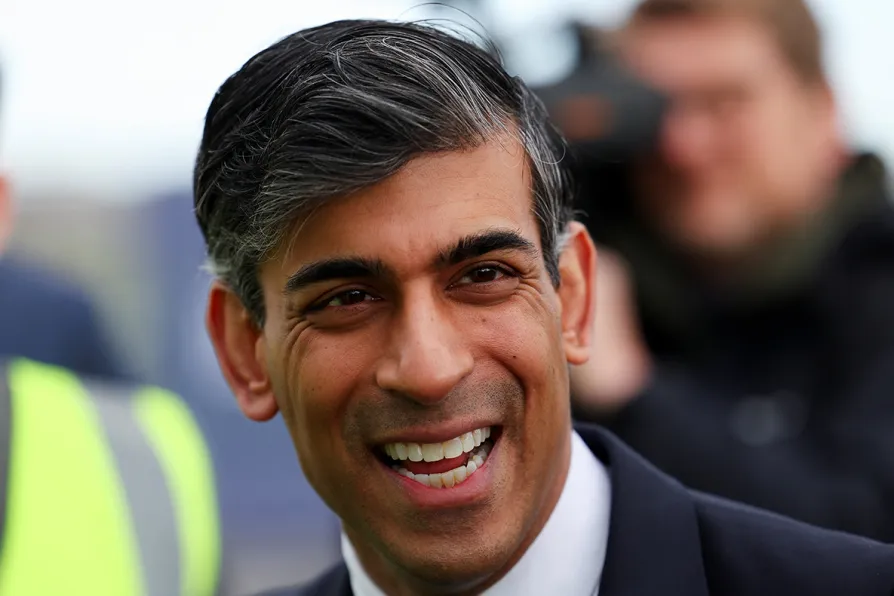
 Prime Minister Rishi Sunak during a visit to Panattoni Park, an industrial park being built on the site of the former Honda Swindon car plant, near Swindon, March 4, 2024



JUST about two-thirds of people in Britain (65 per cent) think the country is going in the wrong direction with just 15 per cent thinking things are going right.
It is not a very bold assertion to understand that these people lean towards the right and it is this demographic that the Tories are tempting with their ambiguous messaging about tax cuts.
These figures are no surprise. According to the latest Ipsos poll dated less than a week ago, this is the ninth month in a row where around six in 10 have said things are moving in the wrong direction.
The reputation of Rishi Sunak is the most threatened by these figures. He has been chancellor of the exchequer or prime minister for most of the recent period and has nowhere to hide save behind the impenetrable barrier that his extreme wealth, global property portfolio and judicious choice of in-laws affords.
In the favourability stakes, only one in five have a favourable opinion of him personally. He can gain some small comfort from the politically not very significant fact that his government is favoured by even fewer people, a mere 13 per cent.
In fact, eight in 10 people are dissatisfied with the way the government is running the country.
None of this is very surprising. The Tories have been in office almost the entirety of the long-running global crisis of capitalism, which makes Britain’s lop-sided, parasitic economy particularly vulnerable and leaves every political formation that is committed to the continuity of the system compelled to shape their economic policies in ways that do not offend people of property or spook the financial markets.
Of particular significance to readers of this newspaper are the opinions of the mass of the working people, everyone whose livelihood depends on their labour, past or present, and who cannot avoid the necessity to work. We tend to discount the opinions of those whose livelihood derives from profits, rents or interest but such is the depth of the crisis that they too are worried.
And here there is a contradiction that lies at the heart of Britain’s political crisis.
It will take a maladroit genius of a Labour leader to lose the next general election.
We should not discount the possibility — after all Neil Kinnock lost to John Major, but just about half of those who plan to vote say they will vote Labour.
The Tories are a shade over a quarter of the electorate with the Greens and Lib Dems around 7 per cent, and Reform on a third of the residual 9 per cent of votes. Labour’s lead is 5 points up from its 15 per cent lead in November.
The contradiction lies in the convergence of several factors.
Firstly while half are firm in their voting intention another half say they might change their minds. And secondly, while he is less unpopular than Sunak Keir Starmer’s net rating of -18 (up from -21) in December only 30 per cent are satisfied with the job he is doing and just about half (48 per cent) are dissatisfied.
Fewer people think Starmer will make a competent prime minister than those convinced he won’t.
Crunch the numbers whichever way you want, and we still have an opposition that can win by default but without much enthusiasm.
While an element of this is the lack of trust in Starmer that is the inevitable consequence of his mendacity much is down to the failure of the party to make a challenge to the anti-working-class policies that unite neoliberals of all “parties of government.”
That is the measure of the problems workers face.

JOHN McINALLY sees little chance of change at Westminster, and calls on the left to get serious about building a real alternative
The defence secretary’s resignation reveals not a split over principle but a dispute over pace of military spending, as Britain’s political Establishment unites behind deeper Nato commitments, argues NICK WRIGHT