

 Latest editorial
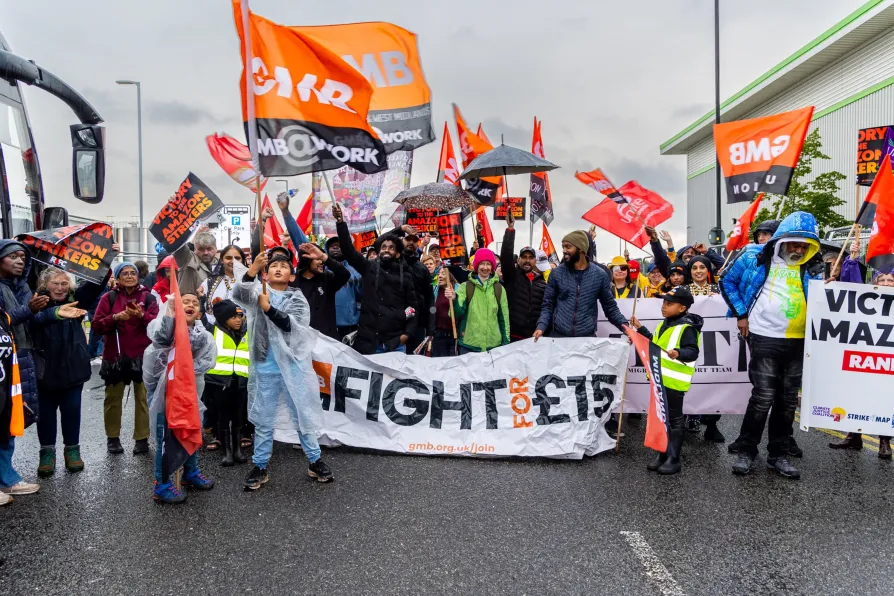 Amazon workers and their supporters outside the company’s BHX4 warehouse on Saturday
[Neil Terry Photography / neilterryphotography.co.uk]
Amazon workers and their supporters outside the company’s BHX4 warehouse on Saturday
[Neil Terry Photography / neilterryphotography.co.uk]



STRIKING Amazon workers at Coventry and their GMB union can count the weekend a victory after warehouse bosses caved in for a day.
Rather than try to keep deliveries running in the face of a militant walkout and a passionate supporters’ rally at the gates, management closed the warehouse on Saturday and sent workers home on a full day’s pay.
This demonstration of workers’ power should warn bosses that the Coventry workforce will not be bullied or duped out of their right to organise.
GMB called out the online retailer’s “dirty tricks” in June, after staff at the site reported it had been flooded with around 1,000 new starters following the union’s application to the Central Arbitration Committee for recognition (a ploy to reduce union membership below 50 per cent of the workforce, the threshold for statutory recognition).
That’s nothing new from Amazon, where in New York last winter a judge had to order it to “cease and desist” its illegal persecution of union organisers.
Amazon might be a transnational giant, whose founder Jeff Bezos more than doubled his wealth during the pandemic and now sits atop a $150 billion fortune, but it is terrified of unions, having closed entire plants where it suspects they may get a toehold.
If hiring 1,000 extra workers (to join a previous workforce of 1,400) seems an extreme way to rig a ballot, that only points to the priority Amazon gives at global level to crushing unions, even if this means spending more money than it would cost to meet workers’ demands locally.
Partly this is because it knows how quickly unionisation news would spread. Amazon workers’ ability to make headlines and attract public support reflects the high profile of the company — the world leader in its field, one of Britain’s biggest private employers — with a cartoon-villain, space-invading, household-name chairman to boot.
That’s a plus for union organisers who know that a dispute at Amazon gets noticed, and that huge numbers of people either know people who work at Amazon or work in very similar jobs, so building sympathy with the aims of a strike is easier.
But that advantage is dwarfed by the challenges organising in such an environment poses, as food workers’ union the BFAWU has found in its battles with a similarly famous employer, McDonald’s. Insecure work, high staff turnover and a culture of fear are high barriers to union recruitment and retention.
But this kind of employment is increasingly the norm. The size of the so-called “gig economy” has ballooned over the past decade, and the sorts of workplaces where a union presence is taken for granted are getting rarer. Three-quarters of Britain’s workers are not in a union.
Unionisation of workplaces like Amazon’s is key to the future of the trade union movement — perhaps even more than McDonald’s, given the way its vast warehouses can dominate local economies and bring workers together in numbers reminiscent of the factories of Britain’s industrial heyday.
It is also key to reversing the race to the bottom on terms and conditions faced by all workers. A market player Amazon’s size sets the trend for its sector: indeed, its super-exploitative model inspired Royal Mail’s attacks on postal workers’ pay and conditions over the past year, and the repeated attempts to hive off profit-making parcels from letters and let the latter sink into decline.
All the horror stories splashed across front pages about Amazon — the timed toilet breaks, the high hospitalisation rates, the impossible targets — become grimmer still when we realise the message broadcast to employers everywhere is that success means treating your workforce like slaves.
Fixing Amazon is part of fixing work in general: restoring the expectation that workers have a right to predictable hours, safety, dignity and above all a voice in their workplace. The Coventry strikers are fighting for us all.

A just transition to Great British Railways and a clean and safe railway for all is not only desirable but also necessary. MARYAM ESLAMDOUST explains

It is only trade union power at work that will materially improve the lot of working people as a class but without sector-wide collective bargaining and a right to take sympathetic strike action, we are hamstrung in the fight to tilt back the balance of power, argues ADRIAN WEIR

BFAWU general secretary SARAH WOOLLEY highlights a catalogue of health and safety failings at the Mowi fish processing plant in Fife