The new Prime Minister must abandon decades of automatic support for US foreign policy, which makes us all less safe, argues DIANE ABBOTT MP


 Latest editorial

North Korea must be brought to the negotiating table
SEAN MORRIS warns of the increasing threat of proliferation of nuclear weapons

Media Lens at 25: David Cromwell and David Edwards reflect on a quarter-century of media criticism, explaining why independent journalism is more important than ever
by Weyman Bennett and Maz’s family
The International Court of Justice has delivered its clearest ruling yet that the right to strike is protected under international law, write Professor TONIA NOVITZ, Professor KEITH EWING and Lord JOHN HENDY KC
Emergency phone alerts could help Britain respond to rising wildfire risk, but Australia’s experience suggests they work best as part of a broader strategy, write ELLIOT CONVERY-FISHER and KATE PARKINS
A champion motorcyclist, trade union organiser and communist, Clem Beckett went from Britain’s speedway tracks to the battlefields of Spain, where he gave his life resisting Franco’s forces at Jarama. GEOFF BOTTOMS pays tribute to this remarkable anti-fascist


THE Nuclear-Free Local Authorities (NFLA) group is very concerned with the reported news that the North Korean government has apparently successfully test-fired a missile — with the capacity to bear nuclear weapons — to a potential distance of over 4,000 miles, putting them in the range of North America and much of Europe.
The proliferation of nuclear weapons to now include North Korea is a real example of the weakness of the nuclear Non-Proliferation Treaty (NPT) and why it is more important than ever to move forward with more effective multilateral policies for disarmament.
That the existing nuclear weapon states are all planning to modernise their nuclear weapons — at huge financial cost — is a key part of what has influenced North Korea to pursue a nuclear weapons programme, even at the expense of the welfare of its own people.
Receiving next to no media coverage in Britain, over 120 countries at the United Nations have approved an international treaty seeking to ban nuclear weapons.
These discussions partly arise out of deep frustration from the vast majority of UN members with the intransigence of the P5 nuclear weapon states — the US, Russia, China, Britain and France.
The nuclear weapon states, along with most Nato members and those under the US “nuclear umbrella” like Japan and Australia, have boycotted all discussions to develop a nuclear weapon ban treaty.
US ambassador to the UN Nikki Haley has argued their non-attendance is because of these “new” nuclear proliferation threats from the likes of North Korea.
While it is a major development for North Korea to fire a missile which could theoretically travel such large distances, it does not mean it could yet be able to deliver it.
The South Korean government, for example, says there is no evidence the missile could withstand high temperatures and successfully re-enter the atmosphere. So there remains a limited window of opportunity to put international diplomatic pressure on North Korea to negotiate on its nuclear programme. That opportunity should be taken.
However, North Korea’s belligerent stance partly derives from the perceived threat it sees to itself, and the country sees little evidence that the nuclear weapon states will ever seriously move towards multilateral nuclear disarmament. For example, here in Britain, highly expensive plans to spend billions of pounds on four new Trident nuclear weapon armed submarines are moving forward, with similar programmes in the US, France, Russia and China.
The development of a UN Nuclear Weapon Ban Treaty, formally agreed in New York yesterday, is a hugely positive development.
It says that the vast majority of the governments of the world want a nuclear weapons-free world. That also still remains the policy of the British government and all British and Irish political parties, though little is being done by Westminster to realise it.
It is now incumbent on nuclear weapons states to stop boycotting such discussions and actively work for nuclear disarmament, or North Korea will be joined by other states that have followed the actions of Israel, India and Pakistan to develop their own nuclear weapon programmes since the NPT was ratified.
NFLA steering committee vice-chair Councillor David Blackburn said: “As a strong and vocal supporter of the International Campaign to Abolish Nuclear Weapons (ICAN) and the Mayors for Peace, NFLA warmly welcomes the dedication of many states to encourage and realise nuclear disarmament through the Nuclear Ban Treaty process.
“It contrasts with the belligerence of nuclear weapon states and North Korea over much of the past decade, where much was promised but little delivered.
“The only substantive success in that period was persuading Iran to co-operate on its own nuclear programme.
“While there remain so few signs of significant nuclear disarmament among existing nuclear weapon states, it is hardly surprising North Korea is continuing to develop its own programme.
“We have limited time to bring North Korea back to the negotiating table and the United Nations must try to do so.
“A fully nuclear armed North Korea is part of the nightmare scenario the NPT was supposed to prevent. Now we must look to the new Nuclear Ban Treaty process as the genesis of a more effective and widely supported corollary process to encourage North Korea and others to disarm these weapons of mass destruction.”
Sean Morris is secretary of the Manchester-based Nuclear Free Local Authorities group.

Similar stories

We need a government that invests in saving lives not destroying them, argues SOPHIE BOLT
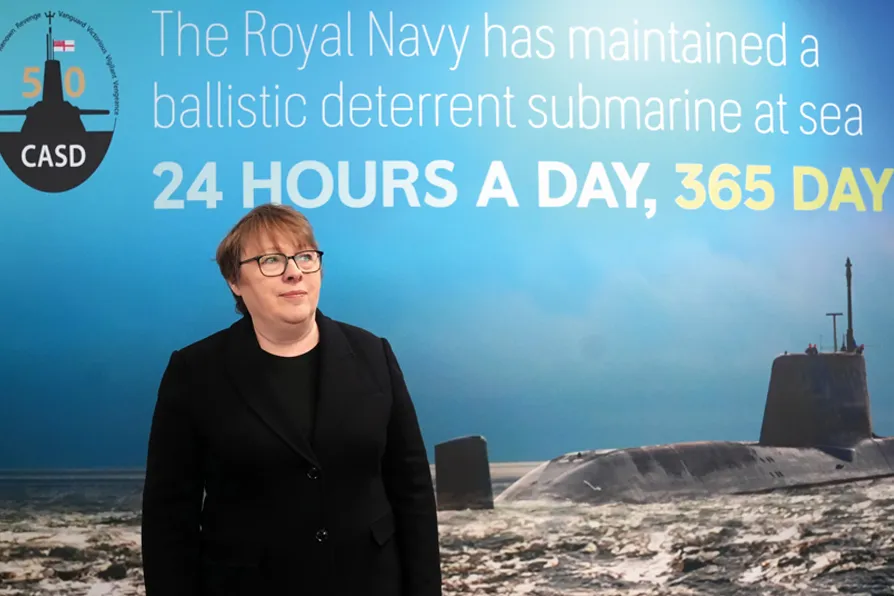
Expanding Britain’s nuclear capability increases the risk of nuclear confrontation. It does not keep us safe – it makes us a target, argues CAROL TURNER
For 80 years, survivors of the Hiroshima and Nagasaki atomic bombings have pleaded “never again,” for anyone. But are we listening, asks Linda Pentz Gunter