CJ ATKINS takes a closer look at Trump’s recent spate of red-baiting speeches and asks why the authoritarian president is running scared


 Latest editorial
Nine years after Grenfell, Kensington & Chelsea council hasn’t learned a thing
EMMA DENT COAD explains why she is stepping down from the council after 20 years and how the legacy of the fire still haunts the area

JOHN McINALLY sees little chance of change at Westminster, and calls on the left to get serious about building a real alternative
With the centenary of the UN Slavery Convention upon us, ROGER McKENZIE argues much needs to be done to rid us of all its contemporary manifestations
SEVIM DAGDELEN says European Nato states are escalating ever closer to direct conflict with a nuclear power, and sacrificing welfare states built up over a century to finance it
CLAUDIA WEBBE says the horrific price British patients will pay for this NHS deal is now clear — and there’s time to get out of it, if MPs will only force the issue
KENNY MacASKILL says the lines between party, government and Civil Service in Scotland have been blurred and we need a thorough investigation into how


MY 20 years’ service as a councillor at “the Grenfell Council” ended on May 7. I could no longer bear to be seen as complicit with the Royal Borough of Kensington & Chelsea Council’s ongoing failures for another term. Many people tell me, with exhausted resignation, that they have got worse. I agree.
Last summer they were handed a “C3” grade by the Social Housing Regulator, which is second to worst. This was because nearly one-third of council homes did not meet Decent Homes standard.
The repairs reporting system is mostly online and is unreliable, which makes it even more difficult for anyone not online or who struggles with the internet. If they get booked in, the work can be dodgy, requiring a revisit.
Some people have resorted to fixing things themselves. This is truly appalling for a council that has been under intense scrutiny for the nine years since the Grenfell Tower fire, and given the multiple evidenced failures in the two Grenfell Tower Inquiry reports.
What have they been doing for nine years?
Recently the council has been trumpeting that they are striving to be “the best council they can be.” If you read their press releases, or attended some of their meetings, you might well applaud them for their successes. Unfortunately for council tenants, ‘the best’ is pitiful.
In November last year, the council was hit by a massive cyber-attack. You might say it could happen anywhere, but they had no less than five warnings over the previous year.
In November 2024 when discussing budget cuts, a member of the committee responsible for oversight raised concerns about the potential risks of cuts to the cybersecurity budget.
Then in March 2025 the auditors expressed concerns about the implementation of the new Oracle system handling finance, HR and payments, given the overlap of older systems and staff not properly trained to date.
In June a group of council tenants, looking at the failing repairs reporting system, warned about “gaps in IT systems.” In July the Local Government Association comment about the “complex landscape of digital platforms and legacy systems” — some of which could no longer be updated. And then there was the Social Housing Regulator C3 rating, in part due to some of these failures.
Yet they did nothing.
The frustration of residents over the chaos of the cyber-attack has been increasing over the months, as payments have been made or not, benefits stalled, and planning applications left on hold.
Many residents struggled with the three-month hit of council tax payments. On asking what kind of help they were offering, the council said “it’s all on the website” — not much good for people not on the net.
Some were getting automatic threatening letters from their housing associations due to unpaid rent, and told to “ignore them.” Most recently a demand for six new officers has been made, to tidy up the ongoing mess, which is likely to take another year minimum.
Much has happened to the Grenfell community in the past 12 months. For a period we had Angela Rayner as secretary of state in control, and she was a breath of fresh air, seeming to understand and empathise in ways we hadn’t experienced before.
This brief solace dissipated quickly when she upset bereaved and survivors by muddling the announcement of the tower’s imminent “deconstruction.” This could have been at least partially avoided if she’d shared the Tory government’s engineering report of 2021, which said the tower should be taken down asap — which they ignored — and then talked everyone through the updated report, which made clear it was getting urgent.
I read both reports and there was no other option from what I understood. We lost this sympathetic voice when she was forced to resign her position due her tax affairs, and we are faced with a hard-faced replacement secretary of state.
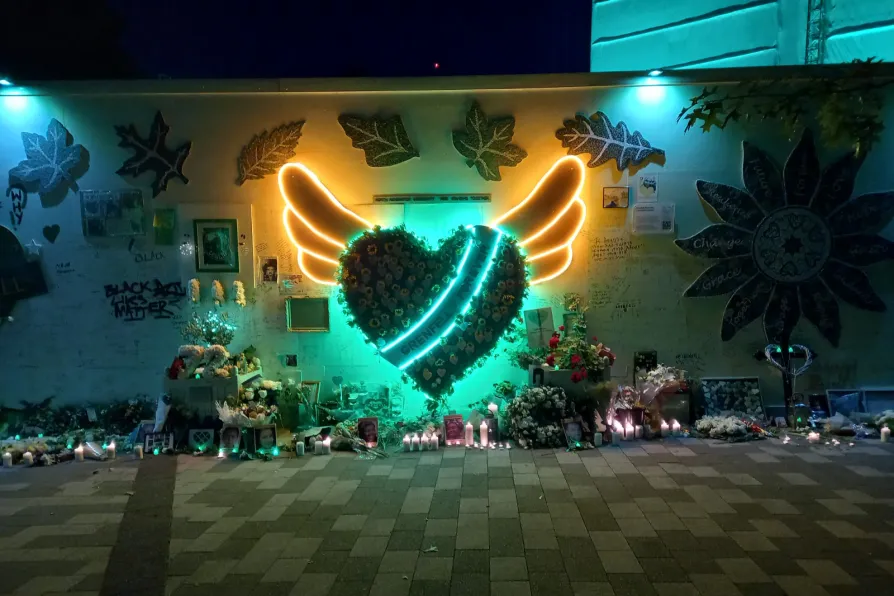
So, in the run-up to the ninth anniversary on Sunday June 14, the tower has been coming down.
Barely a third of the building in its shroud is now visible, and it will be completely demolished very soon in readiness for the developing plans for a memorial garden.
This has been hugely traumatic for those who think the world will forget what happened without the tower’s looming presence, for those who regard it as a sacred site, and for those who thought it should stand as a permanent rebuke to those responsible. For some it will be ever-present in their minds, physically or not, and they might feel pain from a “phantom limb” forever. For me, and some others, I’m relieved it will be gone soon and that I won’t be triggered daily.
I have sadly failed in persuading my traumatised and angry neighbours that the world has absolutely not forgotten Grenfell. It is a daily issue in the built environment world due to the struggles of architects, developers and contractors navigating around new legislation.
Of course the housing press regularly reports tenants facing genuine fear of a possible fire, along with frustration and unpayable bills for the “excluded” for whom the government won’t cover the costs to fix the homes they have moved into or invested in.
I’m returning to my former role as a journalist, and am in the final stages of writing my second book on this subject — Grenfell Britain: Greed, Power and National Tragedy which will be published by Verso next spring.
With Grenfell at the heart of the book, it expands to take in all the housing crises we are facing that relate to fire and building safety issues. When you add together all the people living in danger in their homes, it is absolutely terrifying.
Emma Dent Coad was MP for Kensington from 2017-19 and served on Kensington & Chelsea Borough Council from 2006 until last month.
