

 Latest editorial

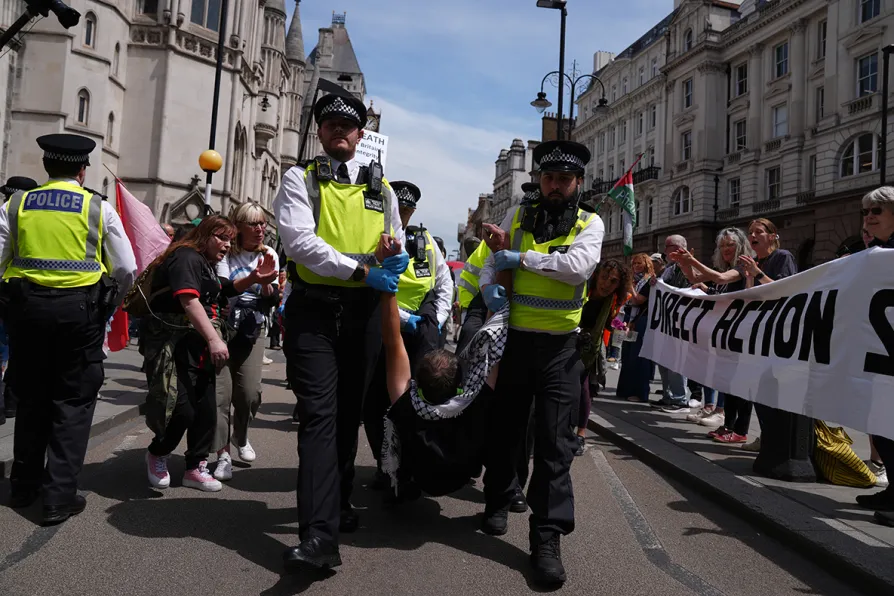 Police remove protesters from outside the Royal Courts of Justice in central London after the Court of Appeal ruled that the decision to ban Palestine Action as a terror group was lawful, June 15, 2026

Waiting for the grander vision to emerge


THE Court of Appeal decision to uphold the government’s absurd ban on Palestine Action as a “terrorist” group shows the need for a political revolt against the decree.
The definition of terrorism is being stretched to include any criminal damage to property done with a political motive, as we saw with Friday’s sentencing of the Filton Four. There, Mr Justice Johnson cited defendants’ aim to “influence the government” as evidence in favour of treating their attack on an arms factory belonging to Israeli firm Elbit Systems as a terrorist act.
The Court of Appeal is similarly sweeping. “The whole premise of Palestine Action is to cause damage to property,” it charges, before adding: “At no stage has Palestine Action suggested that its terrorist activities were either a mistake or an aberration.” “Damage to property” has by sleight of hand become “terrorist activities.”
Judges’ reference to the Suffragettes, in order to contrast their direct action to Palestine Action’s so-called terrorism, is again misleading; they state that the latter has “caused injury as well as property damage” (so did some Suffragette activities) and that its use of “secret cells to avoid … detection and prosecution” adds to the case for it being terrorist.
Elbit’s production of weapons used in a genocide against the Palestinians is described as “lawful business” despite the cases against Israel and Israeli leaders at the International Court of Justice and International Criminal Court. And speculation about future activities is given as much weight as anything that has actually been done (“The future threats and risks posed to third party individuals and property by Palestine Action are perhaps the most important factors … the home secretary is in the best position to assess those future threats and risks”).
All this simply shows that the courts are not a defence against authoritarian government.
Denying that the ban has had a chilling effect on freedom of protest, when police have arrested thousands of people for sitting down in public holding placards, is ludicrous; so is trusting ministers to tell the truth about groups they want to ban (the home secretary who pushed the ban through, Yvette Cooper, prepared the ground with baseless smears that Palestine Action might be funded by Iran).
Evidence-free froth about links to foreign states is doubly dangerous: it provides an excuse to suppress dissenting voices at home and raises international tensions when the risk of world war is again real, thanks in no small degree to the belligerence of our own government and its trigger-happy allies.
If the government cannot be turned from its repressive path judicially then this needs to happen politically. Even if Palestine Action can appeal to the Supreme Court, that won’t stop plans to give police powers to ban marches based on their “cumulative impact” or the prosecutions of peace movement leaders like Ben Jamal and Chris Nineham. We need a mass movement that forces ministers to back down.
And Palestine solidarity is a mass movement — the very reason the state is determined to suppress it. Not only has it had a real impact — pressing a reluctant government to demand a Gaza ceasefire, and impose some restrictions on arms sales to Israel — but its exposure of the power of the military-industrial complex and the sick nature of Britain’s foreign policy undermine the Establishment’s wider bid to rally the country behind a new war drive.
Labour will soon be plunged into a leadership contest, and this is terrain — given majority support for the Palestinian cause among affiliated unions and party members — suited to a mass campaign to end the ban. Huge pressure will be put in the opposite direction by the securocrats and the arms dealers — but the majority of the public are on our side, and we need to make that count.
