

 Latest editorial

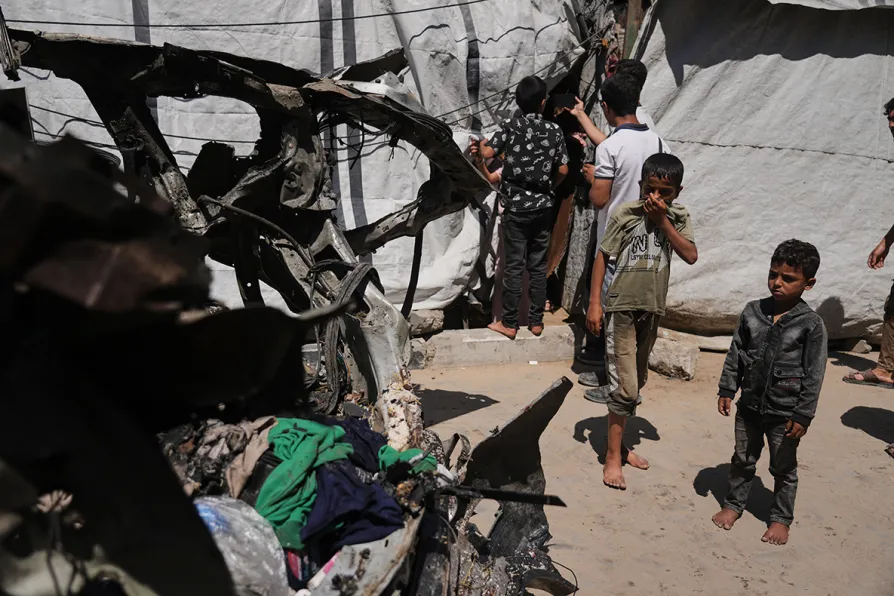 Palestinians gather around a car hit in an Israeli strike in Gaza City, June 18, 2026
Waiting for the grander vision to emerge


MANY factors could yet upend the pause in hostilities in the Middle East, currently subject to a 60-day pause.
President Donald Trump’s own volatility is certainly one. Given the widespread sense amongst his own bellicose supporters in the US that the deal represents at very best no gain for all for Washington the risk of him restarting hostilities on a whim is a real one.
But the even wilder card is surely Israel. That the immediate conflict is over, with the Iranian government still very much in place, underlines, once again, the failure of Benjamin Netanyahu’s policy of endless war.
None of the expected achievements he sold to the Israeli people — and to Trump himself — have been attained. The Islamic Republic has been strengthened, not overthrown; its nuclear programme is subject to future negotiations; its missile programme is explicitly left intact and it has the prospect of relief from economic sanctions.
Thus a war Netanyahu has been trying to cajole successive US presidents into for decades has come and provisionally gone without the expected results for imperialism and its local instrument.
Indeed, it has deepened still further the international isolation into which the genocide in Gaza and the ethnic cleansing on the West Bank had already plunged Israel. As Trump purportedly told Netanyahu last week “the whole world hates you.”
The Israeli government has worked might and main to prevent any agreement being reached between the US and Iran. Its main lever has been continuing bloody aggression in Lebanon.
Iran has made it clear that a ceasefire in the conflict must include Lebanon too — that peace in the region is not divisible.
Yet Netanyahu has continued to order one murderous assault after another, slaughtering thousands of Lebanese civilians as well as trying — and failing — to destroy Hezbollah, the Lebanese resistance movement allied with Tehran.
Israel has also continued to expand its sphere of occupation in southern Lebanon and is stubbornly refusing to leave — just as it occupies a growing swathe of Syria as part of its programme of expansion.
Netanyahu’s object is to create a climate in which a US-Iran deal is impossible, or to undermine it as quickly as possible if it emerges nevertheless.
Israel’s every action proves that it is one of the most important destabilising elements across the Middle East and that no broader settlement is possible until its aggressions are curbed.
That means above all demanding that Israel withdraw from Gaza as it had pledged to and immediately cease its ethnic cleansing on the West Bank, as a precursor to a full withdrawal from the occupied Palestinian territories.
It also means a full and complete withdrawal from Lebanon as well as from all parts of Syria, including the Golan Heights illegally annexed in 1967.
From there it must include a full settlement with the Palestinian people, including addressing the right to return for the refugees and their descendants displaced in 1948 and since.
It is idle to suppose that any such policy is going to be embraced from inside Israel itself. While there are internal forces ranged against Netanyahu and his fascist accomplices, the opposition in Israel mostly embraces too much of his programme, including rejection of a Palestinian state.
Thus the elections scheduled for October will not bring peace. Only international pressure, including from the major powers which have sustained the zionist project for nearly 80 years, can effect the changes needed.
It is now more than ever urgent that they do so as peace in the Middle East hangs in the balance. Britain’s Labour government — shortly to be under new management — must unequivocally back such pressure.
