The Tories introduced the 50% strike ballot threshold to make industrial action harder. MATT WRACK argues that a Labour government has no justification for leaving it on the statute book


 Latest editorial
By the People, For the People: a young communist’s report from China
MAISE RILEY reports on her recent visit to China with a delegation of young communists from Europe and North America to see China’s people-led development
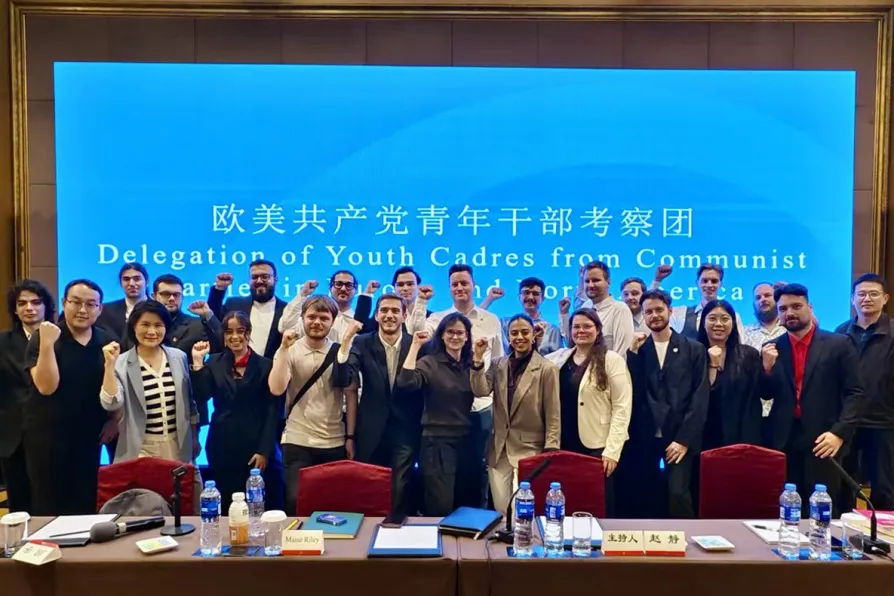 SOLIDARITY: Delegates (Maise Riley front row centre)in China, May 2026

In the wake of Ann Widdecombe’s murder, JOHN GREEN wonders whether the government will really get to grips with the root cause of these attacks on our MPs
The new PM’s opening addresses offered hope, council homes and reform — but little detail on how any of it will be delivered, warns CLAUDIA WEBBE
Despite the screeching from the right-wing media, Burnham’s speech chimed with the public mood - and socialists should take advantage, says Morning Star editor BEN CHACKO
Scotland's Labour leader cannot continue to evade responsibility for the party's decline, argues LAUREN HARPER
Nature as well as society works dialectically, asserts the Marx Memorial Library and Workers’ School


LAST month, the international department of the Communist Party of China (CPC) hosted a delegation of young communists from Europe and North America to discuss the role of communist parties in the new era and the global challenges facing young people.
Our trip took us to Beijing, Sha’anxi, Yan’an and Xi’an to see the China’s astonishing development. We also learned about the origins and development of the CPC, its theory of people-first governance and Xi Jinping Thought for a New Era, and about Chinese history and culture.
Our visit began in Beijing with official meetings with Vice-Minister Jin Xin, director of the CPC international department. I joined Irena Maliyuk from the Communist Party of Belarus and Nichita Liga of the Romanian Socialist Party in a discussion with comrade Jin Xin who told us how the CPC continues to work with and learn from fraternal communist parties as it develops Xi Jinping Thought for a New Era.
Minister Jin Xin also commented positively on so-called “Chinamaxxing,” the social media trend in the West that promotes Chinese culture and development to a wider audience. So, for critics of this trend, I’m taking that as permission to carry on!
We visited Hubei, Yan’an and Shaanxi provinces, which are less developed than big cities like Beijing and Shangai, to see how Chinese modernisation is being applied and developed in practice.
At a multilateral meeting in Hubei with delegations from Nicaragua, Tonga and Laos, I compared the decline of rural Britain with the rural revitalisation programmes we witnessed in China.
We heard testimony from local community members about their rural revitalisation work. Zhang Hua, a Domestic Service Worker, had taken an upskilling programme enabling her to earn her own income. She said she was so happy when she got her first pay packet, it inspired her to help other women obtain education, qualifications and references through the programme.
We also heard from Lu Yange, chair of a co-operative producing Chitin, a polymer (polysaccharide sugar molecule), a natural building block that acts as organic armour for many living organisms.
Lu Yange explained how farmers used to struggle to harvest jujube berries, which suffered from fruit shrink disease. After attending university, he was inspired to support local farmers to improve the quality of the jujube harvest. This was so successful that jujube berries from Hubei are now presented as diplomatic gifts — and I can confirm, they taste delicious!
Our delegation also learnt about aspects of Chinese culture and the development of the CPC. We traced the historical and theoretical developments of the party and of Xi Jinping thought and its influence on Socialism with Chinese Characteristics for a New Era.
To see China’s people-led development path in practice, we visited the rural village where Xi Jinping was sent to work in 1969 aged 15 as an “educated youth” and where he lived until 1975.
We received a historical lecture from local villagers on grassroots people’s governance and Xi Jinping’s own personal history. When Xi first arrived in their village, he brought a suitcase of books so heavy that the villagers thought he had brought a suitcase full of gold.
Initially, finding it hard to adapt to rural life, Xi learned to labour with the villagers by helping to dig wells and build septic tanks. Xi credits these experiences as teaching him the importance of seeking truth from practice and learning the importance of people-first ideology — rooted in the people and based on practical experience.
As part of our CPC history study we visited revolutionary memorials, including the Xibaipo Memorial Hall where comrades in our delegation sang The Internationale in their own languages with their party flags to commemorate Victory over Fascism Day on May 9.
The People’s Daily media reported this, and a video of our visit went viral on Chinese social media. From then on, we were stopped in museums, at monuments and regularly on the street for photos!
We also visited Nanniwan, site of the Red Army’s self-sufficiency campaign and CPC’s headquarters between the 1930s and ’40s, where a gigantic, red hammer and sickle monument is inscribed in German with the Communist Manifesto.
Our arrival caused quite a stir and after many photos with visiting Chinese aunties, we danced with them in the square, ending with them joining us in a conga in front of the monument!
This was just one example of the warm welcome we received from ordinary people in China.
We visited several museums exploring the diverse and rich cultural heritage of China, including a visit to the University of Traditional Chinese medicine where we experienced cupping and acupuncture.
At the Cultural Studies department at Xi’an International University, we found study programmes on traditional Chinese culture alongside degree modules where students can study traditional tea ceremonies, calligraphy, music and painting.
These experiences, alongside Vice-Minister Jin Xin’s appreciation for Chinamaxxing, gave us a real sense of a China that is proud of its cultural heritage and wants to continue to preserve, develop and share it with the world as part of socialist modernisation.
The differences in approach to traditional cultures between China and Britain is stark. Whereas China cultivates and supports traditional cultures and rural peoples in the context of socialist modernisation, in Britain we see a decline in the number of people able to afford to learn and practice traditional crafts, with many at risk of becoming extinct.
Rural revitalisation is an issue about which we can learn much from China. In Britain, rural communities struggle to access education, jobs, healthcare and public transport.
While in China the age of rural communities is increasing as younger people move to cities for better economic opportunities, China is bringing better job opportunities to villages and providing equal access to education and healthcare as part of its plan for full-basic, socialist modernisation by 2035.
Sustainable ecological development is also an essential part of China’s long-term development of productive forces, guaranteeing food and national security. China’s 15th Five-Year Plan seeks to reduce reliance on fossil fuels.
The solar farm we visited in Qinghai for example, creates green energy and simultaneously supports de-desertification.
China’s planned and holistic approach to ecology is in marked contrast to our own environmental crisis in Britain, where water firms pollute waterways with impunity, there is no long-term plan to guarantee food security, and our National Grid has not yet been upgraded for renewable alternative energy sources.
People-first governance may seem like an alien concept to people in Britain, inured to governments that represent the interests of private capitalist monopolies, which provide a revolving door for senior civil servants and politicians into lucrative private sector careers and directorships.
But China’s people-led governance under the leadership of the CPC has seen its development go from strength to strength, becoming the world’s leading economy and eradicating absolute poverty.
From defeating Japan’s invasion in 1945, to founding the People’s Republic of China in 1949, to raising nearly 800 million people out of extreme poverty since the late 1970s, to achieving rapid industrialisation faster than any other nation, and today undertaking the challenge of green transition, China has a clear plan for future socialist development led by the people, for the people.
