The Tories introduced the 50% strike ballot threshold to make industrial action harder. MATT WRACK argues that a Labour government has no justification for leaving it on the statute book


 Latest editorial
Wales has a new government. Now it must deliver on housing
ALLISON FEWTRELL on what Plaid Cymru's historic election victory means for the communities being failed by Wales’s housing crisis, and four things the new government can do right now
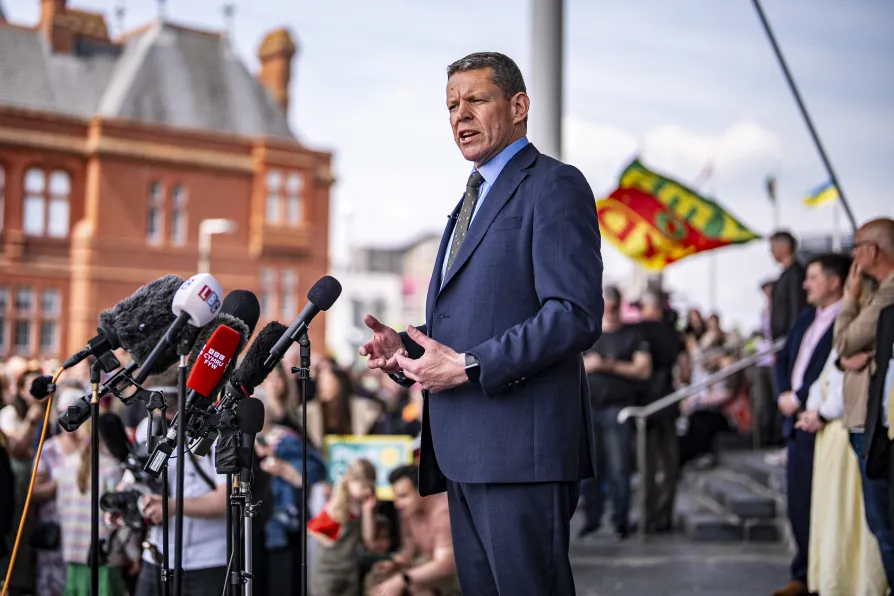 TIME TO DELIVER: Plaid Cymru leader Rhun ap Iorwerth speaks to supporters on the steps of the Senedd

In the wake of Ann Widdecombe’s murder, JOHN GREEN wonders whether the government will really get to grips with the root cause of these attacks on our MPs
The new PM’s opening addresses offered hope, council homes and reform — but little detail on how any of it will be delivered, warns CLAUDIA WEBBE
Despite the screeching from the right-wing media, Burnham’s speech chimed with the public mood - and socialists should take advantage, says Morning Star editor BEN CHACKO
Scotland's Labour leader cannot continue to evade responsibility for the party's decline, argues LAUREN HARPER
Nature as well as society works dialectically, asserts the Marx Memorial Library and Workers’ School


WALES woke up to a different political landscape last month. For the first time since 1999, Welsh Labour is out of government. Plaid Cymru is forming a minority government after winning 42 seats, and Reform UK, on 34 seats, is the official opposition. Nowhere is the pressure on Plaid to deliver greater than housing.
The scale of the crisis is hard to overstate. Wales has a backlog of 9,400 households with no suitable home, up 64 per cent since 2019 (Welsh government, 2026). Social housing is just 16 per cent of total stock, when 20 per cent is the minimum needed to ease pressure on the private market (Senedd Research, 2024). Over 120,000 Welsh homes sat unoccupied in 2021, the most recent figures available (ONS, 2024). Meanwhile, more than 2,200 privately rented properties have been lost since the last Senedd election as landlords switch to holiday lets (NRLA, 2026).
The communities bearing the brunt
The crisis lands hardest in five places:
The communities bearing the brunt
The crisis lands hardest in five places:
- Gwynedd: five of Wales’s 10 most deprived housing communities are here (WIMD 2025); 60-65 per cent of local people cannot afford to buy or rent locally, homelessness rose 48 per cent between 2019 and 2022, and the Welsh language is leaving with the people priced out.
- Ceredigion: nearly 7 per cent of all properties are vacant or second homes, with second home ownership rising steadily over the past decade (ONS Census 2021).
- Cardiff, Grangetown and Riverside: four of the 10 most deprived housing communities in Wales are in the capital; Grangetown 9 is the worst in the entire country on both housing conditions and availability (WIMD 2025).
- Rhondda Cynon Taf: over 2,700 empty homes stand in communities where families are in temporary accommodation.
- Rural North Wales, Ynys Mon and Denbighshire: Denbighshire saw the sharpest rental growth of any Welsh council in 2025 at 8.4 per cent, pricing young people out of the communities they grew up in (Savills, 2025).
What the new government has promised
Plaid’s manifesto goes further than anything Welsh Labour delivered in 27 years. A legal right to adequate housing. Twenty thousand new social homes by 2030. Unnos, a new national body to build homes and acquire land, named for the Welsh tradition of building overnight to claim common land. Abolishing no-fault evictions and capping rent rises. These are real commitments. But commitments are not delivery.
Four things Plaid can do now
First: direct all 22 councils to use their powers over empty homes.
The Housing Act 2004 already lets councils take over long-term empty properties, rent them out, recover costs, and return the home to its owner. Most Welsh councils never use this power. A Welsh government direction with clear targets could bring empty homes back into use within months — no new laws, no new budget.
One caveat: families housed this way need security, not just a temporary roof. When an order ends and the owner reclaims the property, they can be back to square one. The Welsh government must pair any directive with a priority rehousing guarantee and a council right to purchase if the owner decides to sell.
Second: ensure second homes premium income is spent on affordable housing.
Most Welsh councils now charge second home owners 150 per cent council tax. The money is coming in — but it is not consistently being spent on the housing problem it taxes. A simple direction requiring all this income to fund affordable housing, with public annual reporting, would redirect existing money without a single new law. See the Welsh government’s written statement on second homes (November 2025).
Third: make the empty homes grant scheme compulsory.
Wales already has a grant to fund renovation of vacant properties. Several councils have opted out. Making participation mandatory across all 22 councils, with proper funding behind it, could turn thousands of empty buildings into homes.
Fourth: give Unnos the power to buy land before developers push prices up.
Unnos will only transform Welsh housing if it can acquire land at its current value before planning permission inflates prices. Without that power, it will be outbid by developers and operate on their terms. With it, the value that public investment creates would flow back to Welsh communities, not private landowners.
None of these four actions needs Westminster’s permission. All are within the power of the Welsh government today. The mandate exists. The powers exist. The only question is whether Plaid Cymru will use them.
Allison Fewtrell is a housing activist based in Wales.
