While international actors discuss governance and reconstruction, Netanyahu has made it clear that Israel has no intention of ending its military occupation, says RAMZY BAROUD

France’s role in Trump’s global war drive
While millions face poverty and public services are squeezed, France is committing billions to defence spending and weapons production, in a dangerous shift towards permanent preparation for war, says CONOR BOLLINS
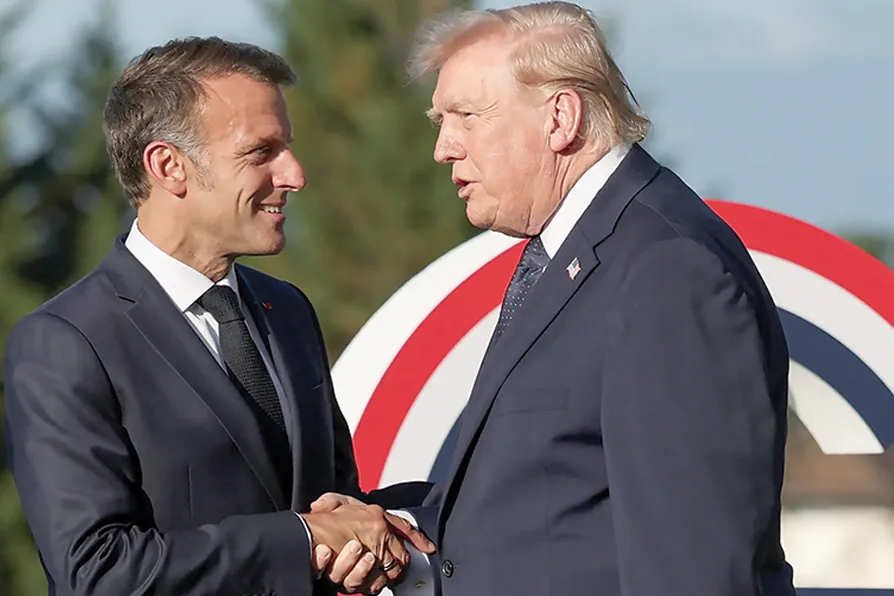
 FOREVER SERVILE: French President Emmanuel Macron greets US President Donald Trump at the G7 summit in Evian, France in June 2026
NICK WRIGHT continues his series analysing the trends in European politics
We have the alternative economics, histories of our struggles and the confidence to change the world
General Federation of Trade Unions assistant general secretary HENRY FOWLER reports on the final day from the GFTU’s residential Summer School at the Workers’ Retreat, Quorn Grange Hotel
Capitalism has exploited — and polluted — our natural resources for too long, it’s time we treated our rivers as living beings, writes MIRIUM GAUNTLETT, LIAM SHAW and ROX MIDDLETON
Treating the Clacton by-election as a joke risks reinforcing the Reform leader’s claim to be the victim of an out-of-touch Establishment, argues JOHN McINALLY
MPs and others called for the urgent release of tortured Palestinian doctor, Hussam Abu Safiya, held hostage by Israel and reportedly near death, reports LINDA PENTZ GUNTER


EMMANUEL MACRON, in his final address to France’s armed forces ahead of Bastille Day, declared that Europe must be prepared to defend itself even “at the cost of our blood.”
As president of France, Macron has been overseeing preparations for “high-intensity” warfare. At last week’s Nato summit, Macron claimed that Europe was now in a much better position to fend off Russia.
In truth, Nato member states have only committed to huge increases in military spending, at the expense of social welfare and public services, in order to appease Donald Trump. Ultimately, it has been the pressure exerted by the Trump administration that has forced France and other Nato members to agree to spending 5 per cent of their GDP on so-called defence by 2035.
Macron has played the decisive role in arguing that France needs to build a war economy, or economie de guerre. Legislation, such as the “military programming law,” has emphasised the need to expand the production of weapons and ammunition on an industrial scale.
These laws have also enabled huge sums of public money to be spent on lethal new technologies, such as drones, artificial intelligence and autonomous weapons systems.
Last month, the French parliament approved government plans to increase military spending by an additional £30.5 billion by 2030. This will raise France’s annual defence budget to £65 billion by the end of the decade.
With the exception of La France Insoumise (France Unbowed), political parties from across the political spectrum voted in favour of these military spending hikes.
Jerome Legavre, a deputy in the French national assembly and member of La France Insoumise, has noted that these measures have come at a time when there are 10 million people in France who are living in poverty.
As president, Macron has championed fiscal austerity and cuts to public services. This makes the vast increases in military expenditure all the more galling.
Peace activists are calling for this money to be instead spent on health, education and tackling climate change. Sadly, the government is very much entrenched in its position.
Since the outbreak of the war in Ukraine, Macron has regularly tried to present himself as a strongman. This has often reached bizarre heights. At one point, the Elysee Palace even released a series of cringeworthy photos depicting Macron as a musclebound boxer.
In recent months, there has been an increase in civilian casualties as a result of the war. However, rather than helping to bring about peace, Macron has frequently floated the idea that European states could deploy ground troops in Ukraine.
These threats accelerated in 2025, when the so-called “Coalition of the Willing” was formed. This is a group of European states who will allegedly seek to install a combined military force in Ukraine.
As all of the members of this coalition are also members of Nato, this could possibly trigger global warfare.
Realistically, the only way to end the war in Ukraine will be through diplomacy. This will likely require Ukraine, Russia and Nato to mutually agree to a set of multilateral security guarantees.
Refusing to accept this reality, Macron has instead been contributing to an escalation of tensions. This has involved a proposal for France to deploy nuclear-capable Rafale fighter jets to countries such as Germany and Poland.
This would place French nuclear weapons right next to Russia’s borders. So, if a wider continental war did break out, there would also be an increased risk of it going nuclear.
To justify his belligerence, Macron has increasingly argued that Russia represents an existential threat that needs to be opposed at all costs.
In France’s revised National Security Review, published in 2025, his government suggested that the entire nation will need to mobilise to meet this challenge through a “genuine moral rearmament of the population.”
Little wonder that le Mouvement de la Paix, France’s pre-eminent peace organisation, has argued that the French government has demonstrated a desire to militarise minds and souls — militariser les esprits, in French.
In the National Security Review, Russia is portrayed as a natural enemy to European values. Such obvious propaganda only serves to further embed hostilities.
At the same time, Macron has also increasingly claimed that Europe needs to pursue “strategic autonomy” from the US. Donald Trump’s re-election as president of the US has strained the relationship between the White House and the Elysee.
A particular flashpoint has been Trump’s frequent attempts to try and suspend US military aid to Ukraine.
Macron has often responded to these circumstances opportunistically. The highly acrimonious televised dispute between Trump and Volodymyr Zelensky, the president of Ukraine, prompted Macron to call for a discussion about extending France’s nuclear umbrella across Europe.
Earlier this year, Macron was highly critical of Trump’s public threats to annex Greenland. Incidentally, shortly after Macron’s trip to the island, France successfully sold more surface-to-air missiles to Denmark.
There is a historical precedent to France leveraging dissatisfaction with the US to its advantage. Most notably, Charles de Gaulle preyed on European insecurities about the US being able to defend the continent from the Soviets in order to justify the expansion of France’s nuclear arsenal in the 1960s.
As the first president of the French Fifth Republic, de Gaulle argued that France needed to possess nuclear weapons as a mark of international prestige and so as to be able to pursue an independent foreign policy.
Famously, de Gaulle even removed France from the integrated military command structure of Nato in 1966. This was only reversed in 2009, by president Nicolas Sarkozy.
For de Gaulle, it was important to promote France’s “grandeur.” This reflected a set of conservative nationalist sensibilities, which presupposed that France was still a major power that needed to tend to its own self-interest.
Yet this does not necessarily mean that France has ever fundamentally challenged US dominance over Europe. Even de Gaulle accepted that France was a beneficiary of the “Atlantic alliance.”
Following de Gaulle, the aim has simply been for France to be viewed as equals by the US rather than seen as junior partners. To this end, France has sometimes pushed back against the US when it has seen its own interests jeopardised. This partly explains why France was critical of the US wars in Vietnam and Iraq.
Overall, Macron has pursued a foreign policy that is subservient to US objectives. Nowhere has this been more apparent than in his refusal to break with Joe Biden or Trump over their support for Israel’s ethnic cleansing of Palestinians.
Despite a theatrical disagreement with Benjamin Netanyahu over France’s belated recognition of the Palestinian state, Macron has continued to back Israel throughout its genocide in Gaza.
Unlike Pedro Sanchez in Spain, he has refused to support South Africa’s genocide case against Israel at the International Court of Justice. Nor has he heeded Sanchez’s calls for the European Union to enact wide-ranging sanctions and a termination of certain trade agreements.
Most pertinently, France has continued exporting weapons to Israel throughout the genocide.
Jean-Luc Melenchon, who will once again stand as La France Insoumise’s presidential candidate at next year’s election, has consistently denounced France’s subservience to the US. Most recently, Melenchon has been critical of Macron’s failure to condemn the illegal US-Israeli war on Iran.
In a post on social media, he stated that: “Trump and Netanyahu’s crude threats to destroy Iran are only possible thanks to European complicity.”
In an interview, Melenchon has also described the military spending increases gripping Europe as tributes to US imperialism. In part, he explained, this is because the money will be used to buy planes and submarines from the US rather than to build them domestically.
More broadly, as Melenchon explained in his interview, the rearmament of Europe is intended to allow the US to “create the conditions for war with China.” From this perspective, either the war in Ukraine is a distraction for the US, or the Pentagon wants Nato to keep Russia bogged down in Europe while it seeks to open up a new theatre of war in Asia-Pacific.
Trump’s attempts to violently subjugate states with a significant influence on the world’s global oil supply, such as Iran in west Asia and Venezuela in Latin America, are likely meant to facilitate these wider imperial ambitions.
Whatever the precise calculations that are being made, far from keeper Europeans safer, Trump’s global war drive is only serving to make the world an even more dangerous place.
Last month’s International Conference Against War, held at Central Hall Westminster, demonstrated exactly the kind of broad-based opposition that needs to be built in order to resist Trump’s militarisation of Europe.
It is understood that around 800 delegates travelled from France to London for the event. As the representative of La France Insoumise, Legavre highlighted the importance of building international, working-class solidarity in order to “stop the march towards war.”
As Legavre argued, this will mean uniting all of the social forces, including the trade union and peace movements, that want to end “the machinery of death.”
To truly be able to pull the world back from the brink of global war, then this work must happen across borders, and it must begin immediately.

Similar stories
SOPHIE BOLT argues that spending more on military will harm rather than benefit Britain by diverting vital resources away from essential public services

We need a government that invests in saving lives not destroying them, argues SOPHIE BOLT
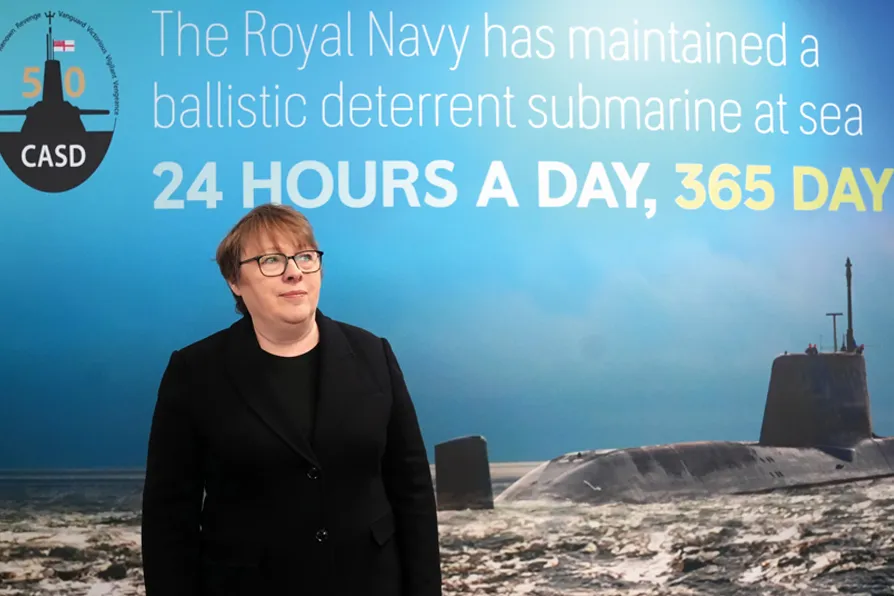
Expanding Britain’s nuclear capability increases the risk of nuclear confrontation. It does not keep us safe – it makes us a target, argues CAROL TURNER