A new generation of right-wing politicians have shifted from promoting deregulation to championing anti-migrant politics warns SOLOMON HUGHES


 Latest editorial

The suffragette who has been conveniently ignored
Sylvia Pankhurst recognised early on that discrimination against women was an integral part of the capitalist system. STEVEN WALKER has the story

by the Greater Manchester Workers’ and Tenants’ Association
The US relationship with Israel has evolved into a strategic liability, argues RAMZY BAROUD
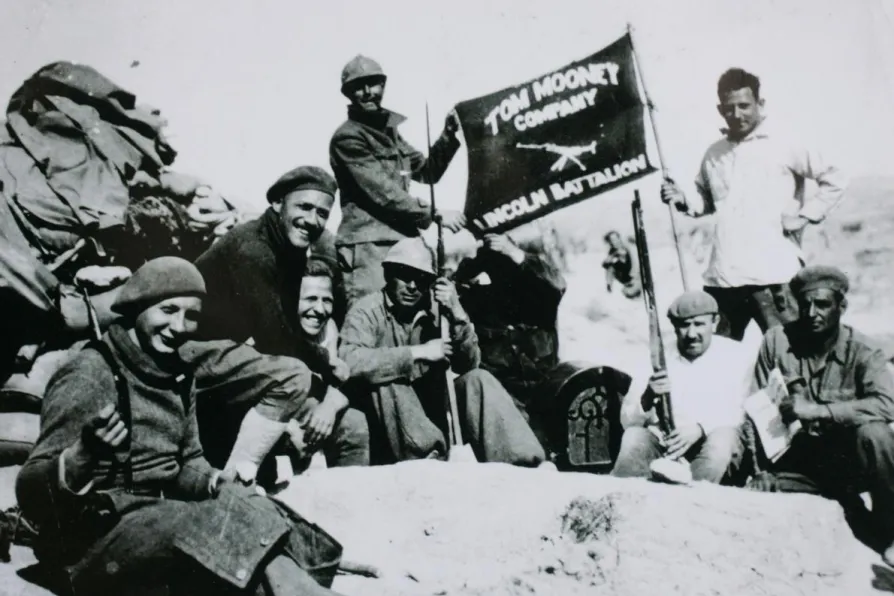
A champion motorcyclist, trade union organiser and communist, Clem Beckett went from Britain’s speedway tracks to the battlefields of Spain, where he gave his life resisting Franco’s forces at Jarama. GEOFF BOTTOMS pays tribute to this remarkable anti-fascist
The greatest threat to democracy may no longer come from political parties but from unelected tech oligarchs like Peter Thiel and his powerful Silicon Valley network, argues JOHN GREEN
Claiming to ease a fertiliser shortage, the Trump administration has suspended tariffs on Moroccan phosphate imports – deepening US support for the Morocco’s control over Sahrawi territory, writes LUKE ROTELLO


The film Suffragette, although widely welcomed, has come in for criticism due to its failure to portray black suffragettes.
At its Bafta screening in London last November, the film’s screenwriter Abi Morgan stated that, due to the low levels of non-European immigrants residing in Britain in 1911-13, there were very few suffragettes of colour in Britain and that those few, such as Indian princess Sophia Duleep Singh, were upper-class women who did not move in the working-class circles in which Suffragette is set.
Dr Paula Bartley, a historian focusing on women in history and the suffrage movement and biographer of Emmeline Pankhurst, confirmed that the film’s depiction of race was historically accurate, telling the New Statesman: “Britain [in 1911-13] was a white society in the main, and [its] suffragette movement reflected that.”
Bartley stressed that the British suffragette movement was “very different from the American case or the Australian case or the New Zealand case, because although there were ethnic minorities in Britain at that time, there wasn’t the same scale or the same questions of citizenship as there were in other countries.”
But there is another omission in the film — Sylvia Pankhurst. The daughter of Emmeline was arguably the more radical member of that incredible family, yet she is largely absent from the screenplay.
Sylvia was passionately anti-war and organised a peace campaign in 1916 in the East End of London.
The protesters were violently broken up as the government sought to stoke nationalist fervour. She would later write: “Peace and the popular government of the world to end this capitalist system of ruthless materialism, stood out for me as the two great needs of the hour.”
This more explicitly socialist, internationalist and anti-imperialist perspective would come to define her activity in the next few years.
For example after the brutal crushing of the 1916 Easter Rising in Dublin and the execution of leading Republican officials it was Sylvia who championed the cause of Irish secession from the United Kingdom.
It is often forgotten that the successful Russian revolution of October 1917 began with female textile workers going on strike in St Petersburg. This protest inspired men from other trades to join in and eventually the troops and sailors who mutinied became a decisive factor in Lenin’s success.
Sylvia Pankhurst was one of a few suffragettes who, while campaigning vigorously for women’s rights, also had a wider political view than her older sister Christabel.
She recognised the Russian revolution was a class war and criticised the provisional government established after the February 1917 uprising, which consisted of those whose leader was a prince who wanted to continue fighting in WWI and sought only superficial political change, and the soviets made up of peasants united with the military and urban proletariat who wanted deeper social changes.
She realised there was unfinished business in Russia and that the nascent February revolution should go further and become an anti-war movement.
When the Bolsheviks gained majority control of the Duma (the Russian parliament) after the October victory they immediately pulled Russia out of WWI. This caused the other anti-German powers to change from having welcomed the premature February revolution in Russia and the pro-war provisional government, to condemning the Bolsheviks and begin a propaganda campaign demonising them.
Sylvia campaigned against this propaganda, organising radical groups in the East End of London, was imprisoned several times but helped establish a group who were to declare themselves the first British Communist Party.
This group, inspired by Sylvia and Jewish organisations in the East End of London, fought against Oswald Mosley’s virulent anti-semitism and fascist ideology, laying the foundations for the subsequent election of Phil Piratin as the first Communist Member of Parliament in 1945.
In a detailed analysis of her life, Sylvia Pankhurst: Suffragette, Socialist and Scourge of Empire, the author Katherine Connelly challenges the prevailing narrative about the Pankhurst family and how Sylvia has been eclipsed.
For example, she broke away from the middle-class elitism of the suffragette campaign organised by Emmeline and Christabel, instead charting a course that put working-class women at the forefront of fighting for the right to vote.
Emmelene and Christabel were in fact vociferous supporters of the war, suspended publication of the militant Suffragette and republished it as the patriotic Britannia.
They urged women to join in the war effort with Churchill’s blessing.
Sylvia, in contrast to Churchill’s desire to: “strangle the Bolshevik baby at birth,” was a strong supporter of the October revolution and was inspired by the soviets which placed power in the hands of ordinary people.
In the 1920s she was one of the first people to recognise the danger posed by the rise of fascism in Italy at a time when Churchill was expressing his admiration for Mussolini. She was also perceptive in predicting the colonialism that spread across Africa as an inevitable consequence of European imperialism.
Sylvia Pankhurst, the forgotten suffragette, was an inspiring and courageous leader, who more than anything else recognised that injustices and discrimination against women could not be separated from wider struggles against a capitalist system that is inherently corrupt and seeks to subjugate workers across the world and maintain the power and control of the ruling class.

Similar stories

The General Strike exposed the power of the working class — and the limits of its leadership, writes Dr DYLAN MURPHY

JOHN REES replies to Claudia Webbe
CJ ATKINS commemorates one of the most dramatic moments in working-class history

Corbyn and Sultana’s ‘Your Party’ represents the first attempt at mass socialist organisation since the CPGB’s formation in 1921, argues DYLAN MURPHY