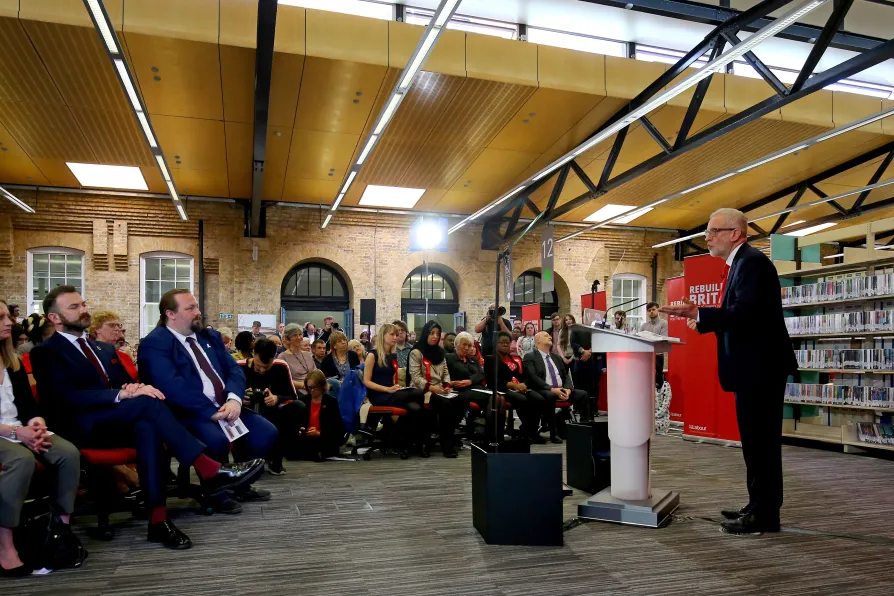
 Labour Party leader Jeremy Corbyn launches his party's European election campaign at the Drill Hall Library at the University of Kent in Chatham, today


AS IS usually the case with his keynote speeches, Jeremy Corbyn’s launch of Labour’s European election campaign today was well judged.
Unsurprisingly the election, like the locals earlier this month, looks set to be dominated by Brexit.
The decades-long hollowing out of local democracy in Britain has robbed councils of most of their power to raise money and decide policy independently, leading many voters to treat the locals as an opportunity to send a message to Westminster rather than to meet the aspirations of their local communities.
The European Parliament is similarly hobbled. Since it lacks legislative power and cannot either direct EU policy (which is determined by the unelected Commission) or alter any of the treaties that dictate the nature of the EU (which can only be amended by unanimous agreement of member states), there is no point in electing MEPs to deliver on specific issues.
Voters instead tend to use their ballot to signal what they think of the EU — which is why Ukip came first the last time these elections came round in 2014.
All indications are that this is happening again. The rapid growth of Nigel Farage’s latest vanity outfit, the Brexit Party, is a case in point.
Formed only in January, the party already claims over 85,000 members — making it larger than the Greens or Liberal Democrats — and is staging sizeable rallies around the country. No party has seen growth this fast since Labour’s renaissance when Corbyn came to lead it in 2015-16.
Polls indicate that the Brexit Party on current form will come first in the popular vote on May 23, benefiting from the support of many ordinary people who are exasperated at politicians’ failure to deliver on the 2016 referendum result.
It would be a serious mistake for Leave supporters on the left to fall into the Farage trap — on previous form he and his hangers-on would simply use their seats to fill their pockets at public expense and indulge in the occasional punch-up.
The Communist Party’s recommendation of a boycott sends a clearer anti-EU message.
Polls also show a significant Remain showing, with the Greens, Lib Dems and Change UK on around 8 per cent each. Their combined total is not far short of Labour’s and well ahead of that of the Tory Party, which has so alienated its voter base through Theresa May’s Leave-in-name-only deal and endless foot-dragging that it is set for a thorough pasting.
True to form, Corbyn recognises that the divide between Leavers and Remainers does not reflect the real faultline in British society — the fundamental antagonism between the richest and the rest — and appeals for a Labour vote as the only way to bring working-class people together and start tackling the real enemy.
His complaint that Brexit delays have got Britain stuck in an “endless loop” will resonate with millions.
His reiteration of Labour’s commitment to respect the referendum result and negotiate a departure deal that protects and advances workers’ rights and restores our ability to “rebuild our manufacturing industries … and restore pride and prosperity to parts of our country that have been neglected for too long” form a principled and ambitious political programme, and again Corbyn has demonstrated our urgent need for a Labour government at Westminster.
It’s unfortunate that many of Labour’s European Parliament candidates show less scruple about reversing the referendum result, with 22 candidates, including their European parliamentary leader and deputy leader, signing a pledge of support for a second referendum — which if imposed on us would keep us stuck in this “endless loop” indefinitely.


Starmer sabotaged Labour with his second referendum campaign, mobilising a liberal backlash that sincerely felt progressive ideals were at stake — but the EU was then and is now an entity Britain should have nothing to do with, explains NICK WRIGHT
While Reform poses as a workers’ party, a credible left alternative rooted in working-class communities would expose their sham — and Corbyn’s stature will be crucial to its appeal, argues CHELLEY RYAN