New releases from Laura Veirs, The Waterboys, and Yard Act


 Latest editorial
Feeling it
ALEX HALL welcomes an analysis of how modern capitalism is deeply intertwined with emotions, and their manipulation
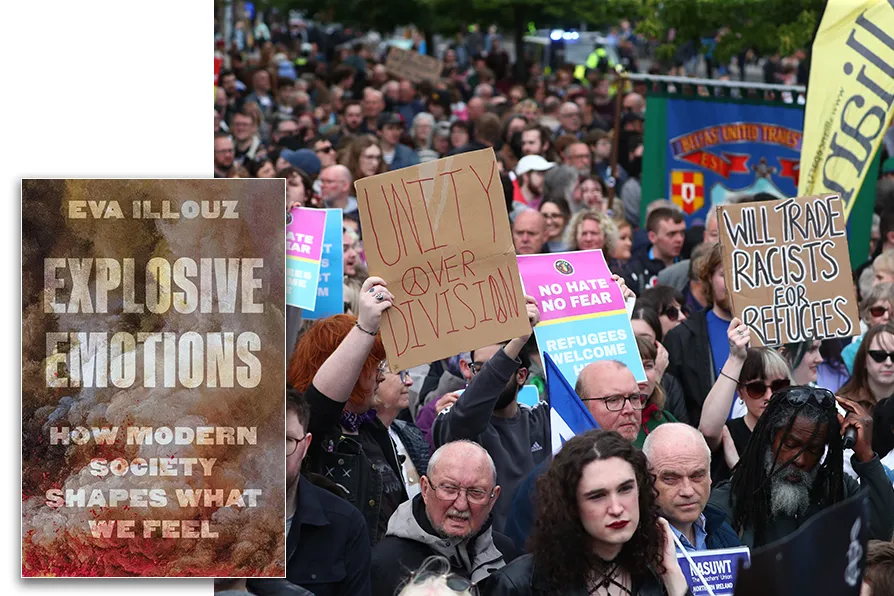 COMMON VALUES: An estimated 20,000 people rally outside Belfast City Hall in Belfast for the anti-racism The Together Against Hate march, June 13, 2026

Ron's rages are sincere and — according to his wife — healthily cathartic. But can these splenetic outbursts loosen the grip of capitalism at its most monstrous?
ANGUS REID considers the power of the podcast as a vehicle for consensus building in opposition to mainstream media narratives
GLENN FOSBRAEY recommends a biography worth reading for both existing George Michael fans and those yet to be converted
FRANCIS DEVINE introduces a new collection of essays that draws on Pease McKenna’s example to indicate future paths for the movement
KEVIN DONNELLY and MARIA DUARTE review Shoot the People, The Last One For The Road, Rosebush Pruning, and Moana
JAMES WALSH recommends an exceptional documentary about the experience of Western doctors in Gaza


Explosive Emotions: How Modern Society Shapes What We Feel
Eva Illouz, Princeton University Press, £25
IT would be difficult to find someone not in the billionaire class who thinks that everything is just fine and dandy. Economic and political problems are legion and crushing.
The livestreamed genocide has been soul destroying to witness, and yet opposition to it is increasingly brutally repressed by governments in the West. Yet choosing to simply get on with a quiet life seems to come with a nagging sense of failure and despair.
Emotions are part of what makes us human and gives us common values, and often what provides individual and group motivations. Emotions are the hallmark of authenticity: in Blade Runner androids were tested against humans by an empathy test.
Yet, very often a malaise of emotional reactions threatens to overwhelm us individually and as a group. In this milieu, Eva Illouz’s recent work provides a fascinating exposition of how this all interacts in modern society.
Psychologists are interested in personal histories and psychic make ups, sociologists are interested in how emotions exercise “a large set of invisible constraints on the inner life.” Indeed: “emotions contain and enact the key ingredients of society.”
This is probably most clearly seen in the discussion on shame, where the perception of others of a deviation is what defines it. Emotions are experienced as internal feelings. But they are a compression of “social structure, group identities, and moral codes.”
Illouz chooses to illuminate this through detailed analyses of literary characters such as Flaubert’s Emma Bovary, or the vengeful Michael Kohlhaas. These readings are then fashioned into an analysis of “emotional capitalism,” and there are some compelling links with how markets work in the present day: Marx’s fetishisation is powered by envy, hope and jealousy.
Hope, disappointment and envy are discussed in relation to the American Dream of endless (upward) social mobility. Hope can keep you hanging on in the most desperate of circumstances.
Disappointment in one’s work prospects, or in the promises of political leaders, ultimately lead to continued (further disappointing) choices, and envy powers both a desire for equality and consumer spending while often also demeaning the subject of it.
Nationalism has its own set of emotions: anger, fear and nostalgia. Anger stems from the view that a certain moral order has been thwarted, expresses a desire to correct it with power, and is “tightly interwoven with the distribution of power across gender, class, and race.”
Fear is very much about biological survival and often supersedes other responses. Fear of groups is promoted by elites to name and frame a perceived threat.
Shame and pride are the direct result of how others define us. As such shame is an expression of power — that of identifying and naming others. Shame is also fuel for the engine of organising identity production, and its opposite reaction — pride — is that self-aware rejection of shame and embracing of that which was considered abnormal.
Modern capitalism is deeply intertwined with emotions – both evoking, elevating and suppressing them. Indeed, once one looks slightly beyond moral codes, emotions are everywhere. Anger at the way the world is, envy for the latest device, shame at being powerless. It is ruthlessly deployed by numerous politicians and their power structures.
Illouz’s thesis is compelling, but there is little suggested in terms of a way forward. Still, the mere fact of awareness is a valuable first step, and this work illuminates how to spot emotional manipulation and the role emotions play in capitalism.
There’s no exit from the emotional maze. But there is a map.
