New releases from The Mountains Goats, Ed O’Brien, and YHWH Nailgun


 Latest editorial

A physicist’s case against war
JENNIE WALSH reviews an urgent political intervention by physicist Carlo Rovelli at a time of escalating militarisation and war
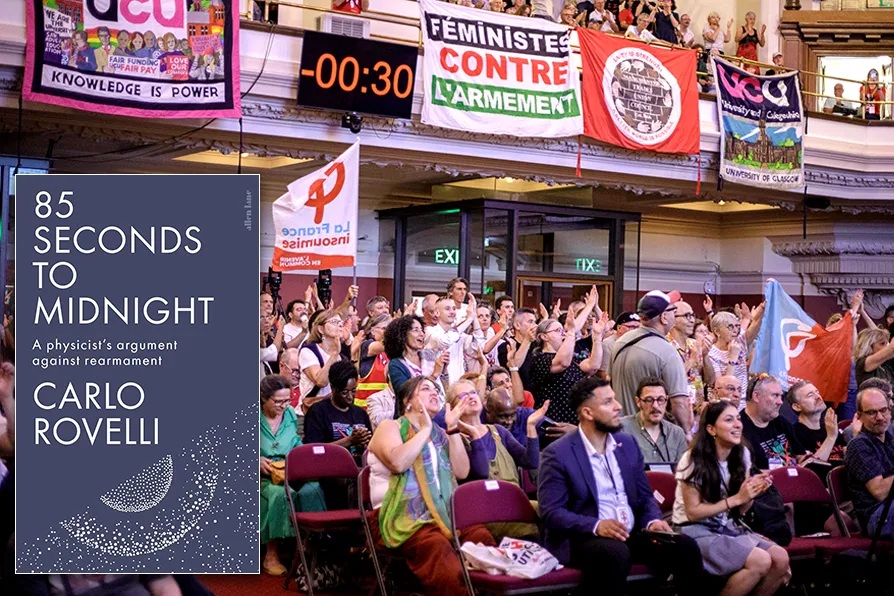 SOLIDARITY AGAINST WAR: International Anti-war conference, central London June 20, 2026 [Pic: Steve Eason]

ANGUS REID, ANDY HEDGECOCK and MARIA DUARTE review On The Sea, A Useful Ghost, Brunello: The Gracious Visionary, and Pinocchio Unstrung
RON JACOBS enjoys a great tale, told by a US communist, of the lives of working-class New Yorkers
BRENT CUTLER searches a new history of contemporary Iran for an understanding of the Islamic Republic, finding both interesting detail and glaring omissions
MARIA DUARTE recommends the true story of the remarkable woman who sued Donald Trump for sexual assault not once, but twice
KENNY MacASKILL is disappointed by a polemical, rather than factual, account of the Lone Star State and its political path since the civil war
PAUL DONOVAN is fascinated by the lives of Charles and Mary Bagot, and the insight this biography shines on the morals of pre-Victorian society


85 Seconds to Midnight: A Physicist’s Argument Against Rearmament
Carlo Rovelli, Allen Lane, £9.99
WE turn to Carlo Rovelli for accessible, popular physics. His latest book is that again, but with so much more – it’s anti-nuclear, anti-rearmament, anti-war – in a few short and lively pages.
He writes at a time of frenzied militarisation, huge increases to already bloated “defence” budgets and a drive to war and conscription across Europe and beyond, paid for by obscene cuts to social programmes and welfare. Ironically, in Britain at least, there are also funding cuts to theoretical and particle physics academic studies with postdoctoral grants slashed by up to 70 per cent.
Applied physics isn’t suffering to the same extent. Think about it in the context. No need to theorise, just bomb the bastards.
Rovelli’s reframing of the story of nuclear weapons, from the arms race of World War Two and the narrowly averted atomic disasters of the Cold War, to the rearmament and drive to war that we have today, shows us how only miscalculation, insubordination and even luck have saved the world from nuclear catastrophe so far.
He starts with Enrico Fermi’s “mistake,” the experiment that won him a Nobel Prize and led to the nuclear age, then points to the actual reason Germany didn’t build the bomb first – the physicists asked by the Nazi German War Ministry to do it rightly advised, because they did not want Hitler to develop a passion for it, that “it was not reasonably plausible to build the bomb within the short term it [the war] was expected to last.”
No such qualms from their US counterparts of course, Albert Einstein among them, who convinced the politicians of the day to shower their Manhattan Project with money, driven by the unfounded fear of a Hitler super-bomb.
Signing the 1939 letter to US President Franklin D Roosevelt that urged the development of the atomic bomb was “the one great mistake in my life,” the pacifist Einstein later admitted.
Rovelli points out that: “If scientists in the US had not panicked, if they had waited, if they had not made a mistake in deducing what their colleagues in Germany were doing, if they simply talked to each other (they were close friends, before the war), nuclear research could have developed in a moment of peace.”
Of course it’s not so much the scientists now driving rearmament in Germany and across Europe and beyond, but the powerful military lobby and the arms companies demanding ever higher levels of “defence” spending, driving the narrative like private sector consultants in the NHS.
Rovelli again: “We hurt ourselves for fear that our enemies will hurt us. We frighten each other, and this triggers wars. Could we be any dumber?”
Clearly those who make billions from weapons of war aren’t dumb, but the politicians who do their bidding certainly are. Keir Starmer insisted on announcing the Defence Investment Plan (DIP) before leaving office, clearly wanting to be remembered as the man who ramped up spending on weapons to record levels, never mind the cost-of-living crisis and the collapsing services he leaves behind, while talking up a fantastical and implausible threat from Russia fed to him by the generals and declaring his determination to “turn the screws” on the Russian economy.
As Rovelli writes, Russia has no intention, nor way, to invade Paris, Rome, Berlin or London.
“Reasonable beings find reasonable solutions – if they don’t try to resolve everything with dreams of military supremacy, and if they behave like rational beings instead of gorillas.”
Starmer claimed, during his DIP speech, that he doesn’t want war, but that the best way to avoid it is to be prepared for it. Rovelli concludes that, if we think we can avoid war by becoming stronger and more aggressive, looking at others in disdain, the result is that others try to become even stronger and more aggressive than us, and to look at us more and more with disdain.
Obviously Rovelli is not the only physicist to have worked all this out, along with the sometimes dubious legacy of his profession. But he certainly stands on the shoulders of the aforementioned Einstein, and others.
He ends his book with a grim timeline, from 1900 when German theoretical physicist Max Planck wrote the work that paved the way for investigating quantum physics, to this year’s setting of the Doomsday Clock at 85 seconds to midnight by the Bulletin of the Atomic Scientists, via almost every Western and Nato war and others, atomic bomb developments, nuclear tests and treaties and the recent US bombing of Iranian nuclear sites.
It is a reminder of why we must keep on calling for welfare not warfare, wages not weapons and urgently build the international peace movement out of last month’s incredible anti-war conference in London.

Similar stories
Expanding Britain’s nuclear capability increases the risk of nuclear confrontation. It does not keep us safe – it makes us a target, argues CAROL TURNER
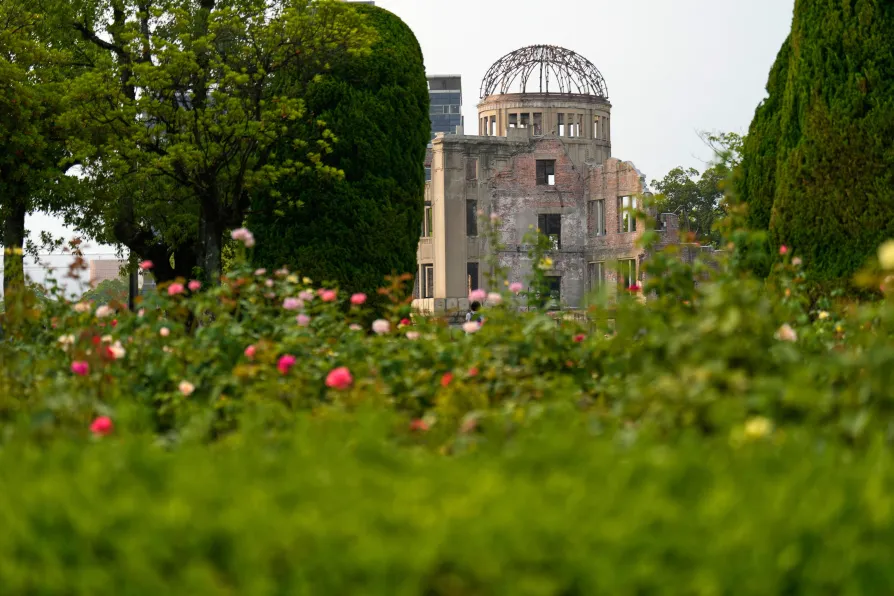
As we mark the anniversaries of the Hiroshima and Nagasaki bombings, JOHN WIGHT reflects on the enormity of the US decision to drop the atom bombs