A World Cup full of memorable moments was also marked by exclusion, exploitation and unprecedented political meddling, writes JAMES NALTON


 Latest editorial

World Cup: politics and football in Argentina
Football may not solve the working class’s problems, but it does matter — and politicians know it, writes BERT SHOUWENBURG
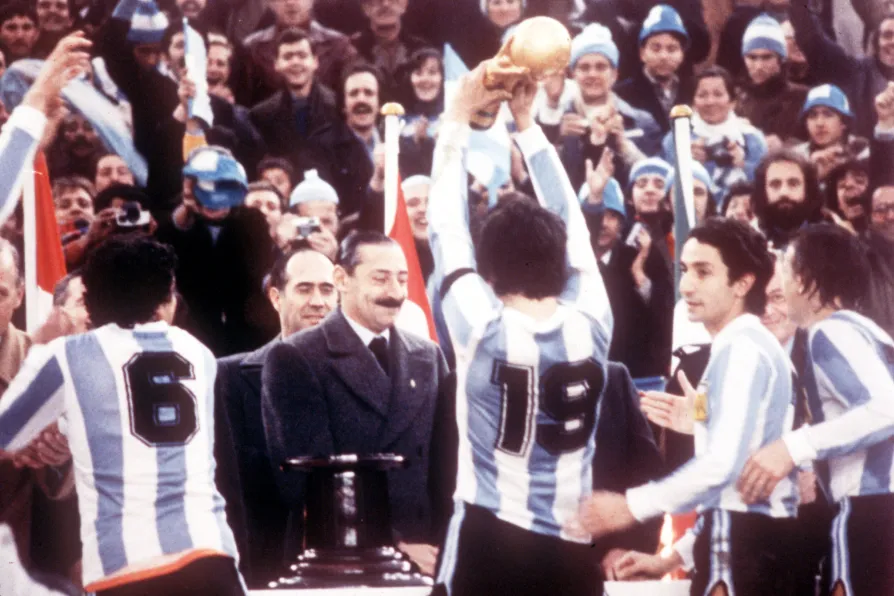 WINS ALL ROUND: Argentine President Jorge Rafael Videla, centre, looks on after he presented the World Cup Trophy to Argentina's captain Daniel Passarella (19) at the presentation ceremony following their World Cup success in 1978
From Barry McGuigan and Carl Frampton to Tyrone McKenna and Lewis Crocker, the city’s fighters carry a complex history into the ring, writes JOHN WIGHT


THE 1998 World Cup was held in France. I watched most of it on TV in a Buenos Aires side street bar just off the Avenida de Mayo near the Congress building.
The barman was an unabashed Marxist who saw football as just one more tool to control the working class. When Argentina beat England on penalties to advance to the quarter-finals, the place was in uproar and the celebrations lasted well into the night.
The barman was unimpressed and when, some days later they lost to the Netherlands, he was of the view that neither result changed anything for ordinary people and could not understand why it mattered so much to them. Nevertheless, to most Argentines, football may not be important, but it does matter, and politicians are well aware of that.
As Argentina progress in the 2026 World Cup, Javier Milei is always among the first to congratulate the national team but if the beleaguered president is hoping that success on the football field will be reflected in higher ratings for him, he will be disappointed. A poll taken immediately before the competition commenced to analyse the political impact of Argentina repeating their triumph of four years ago in Qatar showed that there was a marked separation between results on the football field and political loyalties. Eighty-five per cent of those consulted said they would vote as before and only 10 per cent said it would motivate them to support him.
Significantly, 71.5 per cent said that the World Cup had nothing to do with politics, though over 27 per cent saw it as an opportunity to be more united politically. In the absence of supplementary questions, it is somewhat difficult to understand why so many of those polled believed that football and politics were not related, at a time when there is a protracted struggle taking place for the heart and soul of Argentine football.
Like one of his heroes, Margaret Thatcher, President Milei does not believe that “society” exists and is scathing about Eva Peron’s oft-quoted statement that “Where there is a necessity, there is a right” and has described it as a social aberration that must be banished. Consequently, he is seeking to destroy the very fabric of Argentinian community by dismantling the “Clubes de Barrio” (Neighbourhood clubs) that are unique to the River Plate.
There are more than 20,000 of these clubs in Argentina, owned collectively by their members, receiving government subsidies to assist with their energy costs. Their existence is summed up by a quote from the magazine Meta: “Without clubs there is no neighbourhood.
“Without rights, there is no democracy. Without children practising sport, there is no possibility of creating a more just and equal society.”
Blissfully ignorant of the fact that nearly every one of Argentina’s 2022 World Cup winning team started playing football in Clubes de Barrio, Milei wants to convert them into private entities. Included in his plan are professional clubs that are also owned by their members. While there is no doubt that many of these clubs are struggling financially and, in today’s commercially driven game, could benefit from substantial investment, there has been fierce resistance to Milei’s proposals, led by Argentine Football Association (AFA) president Claudio Tapia who has been accused of financial irregularities between 2024 and 2025 in a blatant attempt to bring him down. Despite many flaws in the Argentinian league, with 30 topflight clubs and ever-changing formats, Tapia is in a relatively strong position owing to the national men’s team run of success under his tutelage.
Amid the furor surrounding the future of Argentinian football, well-known players both past and present have been reluctant to join the fray. When Argentina played a pre-World Cup friendly in April, midfielder Rodrigo de Paul said that footballers play football and don’t do politics because they don’t understand them.
Whether he is disingenuous or merely naive is an open question given that he went to the White House the previous month at a reception given by Donald Trump to honour his championship winning Inter Miami team in the company of fellow Argentinians Lionel Messi and manager Javier Mascherano. Footage of them laughing and joking while Trump gave a rambling speech justifying the assault on Iran drew a degree of criticism back home that was dismissed by Mascherano who said that the visit was merely a “sporting protocol” in the USA.
Other players are openly supportive of Milei’s disastrous regime that has left hundreds of thousands without work, soaring poverty levels and almost complete subservience to US imperial interests, one of whom is Carlos Tevez, a former Argentinian international who played for three clubs in England and is fond of saying that he never forgets where he comes from.
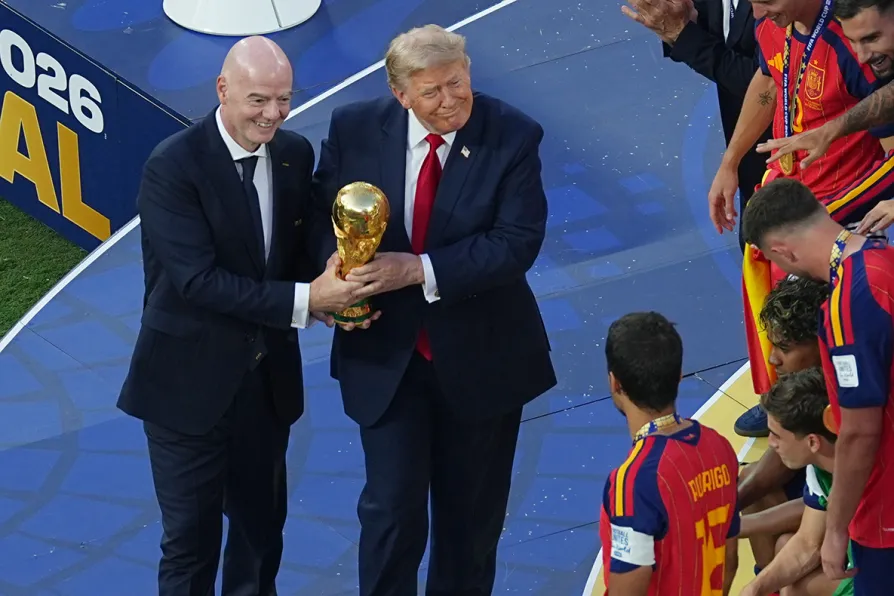
As for Messi, he is undoubtedly the best player of his generation though his only interest outside of football would appear to be making money and if Argentina lift the Cup again, he will have no qualms about accepting it from war criminal Trump.
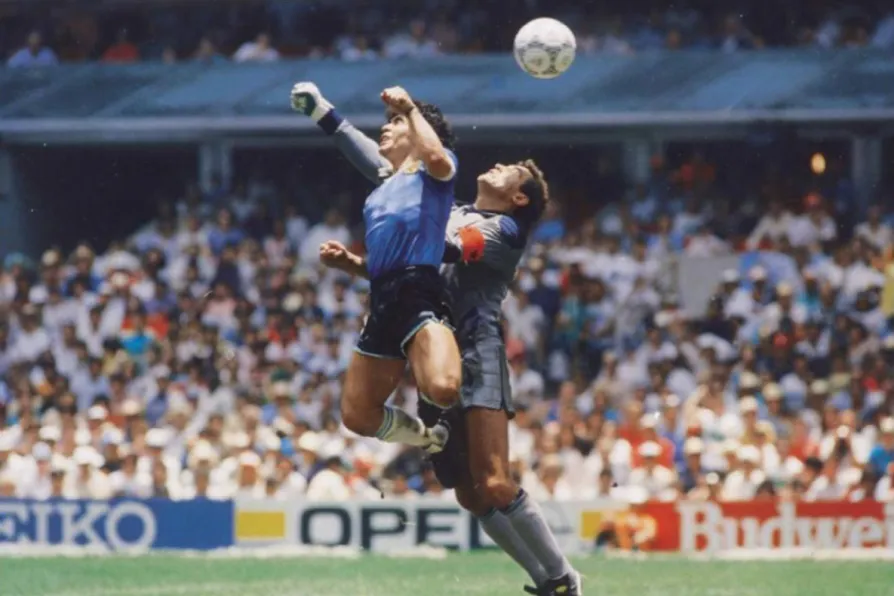
By way of contrast, his most famous predecessor Diego Maradona wore his heart on his sleeve and during what was often a chaotic life was never slow in criticising what he rightly saw as Fifa’s corruption. Forty years ago, he scored the goals that knocked England out of the World Cup in Mexico and dedicated his victory to the young conscripts who lost their lives during the 1982 conflict in the South Atlantic. One can only speculate as to what he would have made of Milei but he was a consistent champion of the working class.
Before the term “Sportswashing” was even invented Argentina hosted, and won, the 1978 World Cup in what was undoubtedly the most blatant example of using sport for propaganda purposes since Nazi Germany held the Olympics in 1936. Fifa had determined the venues for the next three World Cups after the 1966 version of the tournament was held in England, even though a military dictatorship had just been established under Juan Carlos Ongania.
The return of civilian rule under the presidency of the returning Juan Peron in 1973 was short lived and in 1976 another military coup heralded the most brutal regime that the republic had experienced. By the time the tournament started, thousands of people had already been killed or disappeared.
De facto president General Jorge Videla justified the reign of terror by saying that “a terrorist is not just someone with a gun or a bomb but also someone who spreads ideas that are contrary to Western and Christian civilisation” which made trade unionists, students, doctors, teachers and political activists of all persuasions fair game. It will be apparent that his warped sentiments are not dissimilar to those uttered by the likes of Rubio, Hegseth and Trump today to justify the murder of innocent people in Iran and Palestine. Before the competition began in 1978, there were threats of boycotts, and coverage of the atrocities in the Western media though ultimately it went ahead as planned.
This year, despite US atrocities in various places around the world in addition to repression in the country itself, there were no moves to boycott their hosting of the World Cup and Fifa’s money-making machine rolls on. Meanwhile, in Argentina, there will be massive celebrations if they manage to win again but will it change anyone’s lives? Sadly, that bar in Buenos Aires is no more but I know what the barman would have thought.

Similar stories
A World Cup full of memorable moments was also marked by exclusion, exploitation and unprecedented political meddling, writes JAMES NALTON
ASIF BURHAN explores why England v Argentina remains football’s most politically and culturally charged fixture in his new book
ROGER McKENZIE explains why he can’t support this year’s World Cup