

 Latest editorial
 Labour Party leader Sir Keir Starmer in Portsmouth earlier this month



IT turns out that the self-imposed deadline for the conclusion of the Brexit talks dissolved as quickly as Boris Johnson and Ursula von der Leyen’s after-dinner mints.
The issues at stake in the negotiations between the EU and our government are whether the substantial body of trade between the two entities will be conducted under Word Trade Organisation rules — which include constraints on the marketing and pricing strategies of both states and enterprises — or under a compromise formula which will include some of the constraints the EU itself places on market and pricing strategies.
It is a negotiation and both actors have played endlessly with end times language. Nevertheless, in the end commerce will continue with countries in the EU and profits will unfailingly flow.
We start the week with a distinct change in the atmospherics. It seems that Michel Barnier — once the poster boy of those innocent Remainers still lost in the jungle of their illusions about a re-entry to the EU — has in mind a compromise, or set of compromises, that might enable the capitalist trading partners to carry on carrying on. So does Johnson.
The remorse of Remainers are a mirror image of the autarkic outrage of the barmy Brexit faction on the Tory fringes who thought Johnson really was one of them rather than an infinitely malleable instrument of ruling class consensus.
Labour’s shadow business secretary Ed Miliband took to Andrew Marr’s TV show to display a passion and combativity — welcome although currently unfashionable in leading Labour circles — in attacking the Tories.
But the logic of Labour’s positioning — set out with clarity by Sir Keir Starmer — is that Labour will go along with whatever arrangement the EU and Britain arrive at.
This represents a missed opportunity to give a clear view of what kind of trading relationship would better serve the working people of Europe.
The principle of state aid is not at stake. A disproportionate part of Britain’s manufacturing industry is in the “defence” sector and is largely free of state aid constraints.
State aid to bail out the banks and big business presents no insurmountable problem and is routinely negotiated within the EU’s regulatory and fiscal structures.
That these structures, both formal and informal, favour the banks or the EU’s dominant economies and disadvantage the weaker is not a surprise.
Miliband would be better arguing the case for socialist state aid in the service of a planned economy that puts job security with high-skilled and well-paid work at the centre of a green industrial strategy. This was for a few years a real prospect in Britain.
That was and remains, the economic rationale for a break with the neoliberal logic of the EU that would begin a political challenge to privatisation and open the way to a common ownership of the means of production, distribution and exchange.
No-one who has watched the combined assault on Labour over the last few years will have any illusions about the forces ranged against such an assault on the power, privileges and profits of capital.
The EU stands for the centralisation of decision-making in the interests of capital. This already runs up against the democratic demand for decisive powers desired by the devolved governments of Scotland and Wales.
Labour in Parliament, no less than the working class and the labour movement, must find a way to channel the great desire for democratic decision-making and a break with privatisation and profit-seeking into practical proposals that transform the Brexit-to-be into an opening for popular power free of big business and the banks.

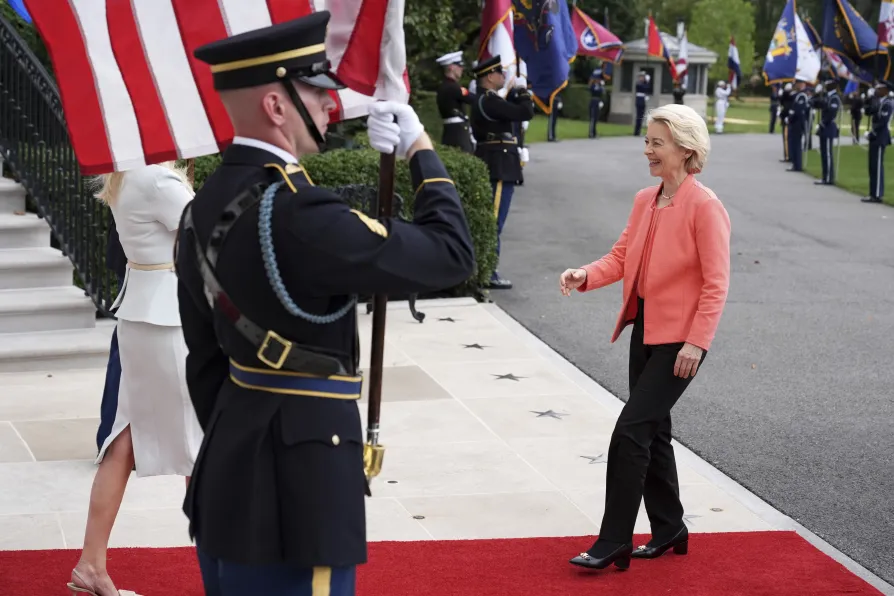
US tariffs have had Von der Leyen bowing in submission, while comments from the former European Central Bank leader call for more European political integration and less individual state sovereignty. All this adds up to more pain and austerity ahead, argues NICK WRIGHT

Starmer sabotaged Labour with his second referendum campaign, mobilising a liberal backlash that sincerely felt progressive ideals were at stake — but the EU was then and is now an entity Britain should have nothing to do with, explains NICK WRIGHT

Deep disillusionment with the Westminster cross-party consensus means rupture with the status quo is on the cards – bringing not only opportunities but also dangers, says NICK WRIGHT